Monday, September 17, 2012

The Sweet Life of an Expat in Thailand


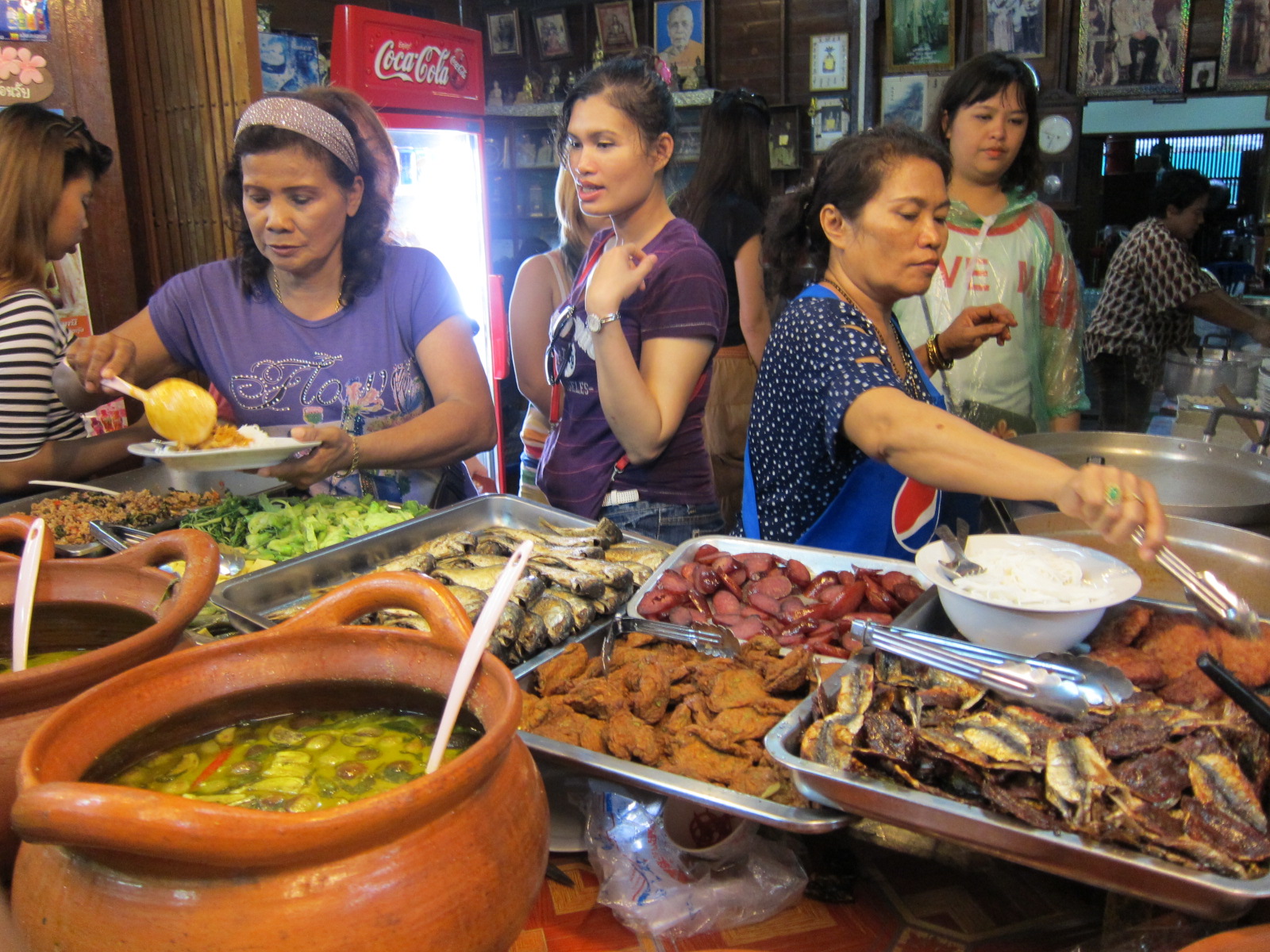
An internet group called InterNations contacted me about featuring my blog on their web site.  They asked that I put their badge on my blog (you can see it on the right, a bit too big for my tastes), fill out a questionnaire and send them a photo.  I spent a bit of time thinking of answers to their questions and began to ruminate on a post about expatriation in general and my experience specifically.  The photo I picked is above; Here is the rather simplistic questionnaire and my attempt to describe this adventure I'm on.

1.    Please tell us a little bit about yourself. Who you are, where you come from, when you moved to Thailand, etc.
Born in Ohio in the U.S. Midwest, the son of a plastics salesman and his Canadian bride, I grew up after World War II in the south and as a teenager in Southern California in the 1950s. I was married twice and helped raise four kids, now grown.  My working life included careers in journalism, entertainment public relations, and magazine publishing. Twenty-five years ago I redefined myself as an academic, got a Ph.D. in environmental history and taught classes in philosophy and U.S. history.  After retiring, I traveled the world and five years ago settled permanently as an expat in Thailand.  Now I teach English several days a week to monks.
2.    When and why did you decide to start blogging about your experiences?
In the spring of 2006, I began writing an opinionated blog about my travels and thoughts on spirituality and world events, not to mention the perils and pleasures of aging. I chose for the title "Religion, Sex & Politics" because I was taught these were topics that should never be discussed in polite company.  But they happen to be the categories of life that interest me most.
3.    Do you have any favorite blog entries of yours?
All of them (and none).  I've written more than 500 posts and almost never go back to read over them.  The most popular have been posts about the conflict over ordaining women as nuns in Thai Buddhism and the playground for sexpats in Pattaya. It's more of a sequential memoir than a travel journal, but my life in Bangkok always provides food for thought.  I'm happiest when I've succeeded in saying something honest about myself. Quite often these are confessions of failure and hope for acceptance.  As for religion, I've traveled a path from practicing as a devout Catholic (with social justice leanings) to a deep respect for the Thai mix of Buddhism, Brahmanism and magical animism.  Mostly the spirituality I affirm is all about being a good person in this world with no thought for institutional rules and an afterlife.
4.    Tell us about the ways your new life in Thailand differs from that back home. Did you have trouble getting used to the new circumstances? Did you experience culture shock?
Before I left the U.S., I was a elderly, retired bachelor living in a converted garage in northern California whose major daily event was a trip to the cafĂ© for cappuccino.  Now I'm married to a wonderful Thai woman and we live in a 9th floor apartment with a spectacular view of the city I have come to love. I took to expatriation like a duck takes to water and never experienced culture shock.  This is perhaps because I visited Thailand three times before moving here for good, and an old friend living in Bangkok and Surin schooled me in the ways of Thai culture.  At the end of my first year, another friend nominated me as expat rookie of the year, which pleased me enormously.  I am fascinated every day by the life I lead here and the adventures that take place all around me.
5.    Do you think you were fully prepared for what awaited you in Thailand? If you could, would you change some decisions/preparations you made?
When I was younger I traveled to many foreign places, living in London for two years in the 1960s, and in the years after retiring from teaching I spent extended periods in Buenos Aires and in Tamil Nadu, India.  Although I never dreamed of expatriation in Asia (Paris or Mexico was a more likely choice), on my first visit to Thailand, a side trip after India, I became quickly hooked and never looked back.  If I had it to do over again, I would have moved to Southeast Asia at a younger age.  Learning Thai when I still had my hearing and memory would have helped.
6.    Every expat knows that expat life comes with some hilarious anecdotes and funny experiences. Care to share one with us?
At first, it was impossible for me to figure out why Thais, even in the big metropolis of Bangkok, walked so slowly. I constantly found myself rushing to get passed them, like the broken field running of a quarterback.  Eventually I had an epiphany: The real goal is not to get anywhere quickly but to stroll leisurely and enjoy the sights. Thailand taught me this.
7.    Which three tips would you like to give future expats before they embark on their new life in Thailand?
First, stop thinking in dollars, Fahrenheit temperatures, the 12-hour clock, distances in miles and weight in pounds; Thailand and the rest of the world do it differently.  Second, don't try to sit on your heels or eat food as spicy as the Thais like it; you have to be born here for that.  Finally, keep an open mind and jettison your preconceptions about differences between human beings.
8.    How is the expat community in Thailand? Did you have a hard time finding like-minded people or fellow expats?
Expats come to Thailand for work, retirement, the beaches, or sex.  And too many of them constantly bitch and moan about Thais and Thai culture on the expat Internet discussion boards, or in letters to the editors at the two English newspapers in Bangkok.  Politically, they side with the upper-class royalists against the democratic aspirations of the majority of Thais who live outside the capital.  I've found that many of those who move here to retire and/or come to find a life partner generally keep an open mind and are curious about their new home.  My friends read articles and books, and attend talks on politics, Buddhism and culture organized by the Foreign Correspondents Club, the Siam Society, Little Bang Sangha, Bangkok Art & Culture Center, and the National Museum Volunteers.  Bangkok is a big city; it has something for everyone.
9.    How would you summarize your expat life in Thailand in a single, catchy sentence?
The sweet life in Thailand is just a bowl of mangoes -- "Don't take it serious, life's too mysterious" (borrowed from the song by Lew Brown and Ray Henderson, sung by Ethel Merman in  the 1931 musical "Scandals").


Sunday, September 09, 2012

The Greatest Country?


They all said it -- Michelle, Barack, Bill -- at the Democratic National Convention in North Carolina this week, and no doubt every speaker at the other party's gathering in Florida echoed this claim: America is the greatest country on earth (adding the request for God to send a blessing that this sanctimonious country certainly does not need).  Obviously no one invited Jeff Daniels, the actor who plays the fictitious anchor Will McAvoy in Aaron Sorkin's new TV drama, "The Newsroom" that just finished its first year run on HBO.  In this clip, McAvoy, a self-proclaimed Republican who's heard enough and can't take it anymore, answers a trite question with a denial of that civil religious claim.  That a real TV celebrity might discover honesty is only a fantasy, but the well-researched facts from Sorkin's writing team made the "greatest country" trop sound ridiculous.  Does anyone still believe it?

Yes, judging from the scripted hoopla along with patriotism, jingoism and nationalism on display by the politicians, delegates for the TV audience.  Misty-eyed representatives from every significant demographic group could be seen in photos from the two events -- I live on the other side of the globe and have no cable tv to watch -- giving their all for the candidate of their choice.  A good friend told me on Facebook I was cynical when I posted a link referring to Michelle's studied stutter and slick sincerity, but I was hesitant to reveal my own feelings, that her highly praised speech was worthy of an Oscar but not the adoration heaped on her by liberal commentators.

The vast majority of my social network friends today are liberals and progressives, Obama supporters all.  But most of my friends from the high school we attended in Southern California who I am still in touch with are Republicans.  A few have shunned me; but at least one is tolerant of our differences and we play word games online together.  There is no accounting for political (or religious) tastes.  George Lakoff thinks that liberals represent nurturing mothers while conservatives emulate autocratic fathers.  Both sides love their children and pets but only those on the left seem to love the children of the Other; the right is more limited in their definition of who they care about (certainly not gays, Muslims, immigrants and abortion doctors).  The people in my high school circles came from the upper middle class and stayed there, while I early on yearned to associate with musicians who took drugs and often were of a different color.

A bit of a confession here: Even though I'd supported Democrats since beginning with Kennedy in 1960, I voted for Reagan to be re-elected in 1984 over the Democrat, Walter Mondale.  I did it because I figured another four years of his cartoon rule (an actor was president of the U.S.?) would hasten the revolution I fervently wished for America.  I was wrong.  And in 2008, after moving permanently to Thailand, I made no effort to get an absentee ballot because I was certain Obama would carry northern California where I remained registered.   An expat then for only a year, the doings back in the U.S. still concerned me personally, and it was easy to see that an Obama administration would be light years away from the devastation that George W. had left in his wake.  I rejoiced at his victory.

Patriotism for one's nation is a difficult passion to resist.  It's inculcated from an early age, passed down from relatives and neighbors and reinforced by civil religious ceremonies like the 4th of July with its parades, barbecue sacrament and fireworks displays.  Historically, nationalism is a fairly recent phenomena, as Benedict Anderson details so well in his masterly Imagined Communities. Before nations, there was loyalty to one's tribe which took the communal form of ethnicity and religion, or the flag waved would belong to the ruling dynasty.  Nations, as Anderson points out, required printing and newspapers, along with centralized education and military service.  Modern technologies like radio, film, TV and now the internet, hastens the process which glues disparate people together.

Which does not explain why some people are repelled by "the last refuge of a scoundrel," Samuel Johnson's definition of a patriot.  I feel as if I were born to rebel (which doesn't account for why my more conventional brother the lawyer has similar political views, even though our parents voted Republican and our mother loved her "Tricky Dick" Nixon.  The people I know who settled down close to where they grew up have leaned toward conservatism while those who traveled far afield seem more liberal in their opinions. My former colleagues from journalism, publishing, entertainment PR and education have broader perspectives I think which encourage tolerance for difference  (the reason why Democrats appear more tolerant of Republicans than vice versa; viz. Obama's numerous failed attempts at bipartisanship).  Most of all, I think travel gives you a unique slant on the rhetoric "back home" and mutes knee-jerk patriotism.

I left America not so much because of my dissatisfaction with "Democrapublican" politics and the expansion of Empire and its wars for oil but because it was cheaper to live abroad and I could survive better outside the U.S. on my Social Security pension.  Abandoning family and long-time friends was no easy decision, despite the convenience of the internet which today allows us to keep in close touch.  If my second marriage hadn't failed I would probably still be there.  The need to reinvent myself led to several years of travel which opened my eyes and doors of opportunity.  Never in my youthful dreams had I ever imagined moving to Asia (Paris was the goal of choice in the 1950s, Mexico in the 1960s and 1970s).  Once ensconced in my expatriate palace in Bangkok, I joined the local branch of Democrats Abroad (who still send me email despite my lack of attendance at their meetings) and discovered that Google News and other sources kept me fully informed about the American scene. There are two English newspapers here with adequate coverage of overseas activities (although strongly biased toward the Thai military royalist elite). Even without TV cable news in English, I can get live telecasts from Russia Today and Al Jazeera on my iPad (which I trust more than similar digital offerings from BBC and CNN).

The longer I lived away from the "greatest country" rhetoric, the more dissatisfied I became with American politics.  Obama has been a huge disappointment.  He quickly sold his soul to the bankers and corporate CEOs, not to mention the military industrial complex and the Jewish lobby.  His policies resemble those of a modern Republican before that party was abducted by aliens.  Of course, Clinton before him was not much better.  In fact he set the trend of abandoning the base for the goals of his corporate backers.  It's a clichĂ© to say that America has the best government money can buy, but it's true.  The rank-and-file in each party blunder along, swallowing the mythical American dream (try selling those lies to the Native Americans and the Mexicans that owned California and Texas before the Europeans took over).  Following the news that is so profoundly and continuously disturbing is clearly an addiction, one that is very difficulty for this long-time news junky to shake.  Time and again I've vowed to break the habit.  I'm an active Facebook user and post frequently, but I've tried to avoid items about the conventions and the upcoming election, choosing to focus instead on stuff of interest about Thailand, Asia and the world in general.  But the monkey on my back keeps biting and refuses to let go.

America Anonymous:  I will not now nor will I ever again vote in another American election, not for Obama and not against Romney/Ryan.  A plague on all their houses.  Since 1960 I've been told to vote for the lesser of two evils.  While I wouldn't call Obama evil, he is clearly a fraud, a snake in sheep's clothing.  That he is clearly a better choice than R/R who wil revisit Bush's efforts to strangle government in a bathtub makes no difference to me.  The Empire is rotten to the core and ultimate doomed (although not, hopefully, until I am gone from the scene since I depend on the continued existence of Social Security).  I'm neither an investigative reporter nor a very wise man, but I've participated in the political process since 1960 and I don't see much change.  Sure, blacks are a little more equal as well as women, but the fat cats are firmly in charge now and the U.S. is the most dangerous threat in the world to global peace.  Democracy and the politics that pretends to sustain it is a failure.

No, America is not the greatest country in the world.  And if I thought there was an Old Testament God, I am certain that he would curse rather than send his blessings.  Hell has a very special place for those politicians who have trashed the American dream. (Thank you, Howard Zinn, for educating me!)


Wednesday, September 05, 2012

Working


My first job was working for a toy store during a Christmas season when I was 12. The store was near our home in a northern suburb of Atlanta.  In addition to wrapping presents, I put bikes together out of the box and performed various assembling chores as needed.  I don't recall my salary, but do remember that I used it to buy copies of digest magazines like Galaxy and The Magazine of Fantasy & Science Fiction.  I was crazy for scifi and read everything I could find, from Asimov to Bradbury.  I think the money also enabled me to buy a Daisy Red Ryder BB gun.

Memories of early work are inspired by the variety of jobs I've done in the past month which will (when I get paid) earn me nearly the equivalent of $1,000 in Thai baht, a princely sum.  In addition to my regular job of teaching English to mostly monks two days a week, I edited a book of essays written by Thai English teachers and a conference paper for another professor, and I spent one day as a model on a stock photos shoot along with a gang of kids, some younger men and women and a couple of grey hairs like me (oh, and there was also a dog in the pictures).  A few years ago on the advice of a friend I signed up with a talent agency.  Although I turned down a film or two that required too much time and travel, I did a job with the same photographer a year ago that was fun and paid actual cash for my looks.  Others on the roster had gotten walk-on parts on "Hangover II" and other Hollywood films shot in Bangkok.  And last but not least, last weekend, I participated in an "English Camp" for 4th year Humanities studies, some of whom could speak a little English but most could not.  This enjoyable two-day job brought a a handsome remuneration and two excellent free lunches. While my survival income is courtesy of U.S. Social Security, the additional funds come in handy and tell me that my working days are not yet over. This expat's not ready for full retirement!

I've had a lot of jobs and even careers in my life.  My father suffered through the Great Depression and saw work as something sacred since he knew what life could be like without it.  Loyalty to an employer was important for him and he changed jobs rarely.  Working in the factory for Libbey-Owens-Ford Glass in Toledo, Ohio, he lost three fingers when his hand was crushed in a machine.  The company put him to work as a salesman for its Plaskon division in the south selling plastics and chemical products including glue for plywood. He stayed at that job throughout my childhood until, when Plaskon was sold, he moved into lumber products, a job that took the family to California.

My second job was sweeping the floor of a record store in the suburb of Los Angeles where I went to junior high school.  I played the clarinet and sax in the band, and browsing in the stacks between sweeps introduced me to the world of jazz (the rhythm and blues records I preferred were not sold at respectable outlets in our all white community).  I also watered yards for neighbors on vacation, and mowed their lawns. I tried delivering newspapers but getting up before dawn was not then my style as it is now. During those years, and while in high school, I worked at a succession of menial jobs, sweeping floors and washing dishes, before graduating to flipping burgers and, finally, selling men's clothes one Christmas season.  My long-term plan was to become a famous band leader (like Stan Kenton) or an actor in movies (I auditioned for the role of Benny Goodman's son in his biopic), so the thought of any less exalted career was anathema.

This all changed when my jazz combo, that had been playing for student parties after football games, won a talent contest at my high school.  We defeated a group that included Bobby Hutcherson, today a legendary jazz vibraphonist, but only because there were more white parents in the audience applauding.  Our prize was an appearance on a radio show put together by two teachers.  This grew for me into a regular spot as a record reviewer and, when the teachers bought a weekly page in the local newspaper for a teen section, I became the music columnist.  My mentor at the paper was a grizzled veteran reporter who wrote a jazz column and collected hundreds of records for free from music companies.  Together we formed a jazz club for teenagers that met on Sunday afternoons to listen to famous jazz performers like Chico Hamilton and Red Norvo.  One night he took me in his convertible with the top down to the all jazz station KNOB on Signal Hill in Long Beach where he was the midnight DJ.  On the seat beside us was his copy of Jack Kerouac's On the Road which had just been published.  My path was set.

Dropping out of Berkeley after a few unsuccessful semesters, I got a job as a copy boy on the Pasadena Star-News which grew into a position as a city desk reporter and arts reviewer, with a weekly column that allowed me to accumulate free tickets and records.  Writing took me many places: to Newark, NJ, as a reporter for UPI, to New York where I wrote for Radio-TV Daily, a trade paper, and to London where I wrote about American TV programs seen in England for TV World. I freelanced articles on music to Sing Out! and the Los Angeles Free Press. Just as I'd given up my earlier ambition to be a musician, it became clear to me that I was not going to make it as an author.  So I switched first to entertainment public relations in Hollywood and then to strictly music PR with Atlantic Records, Fantasy Records in Berkeley and MCA Records in  Universal City.  As a rock and roll flack in the 1970s, I courted writers for interviews and good reviews and dispensed free tickets and records.  While it was an exciting time, I covered over the sleaze factor with booze and illegal substances.

After escaping to northern California from the clutches of incipient addiction, I wrote for a weekly free classified advertising paper, set type and laid out the pages.  When I learned of a position available at Guitar Player Magazine, I applied for it and was hired to paste up the issues for the printer.  Over a four-year period, I advanced to art director, circulation director and then associate publisher.  Taking my publishing skills to the east coast, I worked in circulation for Billboard's non-music magazines and then as general manager of Theater Crafts where I supervised the business side of the magazine that had started by Rodale Press to promote plays about vegetables written by the owner editor of Organic Gardening.   Returning to California, I saw that I'd run out of options in publishing, and after a year on unemployment, I reinvented myself once again and got a job maintaining the alumni database at the University of California.  The next step was to reenroll in school where I remained as a student for the next 17 years.

After finally receiving a doctorate in U.S. environmental history, I taught a few classes before deciding that I didn't really like the privileged and spoiled students in my classes who exhibited very little intellectual curiosity.  So I retired from the fray and traveled the world.  Who knew that I would once again become a teacher in Thailand, inventing classes I'd never taught before in the hopes that I could help my students, who truly loved learning English, to improve their abilities.  And now it looks like my horizons might be expanding, that I might discover more work as a model and as an editor of English manuscripts.  The world is my oyster! (or at least this corner of Thailand).


Thursday, August 30, 2012

Let's Pretend


As a toddler I sat with my mother while she listened to soap operas on the large console radio in our living room.  Television was in its early stages of development as I grew up, and it wasn't until I was 10 that our family bought a 12-inch Admiral TV set for our home in Greensboro, North Carolina.  So my early imagination was fed by radio, the soaps like "Guiding Light" or "Just Plain Bill" (for which I owe my first name), and such shows as "Sky King," "The Great Gildersleeve," "Amos and Andy," "Terry & the Pirates," "Let's Pretend," "Our Miss Brooks," "Lights Out," "Grand Central Theater,"  and my favorite, "Lux Radio Theater,"which adapted popular movies for the radio format.

I'm told the first movie I saw was "Bambi" which came out when I was 3.  While still living in Toledo, Ohio, before moving south after the end of the war, I saw cartoons at the city's art museum which offered children's programs on the weekend.  About the same time as I started watching TV -- my favorite show was "Kukla, Fran and Ollie" -- I also went to the Greensboro YMCA on Saturday mornings when they showed chapters of serial cliffhangers like "The Lone Ranger,""Zorro," "King of the Mounties," and "Batman."  I loved westerns, particular those starring Roy Rogers, but I also was a fan of Gene Autry.  When we moved to Lenoir in the foothills of the Carolinas, I could walk from our house to the one movie theater in town.  After watching westerns or war movies, I would return home to act out the plot with my friends or my toys.

I've been immersed in stories all my life.  They came from the radio, then cartoons and films, and soon after, television.  I also got them from words.  My father read me Kipling's "Just So Stories" and novels by Edgar Rice Burroughs about Tarzan, Jane and Cheetah.  When I was able to check books out of the library, they were non-fiction stories about heroes, from Thomas Edison to Daniel Boone.  I've been reading stories in books and watching movies on the screen, on television, and now through the medium of the internet, all of my life.

Some time ago I read a very interesting paper by psychologist Jerome Bruner on "The Narrative Construction of Reality" which I'm about to study again, and I'm currently reading Jonathan Gottschall's The Storytelling Animal: How Stories Make Us Human.  Questions of identity have long puzzled me, whether of the individual or of a group or a nation.  I strongly reject theories based on metaphysical connection or identity based on blood types. Proponents of "narrative psychological" speak of the "storied self."  We see the world through the lens of stories we hear and the stories we tell ourselves.  We organize the blooming, buzzing confusion of our consciousness with a story that has a point to it, a meaning and usually a moral.  Like me as a child, when I reenacted the plots of films I'd seen, most of us are living the stories we've heard or written.

There is an apocryphal story about the universe, that it is "turtles all the way down," with no first turtle, or prime mover.  From where I sit today, I would argue that it's stories all the way down.  Once I thought my life's goal was to discover the answers to two questions: who am I and what am I to do?  Now I believe that the answers to both can only be given in a story.

There are many arguments against this view.  Stories, some would say, have the sole purpose of entertaining and amusing us.  The real business of living is handled by reports and descriptions of facts. Science, through it's testing of hypotheses about reality, gives us facts about reality.  These facts are cumulative and progressive, and the process helps us to control our experience, to get what we want.  Facts, however, must be interpreted in a language understandable to those unable to read instrument dials.  They must be delivered in a narrative with a point.  In other words, a story.

We are surrounded by stories, our own and others, all the hours of our life, from daydreams to nightmares, from the news and entertainment that reaches us via the mass media, to the memories we have of the past and the fantasies we create about the future.  It's all stories, all the way down.  Scientific theories and advertisements for deodorant and cleaning powders are composed of stories.  Our identities are constructed through the stories we've been told and others we choose to tell ourselves.  And the context in which we live is built by shared stories about the community, the nation and the globe.  Partisans of the left and right persuasion both tell stories, albeit different ones, about how we got here and what we can do about it.  Linguist George Lakoff believes that liberals tell stories about nurturing mothers while conservatives favor stories about autocratic fathers.

Gottschall in The Storytelling Animal (which I have not yet finished) thinks the brain is hardwired for telling stories.  We imagine stories about the future, both while awake and sleeping, in order to simulate different scenarios without the possibility of real failure.  This can have evolutionary advantages for social groups.  In addition, only exciting stories about avoiding trouble and solving problems can mesmerize the brain enough to make the necessary neural changes.  Ordinary life will not get the juices flowing.

Some may think that the storied nature of our perception of reality is a trivial insight.  It's built into language with its need for a syntax that makes experience shareable.  Others believe that our obsession with stories, with the everlasting din of drama produced mostly for profit by a media that constantly demands our attention, is a distraction from the real work of salvation or enlightenment.  This ignores the obvious fact that all religious texts and teaching are conveyed through stories.  What the latter nay-sayers are arguing is that some stories are more valid than others, that the parables of Jesus are more valuable than gossip about Lindsey Lohan's troubles with the law.  To settle this we will need an arbiter, a cultural judge or a divine intervention.  What a great story that will make!

This blog post, my 501st, isn't much of an argument.  I've only begun doing research into the narrative construction of reality and the importance of stories.  I suspect we all have stories about ourself and our experience, and perhaps collectively they might resemble some of the categories of myth imagined by the late Joseph Campbell.  I'm planning to look again at the series of interviews he gave to Bill Moyers many years ago.  I'll never forget Campbell's injunction to "follow your bliss."  I wonder often about how to categorize my own story.  Gottschall thinks that all stories have trouble at their root, and the need to overcome it, which is why we love mysteries and adventure stories so much (the Thais are crazy about ghost stories).

I use to conceive of my life as a journey.  Then, after religion became important, a pilgrimage.  This doesn't seem to me to involve trouble, but is rather a quest for knowledge and wisdom. Ignorance is the enemy and the spur.  It also doesn't feel like a hero's journey which was the ground for Campbell's work on mythology.  But later, after I'd undergone a few negative experiences, I began to think of my story as the triumph over adversity.  Rather than let life get me down, I persevered and survived.  Again, not very heroic.

Now, at the close of my life, there is nowhere left to go but here.  The story is almost over.  We all hope that our stories will continue to be retold by family and friends after we're gone from the scene.  And this hope, too, is a story.

Wednesday, August 22, 2012

500 Posts

At a time when the internet is litered with dead blogs, I am proud to say that mine is alive and well over six years after its beginning.

This is my 500th post.  Here was the first one:
TUESDAY, APRIL 18, 2006 
Here I go, diving into the deep end of the blogosphere. 
Why, I wonder, would anyone want to read my ramblings about the three primary subjects of obsession for most people on the globe (here I am doing my best to deny cultural relativism)? 
But this is the age of the blog and everyone's opinion is valued and visible. So why not add to the mix? 
It's sunny for a change in Santa Cruz although more of the wet stuff is predicted. Where is Noah now that we really need him in California? Sun lifts my disposition. It's the day after Easter and the busyness of the past week. All I had to do today was help Molly with her income tax forms. 
One of these days I'll come up with a more clever title for this blog. At the moment, "Religion, Sex and Politics" seems sufficient. It has a nice ring to it and it can serve as an umbrella for much of my mental world (although I often spend more time ruminating about movies and music). Here I'd like to introduce the blog by saying a bit about each in turn. 
Should I have used the word Spirituality instead of Religion? That's a more acceptable term these days and covers a multitude of practices. But 22 years ago I decided to become a Catholic after devouring the writings of Thomas Merton and visiting the Trappist monastery, St. Joseph's Abbey, in Massachusetts. To the other Catholics I mingle with at Holy Cross Church, I no doubt seem suitably pious and devout. I participate in a variety of ministries. But what my fellow Catholics did not know was that at Easter vigil Saturday night, as I stood at the lectern to read a passage from Ezekiel, under my suit coat and shirt I wore a tee shirt emblazoned with the word "Heretic." My patron saint is Thomas who said "Lord, I believe, help my unbelief." Catholicism to me is a spiritual practice, much like meditation is for Buddhists (and I also count myself a member of a local Buddhist sangha). It's not a set of rules or answers. Religion for me is a language with which to describe the ineffable Mystery of ongoing creation. The Mystery is one, the languages are many. 
Sex is a topic about which I know least, despite my years. I have two failed marriages and not a few unsuccessful relationships in my autobiography. Surely sexuality and spirituality should fit together, hand in glove, but I'm still trying to figure out how. Suggestions will be appreciated. In the meantime, I find myself growing more cranky and cantankerous each day, alone and happy with my own company. 
Politics is easy: what's to like in the current situation? Those of us who marched three years ago in an attempt to stop the madness in the Middle East can feel self-righteous. But what good is that? Most of my friends feel like the character in "Network" who leaned out the window and screamed "I'm mad as hell and I'm not going to take it any more." Venting feels good, but we're still fucked. Santa Cruz is a comfortable place for liberals and anarchists. We vigil and march and protest, and in recent words I've heard talks by Michael Lerner and Medea Benjamin. After Jesuit activist John Dear spoke last year, we started a Pax Christi group and it provides a monthly forum to study the issues, pray, and plan actions. The writings of Bill Moyers give me hope. 
I'll certainly write more about movies. I see about a half dozen a week, at the three theaters within a few blocks from my home and on Netflix DVDs. Right now I can recommend "Tsotsi" and "Don't Bother Knocking" as worth seeing. And music is equally important. I set out last year to find every song I ever loved and my iPod now contains over 7,500 songs, the soundtrack of my life. In the 1970s, I spent five years as a PR man in the music industry. My two younger children, Molly and Nick, both have inherited my love of music and are exceptionally talented. Nick makes hip-hop beats and Molly sings, beautifully I might add. 
And, finally, travel has been important since I first set out to see the world two years ago. I've been to India and Thailand twice each, and visited Vietnam, Cambodia and Sri Lanka last December. A year ago I spent a month at language school in Oaxaca and another couple of weeks traveling around Mexico. Last April I spent two weeks in Guatemala with Habitat for Humanity. In the summer I went to Europe for two months, visiting cathedrals in England and traveling to Barcelona and Rome, as well as Assisi, Siena, Florence and points north. I'll return to India next December with a group from Santa Cruz to stay at Shantivanam, the Catholic ashram in Tamil Nadu, as well as Ramana Maharshi's ashram. Before then, however, I hope to take a trip to South America and travel in the footsteps of Che Guevara. 
Ok, this is a beginning. I'm not sure if anyone will read these words, but let's see what turns up.
There have been a few changes.

In 2007, after several trips to Asia, I left California and became a permanent expat in Thailand.  The following year I began teaching English to Buddhist monks, and it's become the most rewarding job of my life.  Gradually I shed my identity as a Catholic Christian and now think of myself mostly as a Buddhist sympathizer.  Religious labels no longer seem necessary. Strangely, I gave up meditation after moving here, but have devoted myself to reading and studying the history of Buddhism and its unique incarnation in Southeast Asia.

Two years after the move, I met the woman who has become my third and final wife. She has taught me not only what it feels like to be completely loved, but also how to live in the enchanted Thai world of sanuk.  Taking care of her is my pleasure and enormously satisfying, although I must admit that her talents in this area are superior to mine.  I must be the most fortunate man alive!

The internet has become even more important in my life via MacBook, iPod, iPad and iPhone (my wife's, not my antique Nokia).  At 73, my body is slowing down and we travel less (though we saw Hong Kong last year and will visit Korea this December).  Sitting on my couch, I can plug into the world.  On Facebook I've connected with distant friends from every epoch of my life, beginning with junior high school. The latest films, TV shows, books, podcasts and musical sounds magically arrive via wifi; I read bulletins, views and opinions daily on the web sites of the world's newspapers and magazines. Sources to stay in touch with events abound and I manage to keep up with what's happening in the country of my birth, although my feeling of involvement is lessening.  More urgent and fascinating is discovering what's happening in this part of the globe. Learning of events and sharing perspectives with my friends through Facebook or Twitter is satisfying, no matter how many objections raised by the digital doubters.

My blog still looks the same six years on.  I found a style and colors I liked and have stuck with it, despite all the alternative possibilities offered by Blogger.  Photos have become more important and sometimes I feel the words only serve to complement photography that I'm proud of.  I write less regularly now, usually 2-3 posts per month, probably because I've said all I know to say about certain topics.  "Breaking News," however, is always just around the corner, and new insights are born, albeit more slowly.  Lately I've become very curious about "the narrative construction of reality" (Jerome Bruner) and humans as the storytelling animal, and will ponder this topic in future blog posts.  How to respond to the ravages of aging with dignity is also a challenge.  I continue to question who I am and what should I do just as insistently as I did when I was 18 and wet behind the ears.

This blog does not have many regular readers, and that's never been very important to me.  Maybe 150 individuals read an average post.  Nearly 900 have looked at "Pattaya: A Boneyard for Old Men," probably thinking it a guide to the girls.  A large number have seen my posts about Ajahn Brahm's ordination of nuns, Pali scholar Richard Gombrich's criticism of Thai Buddhism, and my wedding to Nan.  Over 300 read about Old MacDonald's farm in the Thai hinterland. And "Family Values" has attracted nearly 400, no doubt Republicans thinking it upholds their Victorian views.

Living in the large Asian capital city of Bangkok, a hall of mirrors and a garden of delight, is a constant wonder. I recommend becoming an expat to anyone who feels their arteries hardening and their heart turning to stone.   I've tried to chronicle my experiences here, but there isn't enough time to itemize all the surprises and mysteries I've encountered living in this city.  Certainly there are inconveniences in not understanding the language, and standing out in crowds like a tall white oddity, but the frequent epiphanies more than make up for it.  I moved here to avoid the rocking chair on the front porch syndrome (not to mention the "retirement" home), and I'm certain that it's knocked years off my age.

If you substitute Posts for People in the title of this video, you'll get an idea of my achievement!


Friday, August 17, 2012

Losing My Mind

William Blake's painting of "mind-forged manacles"
Where did I put it?

I'll first look for it where I last left the glasses I eventually found.  Or maybe, like Mullah Nasruddin, I'll just search for it under the street light where it is easier to see rather than in the darker places it might more likely be.

The mind is a terrible thing to lose.   At least I had the presence of mind to go looking for it as soon as I became suspicious that it was missing.  Great minds, Nasruddin and I, think alike.  I usually make up my mind quite quickly, and invariably speak my mind about the state my mind is in, which often takes a load off my mind.  As we all know, sn idle mind (or is it a dirty mind?), is the devil's playground.  It sometimes crosses my mind, however, that "out of sight, out of mind" troubles the mind less than the constat preoccupation of expressing my mind, and in the end, a quiet (yet open) mind is more likely to bring peace of mind.

And so it goes.  I've spent the last week researching the mind (and all its clichĂ©s) for a meeting of the BuddhistPsychos yesterday.  We met in a lounge adjacent to a bookstore and a McCafĂ©, and a dozen of us expats in Bangkok debated definitions of, and perspectives on, the mind, comparing and contrasting western psychology with Buddhist teaching on the subject.  The topic attracted no women participants, perhaps because the fairer sex knows better than to quibble over how many minds can dance on the head of a pin.

How can something like the mind, so central to our experience of existence, be so difficult to pin down?  And yet any discussion of the mind leads straight into a minefield of paradoxes.  The disciplines of psychology and cognitive science lay claims to objectivity, and yet the mind is as slippery as an eel.  I know I have one, but I'm not so sure about yours.  This thought leads some theorists, and science fiction writers, to suppose that only one mind exists and other minds are illusions produced by that one.  An alternate hypothesis is that no minds exist: What we think we experience in the imaginary chambers of our consciousness is only the epiphenomenon of neuronal activity in the brain, steam rising after the rain.

Buddhism seems to be very sensible about the mind, calling it a sixth sense.  Like the sensory input processed by the other senses, the mind manipulates thoughts.  Just as the nose detects smells, the brain controls and coordinates thought.  In this, the brain comes close to being synonymous with the mind as many believe.  Thinkers like John Locke argued that without sensory input from the five senses, the brain could not produce any thoughts at all.  Prior to the gathering of sensory experience, the mind is a tabula rasa, a blank slate.  This evolutionary proposal is rejected by others who see the brain as hardwired to develop certain proclivities, like language.  Could the mind be a black box we're born with, ready by design to interact with the waiting world?

While the brain is an amazing piece of meat, the mind we speak of is colorless, odorless, tasteless, and, in general, invisible.  The activity of my own mind may be a blooming, buzzing confusion, but all I know of another's mind are inferences made from observing behavior which lead me to postulates about an unobservable will with a multitude of intentions.  Your thoughts are a mystery unless you talk about them, and then you could be lying.  What can a scientist, or a husband, know about what's going on in the mind of another persion?  Mental processes have been compared to actions of particles at the sub-atomic level; with the proper formulas and data, predictions can be made about macro behavior.  But I have my doubts.  Just as our dreams are made coherent by the stories we tell about them upon awakening, I suspect the mystery of our inner life can only be grasped, even by the participant, through the creativity (and hence un-truth) of a story.

One of my research discoveries this week was the location of the mind (when it isn't lost).  For me, an educated westerner, the mind clearly resides in the vicinity of the head with access to the eyes, our primary tool of interaction with the world.  But to an Asian, the mind is in the heart.  In Thai, both the mind and the heart are referred to by the same word, jai.  And this goes for Korean, Japanese and Chinese as well.  In English, the heart is the metaphorical site of emotions and feelings while thinking is   the province of the head, a rigid separation.  Tibetan, my friend the former monk tells me, has no word for emotions.

The key problem for the mind is its relationship to the brain.  Descartes declared "I think, therefore I am," and distinguished thought from the body, a dualism established long ago by Plato.  All religious thinkers, who posit any sort of life after death, are dualists.  Metaphysical entities that transcend the lifeless body are beyond the realms of objectivity and science; their acceptance relies of the truths of faith, propounded by pundits and prophets but beyond the ken of us mere mortals.  Non-dualists have developed the idea of embodied cognition, a mind that inheres throughout the body.  In this view, even the little toe is a thinking thing (holistically, of course).  But when the body dies, this mind disappears.

It's difficult to escape a discussion of consciousness when contemplating the mind and its mysteries.  At its most basic level, consciousness is awareness.  I experience it, and, if you're alive and awake, I assume you do too.  Freud gave us a multi-level structure of consciousness to point out the obvious that some of our memories are lost in the basement, and even out perceptual awareness of what is presented to us is often flawed.  We see so little and miss so much of our surroundings, and what we do perceive is conditioned by previous experience and ideological expectations.  In addition to consciousness, the mind occasionally stands in for: intellect, intelligence, wit, reason and, of course, brain.  Besides being itself a metaphor, the mind is also a metaphor for a multitude of labels for agency and intention, what we call a self.

Today we typically understand mind by using the metaphors of a computer or a container.  It's the software for the hardware of the body, and computer viruses could be the virulent memes that lead people to work against their own obvious interests (smokers with cancer, Social Security recipients who join the Tea Party).  The mind is most often described as a room that is open or closed where the contents are corrupted or pure.  Buddhists practice mindfulness meditation not to fill it up but to clean it out.  Awareness among practitioners is often conceptualized not as awareness of anything but of an empty readiness to appreciate everything on its own terms rather than from some prior perspective, ruled by ignorance, anger and greed.  Just how the mind can be both computer software and a room without furniture will require a story greater than any I can tell.

Whenever I seem too serious and preoccupied, my wife will observe: "You think too much."  This is a common opinion Thais have of westerners in their midst.  Thought is sometimes viewed as the enemy of sanuk, the ethic of enjoyment that Thais value highly.  For me, however, the intellectual chase is highly pleasurable.  I lose myself in the search for the variety of facts and opinions that the internet makes readily available (the library in Alexandria could never have offered such a delightful smorgasbord).  While I no longer see my discoveries as the equivalent to creations of art and music, I do strive to embody my fragile insights, treasures from the common wisdom, within the everydayness of a life lived: mine.  One typical metaphor for mind is the pilgrim on a journey.  From this perspective, all humans are tasked with making sense out of their experience.  I'm fascinated with how others do it.  This is my way.


Friday, August 10, 2012

The Joyful Pessimist


 It's all over, folks.

The planet is trashed, the economy is in the toilet, If cancer doesn't get us, it will be done by the drive-by (or cinema) shooters or the suicide bombers.  Every sign of hope turns to shit. Wars of liberation and democratic revolutions unleash sectarian hatreds, and globalization fuels ethnocentric nationalism and religious strife. Obama sells out to the banks, corporations and Israel, and sends drones to assassinate "terrorists" without benefit of trial. The spread of digital technology brings expensive gadgets that addict us no less than the illegal drugs that are destroying the minds of those unable to bear much reality.

It's not all fun and games, as the above ditty might indicate. Back in the Cold War era, it was assumed Nuclear Annihilation was the earth's biggest threat; now we know that human-caused Global Warming can do the trick.  The jolly mathematician, Tom Lehrer, wrote humorous songs about serious subjects that amused worried political and cultural activists in the 1960's.  The pessimist's anthem, "The Merry Minuet," sometimes mistaken for a Lehrer song , was written by Sheldon Harnick, lyricist for the musical "Fiddler on the Roof."
They're rioting in Africa
There's strife in Iran
What nature doesn't do to us
Will be done by our fellow man
Can we laugh about Armageddon? Can we live joyfully in the present moment while the sky falls and the universe turns to dust?  I think so.

I began to reexamine pessimism as part of my critical analysis of the false hopes and optimism of other-worldly religion (see last blog post), and what I see as the necessity of living fully, and joyfully, in this world.  One day I found a trove of videos on YouTube of Eva Cassidy, a notoriously shy singer who left us with only a few recordings after her untimely death from melanoma in 1996.  In a documentary for ABC Nightline, friends describe how Cassidy had to be helped onto the stage for her last performance two months before she died.  The song she choose to sing was "What a Wonderful World."


Aside from hearing her beautiful voice, I was deeply moved by the choice she made of this song, a hymn to the wonders of life.  It affirmed for me the possibility that one can choose, out of the deepest darkness, to live in the light.  There was nothing optimistic about it, for hope on your death bed is a pointless luxury.

Pessimism has certainly got a bad rap.  Most people understand it as a black mood or attitude, a negative disposition, a psychological state perhaps resulting from an unhappy childhood.    The term comes from the Latin pessimus which means "the worst," and it's been called the most un-American of philosophies because America was built on the values of reason and progress, not to mention the pursuit of happiness.  But Joshua Foa Dienstag, a political philosopher at UCLA, believes pessimism is not the same as skepticism, cynicism and nihilism.  "Pessimism is a substitute for progress," he writes in his 2006 book, Pessimism: Philosophy, Ethic, Spirit.

Catholic philosopher G.K. Chesterton called "sincere pessimism the unpardonable sin," while progress historian Howard Zinn echoed the fears of political activists by writing that "pessimism becomes a self-fulfilling prophecy; it reproduces itself by crippling our willingness to act."  Even the saintly Helen Keller thought that "no pessimist ever discovered the secret of the stars, or sailed to an uncharted land, or opened a new doorway for the human spirit." To admit that one is a pessimist is to declare for the dark side.

Mark Twain, however, believed that "the man who is a pessimist before 48 knows too much; if he is an optimist after it he knows too little."  Robert Oppenheimer, "father" of the atomic bomb, is reported to have said, "The optimist thinks this is the best of all possible worlds. The pessimist fears it is true."  Marxist Antonio Gramsci, jailed by Mussolini in the 1930s, wrote, "I'm a pessimist because of intelligence, but an optimist because of will." Finding the right balance between an understanding of pessimism and of optimism is the key.

"Optimism," writes Dienstag, "makes us perpetual enemies of those future moments that do not meet our expectations, which means all future moments. It is when we expect nothing from the future that we are free to experience it as it will be, rather than as a disappointment." This to me is a very Buddhist prescription for living in the present moment.

Conservative British philosopher Roger Scruton sees optimism as a liberal plot in his small book, The Uses of Pessimism and the Danger of False Hope.  Optimism and hope are behind all the social engineering projects of everyone from the Nazis and Mao Zedong to Barack Obama's mildly democratic schemes.  The desire for improvement is an abomination, an escape from the true values of tradition.  But this conservative spin on pessimism is only partly true. Hannah Arendt, in The Origins of Totalitarianism, warned against both "reckless optimism and reckless despair."  She pointed out that "Progress and Doom are two sides of the same medal; that both are articles of superstition."

At my age, it's easy to give up hopes and plans for the future.  Having a good poop in the morning is often the most I can wish for.  My 60's generation condemned pessimism as the evil of negative thinking. But I've always had difficulty with pollyannaish Power of Positive Thinking.  Anyway, I've think that hubris is the greater sin.  Hubris was the attitude of the first farmers who abandoned foraging for food because they'd learned how to control the growing of plants and the domestication of animals.  It's been all down hill since then. The development of chemical fertilizers and pesticides, a byproduct of World War II, is only the latest phase of the war by optimists on the planet.  When I was teaching environmental issues to undergraduates I was made constantly aware of the unintended consequences of technology.  Today, in addition to iPads we have drones and the reality of hands-off warfare.

The recognition that optimism and hope are false friends does not preclude actions in the present that may benefit the future.  Recently I joined a group of tenants from my condo in the planting of mangrove seedlings along the coast of the Gulf of Thailand to prevent erosion.  Such this-worldly realism also does not turn one into a dogmatic materialist.  Our lives become meaningful not only by performing such concrete deeds joyfully but by also by listening and contributing to the stories and myths that give them significance.

Friday, July 27, 2012

Embracing Samsara

The Peasant Dance, Pieter Bruegel the Elder (1568)
Bruegel celebrated life in his paintings, although he occasionally descended into demonic realms like his major influence, Hieronymus Bosch. While both were under the spell of the otherworldly Christianity of the Reformation and its fascination with hell, Bruegel could find beauty in everyday life. This is my practice as well.

Son lights his father's funeral pyre
All religions create scenarios of the afterlife probably because their major task since the beginning has been to make sense of death.  As I learned during my long apprenticeship as a Roman Catholic, this infatuation with the future can result in a denigration of the present.  Despite the emphasis on love of neighbor and the Gospel call to feed and clothe the poor, Christians in my experience are too focused on the possibility of reward and punishment after they die, on Judgment Day when they meet their Maker.  They seek the good not out of compassion for the sufferings of others but because it is defined by God in their scriptures and teachings, and the penalty for disobedience is the Devil's fiery furnace.  This argument was never persuasive to me.

Buddhism, I thought, was different.  There is no god, the teacher is not divine, and his teachings offer a treatment for suffering that can be individually tested rather than needing to rely on assurance by authority.  At least so it seemed to me when I first encountered the Westernized Buddha back in the U.S.  Living in a Buddhist country for the past five years has opened my eyes to other aspects of the 2,500-year-old religion.  Good and bad deeds have consequences not in a heaven or hell (although Buddhist artists have their own interpretation of hellish realms) but in the next life.  Although strictly speaking, there is no "self" in Buddhism, something non-physical is apparently transfered after death to another being in a womb waiting to be reborn.  Tibetans have developed an elaborate methodology to find and verify the identity of reincarnated tulkus.

To me this is otherworldly Buddhism.  And although I'm curious about the metaphysical beliefs of Thai Buddhists in spirits and ghosts (some see this as a holdover from animistic practices), the otherworldlyness of reincarnation is a put off.  Some prefer to interpret it symbolically as a playing out of the drama of cause and effect which Buddhists term kamma/karma.  There is even a Thai TV program that dramatizes karmic effects from bad actions that occur in this life (it pretends to be a "reality" show).  But there is no doubt that all Thais look forward to rebirth and hope that it will be fortunate.  The primary practice of Thai Buddhism is tam boon, "making merit," and it involves everything from charity toward beggars to feeding monks on a daily basis during their morning alms round, even on Bangkok streets.  Accumulated merit is believes to guarantee a good rebirth.

Buddha instituted the sangha of monks, and the robbed acolytes with shaven heads can be seen in all Asian countries, and are present in token amounts at Western Buddhist monasteries.  Their goal is to renounce the pleasures of everyday life, samsara, to follow the 8-fold path and pursue nibanna.  Thailand accepts temporary monks who ordain for specific short-term purposes, like obtaining merit for a parent or relative, or getting an education.  But many remain monks for life.  Only the forest monks renounce everything rigorously, and I'm reading a fascinating history of them in Kamala Tiyavanich's book, Forest Recollections: Wandering Monks in Twentieth-Century Thailand.  These guys are spiritual athletes, wandering through the jungle without purpose, sleeping in caves, and depending on the charity of villagers who sometimes have never seen a monk before.  The Buddha set down rules of conduct for all monks in the Vinyaya and they can be (but not always) very strictly interpreted (it doesn't stop my monk students from owning mobile phones, computers and TV sets with DVD players).  No matter how you slice it, monks are top dogs in the Buddhist universe and renunciation of samsara is the rule.

Samsara, in my view, gets a bad rap.  Buddhists believe it is beneficial to be born a human being, given the alternatives, but that living in the world brings suffering, from birth to sickness, old age and death.  The endless wheel of birth and death is particularly painful and the goal set by the Buddha is to stop the train and get off.  Different buddhisms describe the end of the process different, but the word "enlightenment" comes from the Pali word to extinguish the flame.  Many early students of Buddhism in Europe saw this as pessimistic and nihilistic.  There is certainly none of the "God created everything and called it good" attitude to be found in Buddhism.

At the last BuddhistPsychos meeting, held at a French restaurant in Silom, I tried to sir the pot by arguing that Buddhism seems to aim at transcending the world rather than affirming it.  I quoted Donald K. Swearer, the leading academic on Southeast Asian Buddhism, who writes that, "From its very beginning some 2,500 years ago there has been within Buddhism a tension between the this-worldly and the other worldly."  I mentioned Bhikku Bodhi's 2007 challenge to Buddhists to "stand up as an advocate for justice in the world, a voice of conscience for those victims of social, economic and political injustice who cannot stand up and speak for the selves."  He was promoting the now established movement of Engaged Buddhism which comes down decidedly on the side of this-worldly practices.

But the discussion failed to take off because my fellow Psychos were Westernized Buddhists who practice meditation for stress-reduction and attend Buddhist retreats to practice mindfulness and the possibility of becoming an arahant (enlightened being). They do this in the midst of a busy life in which sitting and retreating help them maintain their worldly balance.  Their teachers are often monks who advocate the mini-renunciations lay people find possible but do not claim their privileged role is the purview of all.  Engaged Buddhism, co-founded by Thailand's own Sulak Sivaraksa along with the Dalai Lama and Thich Nhat Hahn, would be a mystery to the average Thai who feeds the monks and visits the local temple regularly to make merit with flowers, candles and incense.  In Mahayana (northern) Buddhism, there is the idea that one should renounce full enlightenment until all beings may be enlightened; but in southern (sometimes alled Theravada) Buddhism, this charitable gesture is not supported and individual enlightenment is promoted.

My Buddhist-tinged goal is to love life and live it to the full.  As a Catholic, I flirted with the idea of becoming a monk and living at the Hermitage in Big Sur, California, with its high hillside view of the Pacific Ocean.  Later I was attracted to Shantivanam, the Catholic ashram in Tamil Nadu, India.  But, to tell the truth, I was never quite ready to give up passion and sex.  The monks I met and admired were either teachers, out in the world trying to help the spiritually adrift, or academics, like the secular renunciates I had met in the university, professor who lived in an Ivory Tower of ideas with little thought for their families or personal hygiene.  Every time I contemplated a withdrawal from the world that often battered and bruised me, something pulled me back.

The Buddhists are right when they say that living involves dukha, sometimes translated as "suffering" but also as "anxiety."  We are animals with a large brain that somehow resulted in consciousness and what we call "mind" (neither of which is been properly explained by the philosophers or scientists).  We remember, often poorly, and we can imagine both possibilities and impossible fantasies (which are sometimes conflated).  Our bodies are wonderful machines with obsolescence built in; it hurts when they age and break.  Our minds let us imagine that we can avoid pain and prolong (forever?) happiness, but we fail again and again.  Friends and lovers rejects us, or die.  The news is full of tragedy.  The power of positive thinking seduces us into believing that optimism and health and productive, when, in fact, it is little different from pessimism.  Samsara sucks!

And yet, I love it.  My body and my mind have brought me endless wonders.  Even the tragedies invariably contain hints of humor and transcendence.  I treasure the memories (and photographs now) I have of witnessing momentous events and beholding physical and natural beauty beyond compare.  Every encounter in love has left an unforgettable tattoo on my metaphorical soul.  The drama of my life has been a movie in which I've starred as both the hero and the bad guy.  Even the failures bring ah-ha! moments, lessons in living.  Pema Chodran teaches us to "lean in" to our pain and suffering, for this acceptance, and even encouragement, is far more enlightening than running away from what ails us.  Meditation is difficult for me for many reasons, not the least the regret I feel for checking out of the lifestream if only for an hour or so, and the fear that I might miss something wonderful.

Nietzsche had an idea that he called "eternal return."  As I interpret it, this means to live in such a way that you would repeat your life endlessly, not because it was perfect but because it was your life. In The Gay Science, he wrote:
What, if some day or night a demon were to steal after you into your loneliest loneliness and say to you: 'This life as you now live it and have lived it, you will have to live once more and innumerable times more' ... Would you not throw yourself down and gnash your teeth and curse the demon who spoke thus? Or have you once experienced a tremendous moment when you would have answered him: 'You are a god and never have I heard anything more divine.'
Another way to look at this is to love your fate.  Nietzsche explained:
My formula for human greatness is amor fati: that one wants to have nothing different, not forward, not backward, not in all eternity. Not merely to bear the necessary, still less to conceal it—all idealism is mendaciousness before the necessary—but to love it.
Samsara, the source of all our trials and tribulations, is also the source of beauty and wisdom.  I have no desire to leave it until it's my time, and then I hope to depart with grace and dignity.  The only rebirth I expect is in the memories of those I love.


Thursday, July 19, 2012

When I Grow Up (yeah, right)

Until I was in my 40s, I didn't feel like a grown up. It didn't last long. Now that I'm in my second childhood (don't call it senility), I'm much happier.

Today I turn 73, and I still want what everyone else wants when they grow up: love and sex without complications and wisdom and enlightenment without renunciation. One out of two isn't so bad.

I've taken hundreds of pictures out my window where I watch the sun rise daily.  My apartment is on the 9th floor of a condo with a spectacular view of Bangkok.  Now it's the monsoon season and I can watch the storms as they move across the city, dense black clouds split by lightning and thunder that rattles the windows.  Down below, the deluge barely disturbs the shirtless workers at the glass factory playing soccer.  This is my life.

A friend writes on Facebook: "Picking and choosing is the mind's disease," and I get it.  Writing a blog is an exercise in pathology. Posting and linking on the internet is evidence of the last stages of a terminal illness.  "We will all go together when we go," sings Tom Lehr.  But expounding and bloviating is a habit difficult to pacify.

Another bad habit of mine has been the urge to change, but I think I'm about over it.  Much of my life I've wanted to be different, someone better, more appealing.  I've tried most of the legal self-help techniques, like dieting and exercise, making bread, meditation and yoga, reading science fiction, recreational sex, jogging, raising a pet, reading books, and travel to foreign lands.  These days, besides the exercise of walking down the street, the only vestige of the urge to change is an almost daily swim in my building's pool.  After 10 laps, I dry off while reading. But little Billy remains, albeit a bit older.

A while back, I resolved to give up making plans (except for our upcoming excursion to Korea in December).  I try to say yes to the past, present and future.  Often this gets me in trouble.  Asked to speak to a group of graduate students in a "Communicative English" (is there any other?) program, I accepted, and then struggled mightily for a week to craft an humorous and inspiring speech.  Now they want me to teach a class next semester and I agreed.  In a few months time I will agonize over the syllabus and lesson plans, as I do now for the graduate linguistics class I am currently teaching.  Am I qualified for this? Retirement does not seem to be an option for the ever optimistic.

On the mornings when I commute to the campus in Wangnoi near Ayutthaya, I am the only farang on the bus which carries mostly kids in their two-tone uniforms to school.  Traffic is backed up at 7 AM and the sidewalks are packed with pedestrians.   It's a joy to be up that early and surrounded by the smells and hubbub of the city: street peddlers selling limes, newspapers roasted fish, rice in bamboo, lottery tickets, crispy chicken feet, sandwiches, not to mention the many beggars missing limbs and suckling babies.  Each big intersection has a troop of traffic cops wearing face masks and holding walkie talkies.  I stroll by them in my shirt and tie carrying a heavy pack past the KFC to the big pink university bus in the Makro parking lot that will carry me to school.  On the bus I listen to podcasts of Democracy Now and The Partially Examined Life, and when we arrive I eat breakfast in the dining hall with the other teachers and lay students (the monks dine upstairs).  I teach only one day a week at the big suburban campus but it's always an adventure.

When I was growing up, I wanted to be a white hat in the black-and-white cowboy movies starring Roy Rogers and Hopalong Cassidy.  In these western morality plays the good guys always won.  But I was also attracted to righteous outlaws like Jesse James and the Lone Ranger.  As the optimistic 50s turned into the rebellious 60s, my role models darkened.  The war heroes and sheriffs were replaced by loners and inarticulate losers who battled the System: Marlon in "The Wild One" and James Dean in "Rebel Without a Cause."  Most of all, I wanted to be Sal Paradise, the alter ego of Jack Kerouac, traveling on that road, listening to jazz, and having lots of free sex (actually I think it was his talkative pal Dean Moriarty that got the women).  I wanted to be an outlaw because, as Lee Clayton sang, "Ladies love outlaws like babies love stray dogs."  It was obvious that outlaws -- the beatniks and the hippies, the yippies and today's occupiers -- got all the interesting women.  And something to write about.

Today it's hard to tell the white hats from the black hats, the good ones from the bad.  After five years of living as an expat half the globe away from the U.S., I still manage to get incensed about the political and cultural nonsense "back home."  The right wing lunacy, Obama's sellout to the bankers, the obsession with celebrity gossip and fake "reality," not to mention the tug of war between "terrorists" and the Empire which only produces more of the former, all continue to make my blood boil.  I spend uncounted hours surfing the web news sites and posting links to those stories that strike my fancy and comments to show my revolutionary outlaw credentials.  I'm beginning to see that this is yet another bad habit, like picking one's nose.  More evidence of the mind's disease.

And yet...(did you know that yet is the Thai word for fucking?)...all this blathering just shows that I'm still trying to change, trying to grow up.  This realization, when it comes, is humbling.  At the last meeting of the BuddhistPsychos we talked about the unequal relationship between master and disciple, and I confessed that I've never been able to accept the authority of anyone pretending to be a guru (for I feel that we're all in this mess together and spiritual evolution is largely an illusion).  The nasty truth, however, is that I've always wanted to be a guru with wisdom to share (and perhaps to sell in books), but I've never even come close.  Perhaps now that I'm a teacher of English, and can strut with a microphone in front of a class of Asians eager to learn what I know and speak like I speak, this is something akin to it.

One of the benefits of aging is that it effectively dissolves ambition.  I'll never play sax in Stan Kenton's  orchestra, write for the New York Times, date a movie star, or publish a book hailed either as "the great American novel" or recipient of the Pulitzer prize.  So it no longer makes sense to wish for these things, or to despair over missing the brass ring.  Becoming a teacher this late in life, one whose students seem to benefit, is a terrific consolation prize in the race of life.  And finding a wonderful woman to love who returns my affection is a blessing I never deserved.  Whatever the future may bring, I am content right now.