Friday, June 24, 2011

Frustration


Once when I was a hot-headed young man, I kicked a dent in my Volkswagen because it wouldn't start.  It felt good, for a moment.  But then I had many years of looking at it to remind me of the consequences of my temper.  "You've got to do something about that temper," my mother told me after I hit a neighbor boy in the head with a pipe, requiring a few stitches, when he refused to share a toy.  She said it again when I shot my younger brother in the stomach at close range with a BB gun which I thought wasn't loaded.  Frustration arises when the world doesn't work the way you want or expect it to work.  Sometimes this results in anger with awful consequences, and occasionally it produces emotions that harm only yourself.  "Holding on to anger," the Buddha taught, is like grasping a hot coal with the intent of throwing it at someone else, but you are the one who gets burned." Frustration impels you to pick up the hot coal.

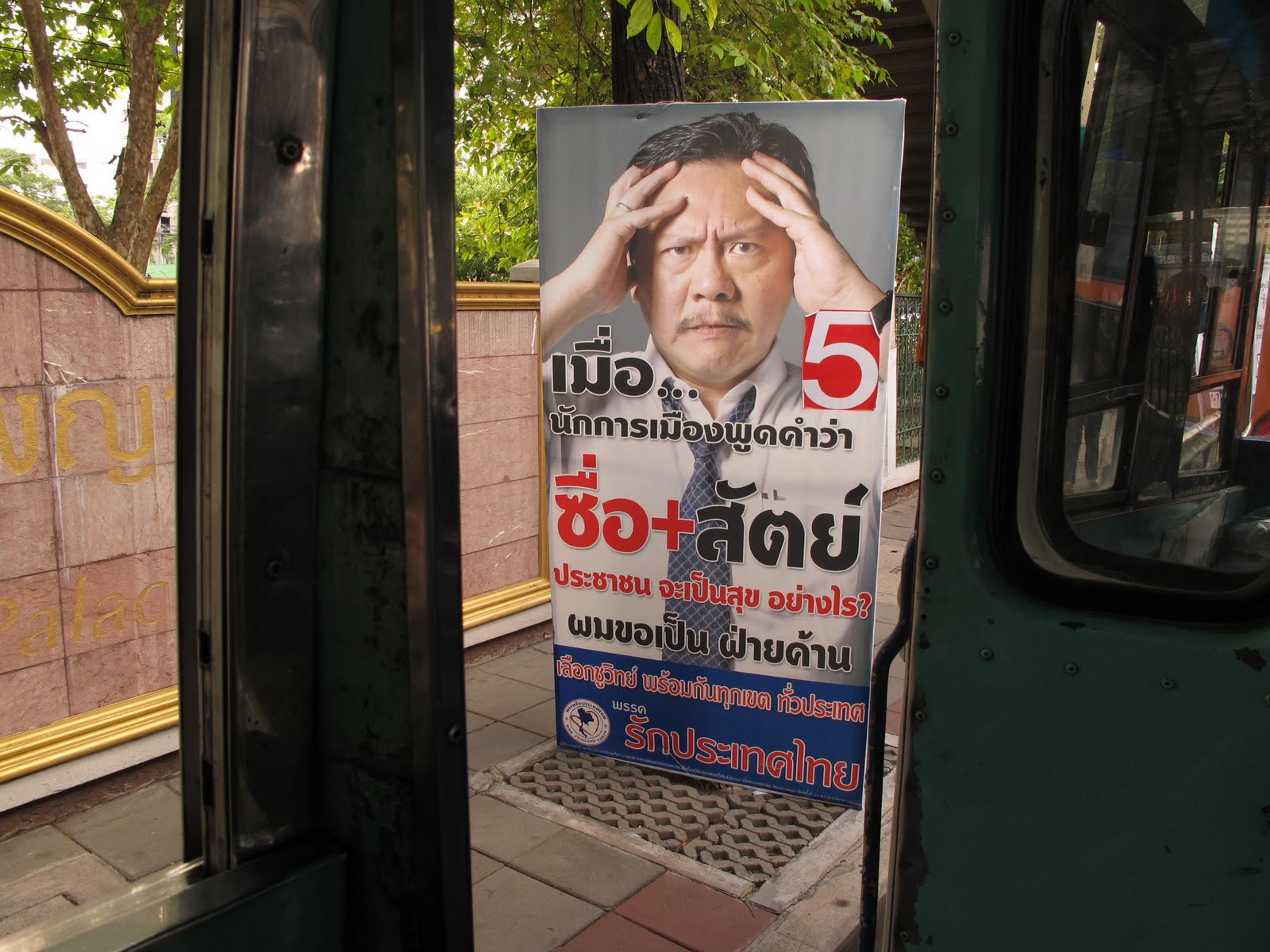
In the election poster above, the candidate looks like I feel when I get frustrated.  Chuvit Kamolvisit is unhappy because politicians can't be trusted and are corrupt, and he offers himself as someone who will be honest. Chuvit boasts that he knows corruption intimately because he used to bribe the police to protect his string of massage parlors.  Frustration, as I experience it, does not lead to running for office. I'm not sure that Nan understands me when I tell her that I am frustrated.  Thais have words for helplessness, irritation, discouragement and disappointment, but not for the more fiery emotion that I call frustration.  And it might have something to do with their less aggressive sense of self.  They do not feel entitled, or stuck on the idea, as my father would put it, that "the world owes you a living."

I get most frustrated by inanimate objects (a kicked dog bites back), and the object of my despair last weekend was a computer program designed by Kobo, an online Canadian company that provides digital books, free and for sale.  A friend told me he bought Tyrell Haberkorn's new book, Revolution Interrupted: Farmers, Students, Law, and Violence in Northern Thailand from Kobo for only $13.  I've purchased ebooks from iBooks and Amazon which has a Kindle app for the iPad.  Kobo looked good.  It had reader apps for both the Mac desktop and the iPhone/iPad, so I downloaded them and they worked fine with a couple of free books that were included.  I set up an account and bought the book.  That was the beginning of my troubles.

For the next two days I struggled to find out how I could read the book I'd bought.  My Kobo account showed clearly that I had purchased the book and that it had been added to my library.  But neither of the Kobo apps I'd installed showed the book. I tried to delete the free books from my Kobo bookshelf in hopes that the paid one would be underneath, but that proved to be impossible.   I sent a couple of annoyed emails off to Kobo which were dutifully acknowledged by a computer which promised a reply soon. Numerous help pages at the Kobo site contained the information "content deleted by owner," not a good sign.  I searched the digital book and Mac forums online and found others had similar problems with Kobo.  As my frustration level rose, my ability to understand possible solutions fell, and it all seemed like gibberish to me.  Finally I resorted to planking on the bed and Nan fled our apartment with a friend for a less gloomy climate.  Over the next two days I learned about Adobe Digital Editions and downloaded the program which was able to read the book from Kobo's .acsm file.  Then I discovered the Bluefire Reader which could open the ADE file on my iPad.  Along the way I also collected Overdrive which will let me order digital books from the library back in Santa Cruz for which I possess a card and borrowing privileges.  Have I mentioned that a week later I've received no response to the half-dozen increasingly angry emails I sent Kobo?  I wasn't willing to pay for a phone call to their headquarters in Canada (and collect calls are impossible as I've discovered from a mobile phone in Thailand). After this, I deleted Kobo's apps from my machines and vowed to never set foot in their online store again.  But I'm cool.

The thing is, I knew that I was experiencing frustration and I could feel the anger bubbling close to the surface.  It was possible for me to watch it and to some extent control its expression.  Now that I no longer own a car, computers are usually the trigger.  I bought a new laptop recently with a more complex trackpad and I make frequent wrong finger moves that take me where I do not want to go.   But I'm too stubborn to buy a wireless mouse and keyboard like my friends.  So I swear a lot at the innocent machine.  Jai yen yen, cautions Nan from nearby when she hears my angry words, which means: "Cool it! (keep a cool heart)."  The opposite, jai ran, a hot heart, is the Thai expression for impatience, a state all too common for farangs.

After I began teaching at Mahachula Buddhist University, I encountered many unexpected situations that caused frustration.  Coming to school one day, I found that a a temple fair was taking place and all classes had been canceled.  No one thought to notify me.  The staff and faculty for the Foreign Languages Department speak limited English and simple requests are arduous.  Anything involving paperwork has been difficult.  Gradually I learned to expect the unexpected and my frustration lessened.  Until this term.  Now I teach at the new Wang Noi campus in an air-conditioned classroom with an excellent sound system and two wireless microphones.  The white board can be cleaned (at the other campus it was permanently gray).  I teach one day a week, two classes of "Listening & Speaking English," one in the morning and one in the afternoon, and am paid for 6 hours of work.

Usually I share students with another teacher who has class 1 while I teach class 2 and vice versa.  This year my partner didn't show up the first two weeks and I taught a combined class in the mornings.  Then I learned that a third class would be added for our students in the late afternoon which had the effect of shortening the morning class to two hours.  As it is, I think 2.5-3 hours a week is not enough to teach my subject.  Anything less is unacceptable.  So I complained, something Thai teachers almost never do (here are a group of them eating lunch).  I felt like a bull in a china shop.  Much discussion and activity took place; a new schedule was drawn up.  I thought everything had been straightened out.  Then the other teacher called a student to ask him to explain to me that I had perhaps misunderstood.  Now he will teach a combined class in the morning and I will have them for the longer afternoon session.  Fine.  Through these negotiations I was watching my frustration level, and noticed that it did not rise to the heights achieved by Kobo.  I think I am making progress.

While I'm on the subject of teaching and frustration, let me speak of the Sound Lab.  Students of English need practicer in pronunciation which can be quite difficult for Asians (just as their languages are almost impossible for Westerners).  When I was hired to teach English to 3rd and 4th year monks, I was happy to learn there was a Sound Lab available.  I soon found that the equipment was old and broken, and the only occasion I used the air-conditioned lab was to give students a final exam.  Imagine my joy when I heard about the new, modern Sound Lab at the Wang Noi campus.  Although it was locked, I looked in the window and saw 50 computer stations along with a large control panel.  I imagined that my students could spend an hour or two a week there and that their pronunciation would dramatically improve.

When I asked my department when the sound lab was open, I was told it was "broken."  Every time I went to the campus I would look longingly through the window at the brand new lab which had never been used.  A friend in the know told me that Thai universities, among other requirements, had to have a sound lab in order to be certified.  But that they work and were used is apparently not necessary.  I took every opportunity when talking with other teachers and administrators to urge that the Sound Lab be "fixed."  Finally, two weeks ago the door was unlocked and I was able to examine the equipment.  I soon realized that it was not being used because the instructions were in English and no one understood them.  I also believe it came with only limited instructional materials, audio and video (and no printed explanation of what or where they are).  Several hours of testing revealed a steep learning curve.  Last week I was unable to get in, so access is a big problem (giving me the key is out of the question).  Next week I was told I can take my class there.  At the very least, I discovered how to connect my iPad to the sound and projection system so I'll be able to show them some videos I found on YouTube.

Frustration is obviously relative.  On a good day, I am not bothered when the universe does not grant my request or recognize my importance.  I don't remember my mood on the day my Volkswagen wouldn't start but imagine that it was bad to begin with.  Sometimes we just need a trigger to release stress on an inanimate object.  Kind of like an earthquake relieves tension along fault lines.   When I get frustrated, I can sense clearly the shape of my ego.  Because I paid $13 to Kobo for a digital book, I deserved their attention.  Of course my upset was justified.  But, as the Buddha said, that hot coal of anger directed at Kobo burned me first, and drove Nan away for the evening.  At school I've learned to put my students first, even though I let my frustration show on the day all the schedule changes were announced, and then changed again.  It gave me a good topic for English conversation for that day: frustration.  At the memorial service last week for my friend Holly Dugan, who died at 71 of cancer, I was able to put my petty frustrations in perspective.  If Holly ever got frustrated with anything other than the idiocy of politicians, it didn't show.  All agreed on her equanimity of temperament.  The monks chanted her passing with passages from the Abhidhamma, we dinned on a sumptuous buffet supper at the Ariyasomvilla Hotel, and reminisced about her life among us.  A few days later, a group of her friends rented a boat and traveled down the Chao Phraya River to a spot that we figured would make a fine last resting place.  Using a plastic coffee cup from McDonalds, and led by her close friend Pandit Bhikku, we scooped out Holly's ashes and spread them on the water.


Thursday, June 16, 2011

Am I an American?


What is a man anyhow? What am I? What are you?
--Walt Whitman, Song of Myself

They call me a farang here, most often pronounced "fa-lang," a generic term that Thais use for all Westerners.  I don't mind the label, although some tourists and expats get incensed at what they perceive as racism (turn about, fair play, I say).  I also don't mind being stereotyped -- all farangs are rich and smell like a turtle (tao) -- because I also benefit for the respect automatically given in Thailand to teachers and the elderly.

National stereotypes are near universal, although less so today perhaps than in the 19th century when the Russian expat Alexander Herzen could speculate in his journal on the essential characteristics of the Germans and the French among whom he lived (never very flattering).  They're exemplified in the old joke about the nature of heaven and hell: Heaven is where the lovers are Italian, the police are English, the mechanics are German, the cooks are French and the place is run by the Swiss. Hell is where the lovers are Swiss, the cooks are English, the mechanics are French, the police are German and the place is run by the Italians.  Americans are just plain ugly wherever they go, obnoxiously loud and demanding that Cokes and burgers be included in everyone's cuisine.


I’m proud to be an American, 
where at least I know I’m free.
And I won't forget the men 
who died, who gave that right to me.
--Lee Greenwood, "God Bless the U.S.A."

Am I an American?  That's become an uncomfortable question.  I moved away from America, the land of my birth, not only because life for me is easier, cheaper and better now in Thailand, but also because after years as an angry leftist I could only vote with my feet.  "America, love it or leave it," said the bumper sticker in the 1970's.  I left.  If transsexuals can change their gender, why can't I cut patriotic platitudes out of my heart?  They're not me.


I am not an earth nor an adjunct of an earth,
I am the mate and companion of people,
all just as immortal and fathomless as myself, 
(They do not know how immortal, but I know.) 
--Walt Whitman, Song of Myself

I've met backpackers from America who sew Canadian flags on their packs so as to avoid unpleasant questions and accusations. But their accent gives them away.  They can't rhyme "about" with "butte." My mother was Canadian and I once made inquiries to the wife of an embassy official about switching nationalities, but it came to naught.  Here in Bangkok where I hang out, the rare Westerners scarcely look each other in the eyes.  They're traveling  incognito and don't want their cover blown.  There are places where Americans congregate, in search of a passable burger or to debate politics with the Democratic Club, but I steer clear of them.  I didn't even vote for Obama.  The U.S. Embassy doesn't know I'm here.


And yet...  In my visit to California last year I was once again impressed by the beauty of that place.  And the warmth and generosity of my friends was overwhelming.  Everything was familiar and comfortable, and I couldn't wait to leave.  I've claimed much of that country as my own: born in Ohio, grew up in North Carolina and Georgia, matured in California, transplanted to Connecticut and worked in New York City.  My parents retired in Florida where I went to visit many times.  I've traversed the continent from coast to coast several times by car, train and plane.  


While becoming a radical in Berkeley, I marched against the House Committee on Un-American Activities which attempted to perpetuate the red-baiting persecution of McCarthy after he had been discredited.  Their definition of "American" was clearly political, and I would have joined the Communist Party had I'd been able to find a chapter, but they had long gone underground.  I hated the Vietnam War (fortunately my asthma kept me out of it) and found myself on the progressive side of social issues, like abortion and homosexuality.  Most of my friends from high school went in the other direction, and now, over 50 years later, we still avoid political discussions (my Facebook postings are mostly ignored by old acquaintances).  From my perspective, the identity of "American" has been hijacked by politicians from Goldwater to Limbaugh.  Our side didn't fight back, and the label no longer fits.

In the classroom, however, I speak American English.  This school term I'm using an American Headway textbook with the monks who study with me because I want them to know that my pronunciation is different from that of the English spoken by Australians and the British.  As I developed the lesson plans, it occurred to me that I could speak to my students of my ambivalence about being an American in order to show them the malleability and social constructedness of identity.  This is not an easy task since my students know who they are and how they fit in Thai (or Lao, Cambodian, Chinese or Shan) culture.  They do not apparently experience an identity crisis; to disrobe or not is as far as they'll go.  In our discussion this week, all of them, without exception, expressed a preference for living at home in their villages over the bright lights of Bangkok or the appeal of another country.  But as I think of myself as a window on the world they might not otherwise look through, I wanted to show them the questions that are possible.  And I'm doing that through songs, which I mentioned in my last post.  I've collected a load of music about America, both pro and con, and designed exercises to teach them vocabulary in the lyrics.  This week I played "This Land is Your Land" by Peter, Paul and Mary and talked about Woody Guthrie's pro-union politics.  I've got patriotic songs by Greenwood and Neil Diamond, but will also play for them "Buffy Saint-Marie's "Now That the Buffalo's Gone," Tracy Chapman's brutal tale of conquering "America,"  and for a finale, perhaps "Party in the U.S.A.," by Miley Cyrus.  My formative years were spent during the folk song revolution and I continue to think of music as a vehicle for radical and even unpalatable ideas.  


I had a voice for these matters when I lived in Santa Cruz, one of the most progressive cities in America, but despite the support we received for our marches and demonstrations, most residents were too well-off and preoccupied with their personal lives to try and change the direction the country has been moving for many years.  In Arizona or Alabama the right wing is dominant and fighting for peace, justice and a redistribution of the wealth is a real struggle.  In radical Northern California, despite the closing of many public parks and the evisceration of the educational system because of budget cutbacks, life goes on as if the crumbling of the infrastructure and the effort of fighting several wars abroad while cutting back on taxes is normal.  Revolution was not a subject for polite conversations that dealt mainly with sports and entertainment.  Bumper stickers were a substitute for bombs.


It's not easy being a citizen of the world with no flag and no anthem (unless it be "We are the World").  Now without a car, instead of bumper stickers I post comments and links on Facebook and Twitter and those that agree with me nod their digital fingers.  This post, however, was intended to be not about impotence but identity.  I wonder if they are connected?  There's strength in numbers.  Just ask a football fan, or a viewer of "American Idol."  Here in Thailand I am, despite any objections, a farang, an American.  Are we what others see in us?  Much identity is negative -- "At least I'm not one of them!"  The worst racists in America were white trash who comforted themselves with the knowledge that at least they weren't black.  There is always somebody on the bottom.


I tell my students that I love the American land and the American people, but I do not love the U.S. government.  I love the mostly unfulfilled ideals and aims that citizen philosophers put into the various founding documents of America after the English settlers, having rid their territories of the troublesome native people, revolted against the king and the corporations that had paid their way across the treacherous Atlantic Ocean and declared their independence.  What I don't love are the deeds of many Americans that have been uncovered in a history that is all too often the tale of conquest and destruction, of people and nature.  Howard Zinn documented this bloody story in his marvelous People's History of the United States.  I was radicalized as a student when I saw police use fire hoses to sweep protestors at the HUAC hearings down the steps of San Francisco's City Hall.  The hopes I felt after the election of John F. Kennedy were dashed by subsequent administrations from both political parties.  Despite the hopes many people felt in Obama, he has failed that promised.  American today is an Empire, the bully of the world, financed by corporations, directed by a bloated military, that wreaks havoc throughout the globe.  I cannot be an America if it means to represent this government and this history.  

Do I contradict myself? Very well then I contradict myself (I am large, I contain multitudes).
--Walt Whitman, Song of Myself


Please, may the sun set on the American Empire, the sooner the better.


Tuesday, June 07, 2011

Knowing the Future


Much needless stress would be avoided if only we could foretell the future.  Fortune tellers at these tables in front of Wat Hua Lampong in Bangkok provide the answers for many worried Thais.  Unfortunately, I'm not a believer in precognition, however useful it might be.  My future as an expat in Thailand depends on annually renewing a visa, and, if I want to continue teaching (as I do), a yearly renewal of my work permit.  These renewal applications require an encounter with two different bureaucracies and each holds my fate in their hand.  Worrying about whether I'll pass the documents test ramps up the aging process and I have little time to waste.  This year I was saved not once but twice by my brilliant wife, Nan.

Getting a non-immigrant "B" visa and a work permit took over four months of bureaucratic hassle the first year I lived in Thailand.  But renewals, I was told, were easier.  And they were, until this year.  The problem was caused by the move of Mahachulalongkorn Buddhist University from Bangkok to its large new campus in Wangnoi, Ayutthaya province, an hour's commute away from my condominium in the Pinklao section of Bangkok where I had also moved from one apartment to another a year ago.   Last year I was told I must file a change of address with the Ministry of Labour.  Thinking this could be done at the Autthaya MOL office I went with Dr. Subodh, my colleague from India whose permit expires at the same time as mine.  After our documents were carefully scrutinized, we were told a renewal could not be done in less than seven days, and we only had six.  So the next day I went with Nan as my translator to the Bangkok MOL office and everything went fine until they asked me to draw a map of Ayutthaya and the new MCU campus.  Without a pause, she asked me how many buildings there were.  I said eight, and she quickly roughed out a totally fictitious map which miraculously satisfied the clerk.

From there we took a taxi to the Immigration office in the cavernous Government Building B in Chiang Wattana to get the visa renewed.  After a three-hour wait that included lunch when all offices in the huge structure shut down so the hundreds of clerks can eat, I went into the cubicle with Nan to get what I thought would be an easy stamp in my passport.  Unfortunately, I'd given two copies of my work permit to the MOL and was unable to provide the necessary original for immigration.  We were told to come back with it.  A few days later, after picking up my renewed work permit with its changes of address, we returned to Chiang Wattana and sat before an unsmiling immigration clerk.  "This can't be done here because you live in Ayutthaya," she told Nan in Thai.   The MOL had changed both my work and residence addresses to the campus address.  Nan quietly and diplomatically convinced the clerk that we still lived in Bangkok.  After being told we must return to the MOL to correct the mistake before next year, I was given the renewed visa.  Total cost for all renewals and changes:  about $200 (and I'll probably have to pay $28 to correct the mistake), plus another $30 in transportation costs.

My anguish over the renewal process was assuaged somewhat by the purchase of a new MacBook Pro laptop to add to my family of Apple products.  My old Macbook was over four years old and showing signs of age.  For the third time the battery had begun to swell up; the first replacement was covered by AppleCare but the second was about $125 out of pocket. I'd never repaired the screen when I had the chance after a thin blue vertical line appeared a half inch in from the right.  The only practical reason I can give for this purchase was: it's time.  And, thinking it will be the last I ever buy, I bought the best.  The trackpad is a little tricky and I've gotten upset at accidental misdirection, but I think there's a learning curve.  I had to buy a new cord for the TV to make use of Thunderbolt and the MiniDisplayPort, but since my Philips flatscreen lacks an HDMI plug, I'm using a VGA connection which offers an acceptable picture (but without sound since I can't find the correct audio inputs).  I should also be able to use my laptop at school with the office projector to show PowerPoint lessons and YouTube videos to my students.

After saving my life, twice, Nan flew to Chiang Rai to visit her family in the small remote village in the province of Phayao where they farm corn.  She took with her my old MacBook to give to her brother Nok who is studying electricity at a vocational college.  He plays guitar and I thought he would particularly like GarageBand.  I bought Nan a Sony point-and click and she brought back photos of where we might someday live.  This is her rice field which is fallow this season, and when she graduates in a year or so, after working for a couple of years we might relocate north.  It depends partly on my health.  If I can't get around easily, living in a tiny village nearly an hour's drive from the nearest store (and three hours from the mall in Chiang Rai) will not be such a problem (unless a hospital is needed).  A house, built by Nan's aunt, Ban Yen, is waiting for us next door to her mother.  It looks very comfortable, though we'll need to add a bedroom for her young nephew Edward who will live with us.  There's a European toilet, a hot-water heater for the shower, and Nan bought her mother a washing machine which will live in our house.  Mobile phone reception is hit-or-miss, and I'm hoping for advances in technology that will allow me to keep plugged in to the internet with my growing family of devices (Nan has put her foot down on the idea of an iPhone but I haven't given up yet).

Now that I know I can teach for another year, I'm able to relax and enjoy my classes.  The commute is not bad (lots of time to listen to podcasts), although now my teaching day is 12 hours rather than the 7 when I taught at Wat Srisudaram which is closer to my house.  The Faculty of Humanity office is in the lower right of the MCU classroom building pictured here and my room is on the second floor above the Sound Lab which is, unfortunately, not working (trying to find out why has so far been fruitless).  I've decided to benefit from my origins and am using the American Headway 2 textbook.  I collected songs about America for a weekly fill-in-the-blanks exercise and began with Ray Charles singing "America the Beautiful," continued last week with Bruce Springsteen's "Born in the USA," and have prepared "America" by Simon and Garfunkel for this week's class.  I'm not sure yet about exposing the monks to "American F*k Yeah" by Team America or "American Idiot" by Green Day.  I told them that I love much about America, the land and the people, but I am profoundly unhappy about politics in the country of my birth.  Also teaching down the hall from me on Wednesdays is Elsa, a middle-aged lady from the Philippines, whose challenge is to teach pronunciation to 3rd year English majors.  At least I think that's her job, since I cannot understand her English very well.  She told me that she's an evangelical Baptist and was sad that I turned down her invitation to attend her church.  I told her I was a Buddhist now that I lived in Thailand, and she promised to pray for me.

A week ago Nan and I celebrated the second anniversary of our first meeting at a coffee shop near her office followed by dinner at Sizzler's with a celebratory meal at the same restaurant followed by a visit to the scenic bar on the 64th floor of the State Tower above the five-star Labua Hotel.  It's called the Distil, and the couches were more comfortable than the standing-room-only Sirocco bar on the other side of the roof where scenes from "Hangover 2" were filmed last year.  The views of Bangkok and the Chao Phraya River below were incredible and the high price of cocktails was offset by problems they had with the credit card machine which resulted in our drinks being made complimentary.  Sometimes malfunctions can be beneficial!

The night of Nan's return, we met her friend Aui (pronounced "we") for dinner at our favorite Rimnam barbecue joint on the Chao Phraya not far from our house.  Aui went to school with Nan in Phayao for two years and now is a caregiver for an old man in Bangkok.  She doesn't get out much and after eating she wanted to find a karaoke place, get drunk and sing songs.  We got a taxi driver to find a few for us and entered the most promising one by climbing up the stairs to wake up the proprietor and convince her to start up her machine.  She brought us towels to wash our hands, and Aui picked out songs she wanted to sing from the karaoke menu.  The women drank wine coolers and I had a beer (with ice, of course) and the service was terrific.  The only other customer was a heavyset Thai man who sat in the corner with a hostess on his lap.  Nan's cousin Bo worked in one of these places and she was more than a waitress.  Aui sang well and even Nan tried out her voice.  I sang the one song that came up with English lyrics but I had to make up the tune since I'd never heard it before.  Not half bad.  When it came time to leave, the proprietor presented us with an outlandish bill of over 500 baht ($16.50).  She charged 20 baht each for the towels, 100 baht for a plate of potato chips (not even a full bag's worth), and over 100 baht for each of the drinks.  I paid without a quibble and Aui gave me her share.  That's one karaoke place that won't get our business again!

My son Nicky sent me an IM on Facebook this morning.  He was writing it on his iPhone in the pool at the Cosmopolitan Hotel in Las Vegas.  What a life!  He's playing drums with Hanni El Khatib and they've begun a two-month tour that will take them to Bonnaroo on Friday, followed by a string of dates with Florence and the Machine, as well as shows with Bass Drum of Death in the midwest, east and Canada.  I only got a taste of that intensity during my travels in the 1970s with Eric Clapton, Crosby Stills Nash & Young, Bad Company, Elton John and Led Zeppelin.  I think being a musician in that scene is infinitely better than being a PR man.  He and Hanni were recently on Fuel TV and a commercial they did for Nike's "Just Do It" campaign is currently being aired.  Nicky has little time to write now and I look forward some day to hearing about his adventures.

It's the monsoon season in Thailand and I'm enjoying the daily deluge, almost always accompanied by thunder and lightning.  The views from my window are spectacular.


Saturday, May 28, 2011

Democracy's Last Stand?


An election will be held in Thailand on July 3rd and larger than life posters like this one have sprouted on cement telephone polls all over Bangkok.  Prime Minister Abhisit Vejjajiva dissolved the House of Representatives and called the election two weeks ago.  Candidates from his Democrat Party are campaigning against those from the Pheu Thai Party and their recently appointed leader, Yingluck Shinawatra, the attractive but untested younger sister of the fugitive former prime minister, Thaksin Shinawatra.  Although there are nearly two dozen political parties fielding candidates, Pheu Thai and the Democrats are expected to win most of the votes and who's in the lead of this close race depends on which poll you believe.  This is no ordinary election.

Since Thaksin was ousted in a military coup in 2006, the country his been divided loosely between his supporters (called red shirts) and detractors who see him as the personification of evil (led by the vocal yellow shirts).  An election following the coup returned Thaksin partisans to power, but street demonstrations by the yellow shirts and court decisions toppled two successive governments.  Abhisit came to power backed by the yellow shirts, military, royalists, and the Bangkok business elite.  Demonstrations a year ago led by red shirts calling for a new election ended with more than 90 dead and nearly 2000 injured.  The Democrats have never carried a national election while Thaksin was an overwhelming winner twice.   Democrat strength is in the deep south while Pheu Thai claims the hearts of people in the populous northeast.  Bangkok appears to be a toss up.  The yellow People's Alliance for Democracy (PAD), disappointed in Abhisit, are urging a "Vote NO" on all candidates in the election and erected this poster at their encampment near UN headquarters.  They want a royally-appointed interim government for several years until the agitation for Thaksin's return disappears ("democracy" is not exactly their forte).  The animal heads on the politicians' bodies are particularly insulting.  Rural red shirts have been slandered as water buffalos and the worst thing you can call someone in Thai sounds like "here," the name for a monitor lizard.  Poster graffiti is also fascinating. I saw one Abhisit poster altered so that he looked like a vampire from a currently popular Thai soap opera featuring a cast of blood suckers.

My Google Reader is filled with speculation from bloggers in Thailand and journalists in Southeast Asia about what will happen.  Most believe that Thaksin will never be allowed to return without going straight to jail and that even if his party earns a bare majority of votes it will never be able to form a Parliamentary coalition government.  The military routinely issues denials that it will stage a coup if the Democrats are defeated, but a renewed war on drug dealers and proposed security measures for polling sites are raising suspicions.  Arrests for lese majeste (the law against insulting the king) have increased dramatically (a Thai-born, American citizen was jailed yesterday) with charges mostly levied against red shirts, causing numerous groups to claim that the government is manipulating the law for political gain.  All parties are emulating Thaksin's strategy of offering everything but the moon to poor, mostly rural voters to win their support in a populist frenzy of solicitation.  Since Thailand's government was declared a constitutional monarchy in 1932, successive administrations, both elected and as the result of numerous coups, have struggled to define a Thai form of democracy.  What's missing in the past has been respect for the outcomes of elections, the cornerstone of any Western democracy.  Pundits worry that if the reds win, the yellow shirts (and perhaps the military) will take to the streets to deny their victory, and if the Democrats win, the reds might do likewise.  It's hard to see a way out of this impasse.

While I try to make sense of Thailand's political system, the "summer" vacation has ended and the new school term is beginning.  I will be commuting to Mahachula's Wangnoi campus near Ayutthaya every Wednesday for the next four months (this photo was taken at the library, looking across to the Rector's office building).  This week, only 6 of my 29 fourth-year students majoring in English attended my first class (it's a tradition to avoid the first meeting).  I'll be teaching the same day as Khun Elsa from the Philippines, and yesterday she told me she was an evangelical Christian and wanted me to visit her church.  I'm still waiting for my visa and work permit renewals but expect to get the needed stamps on Monday, a day before they expire.  Nan begins June 6th as a full-time university student, completing a degree in human resources management.  After three years with the same company, she was fired two weeks ago in an office purge and is taking that opportunity to fulfill her dream to finish a bachelor's degree.  Nan will look terrific in the school uniform of  white blouse and black skirt after losing five kilos with the aid of several packets of little pills given her by the local hospital.  I was not happy about that, since I repeatedly declare my love and support no matter what she weighs, but after determining the pills did not contain speed, I let it go.  Limiting herself to one meal a day probably does more than any pills ever could.  Tomorrow night we celebrate the second anniversary of our first meeting with a dinner at Sizzler's and drinks at a skyscraper bar with a view of the city.  Before her classes begin, she'll go home for a few days to see her mother in the northern province of Phayao.

While Nan is gone, I'll be deep inside of my technological cave.  A few weeks ago I bought an iPad at a discount before the new model was released.  It was a purchase hard to justify because the iPod Touch can do almost as much.  I've been using it to listen to podcasts while I'm traveling, and to try out different apps.  But it is too small to qualify as an e-reader and I'm beginning to lose my resistance to the future of digital books.  So I gave the iPod to Nan and bought the new toy.  My iPad has 3G capability although Thailand has not yet advanced beyond Edge, and I can read email and Facebook posts on the bus.  In addition to iBooks, I got Kindle for the Mac and GoodReader for all my pdf files.  The first book I bought was Nancy Egan's wonderful A Visit From the Goon Squad which I could not find in local book stores.  I downloaded some free titles from Project Gutenberg, and then discovered a cornucopia of pdf, epub and mobi files on torrent sites.  I'm reading Mark Hertsgaard's Hot on climate change and Keith Richard's Life.  Who knew the drug-addled Rolling Stone guitarist could remember so much?  It's a wonderful account of a life loving the blues amidst the madness of pop star fame and fortune.  There are some drawbacks to an e-reader like the iPad.  I like to dog-ear pages and can get high on the smell of paper, and those pleasures are denied me.  I'm learning how to underline and make notes.  The yellow tablet note app that comes with the iPad is great, once you learn how to tap the keyboard.

I've been using the electronic note pad at forums held by the Foreign Correspondent Club in Thailand.  At a recent meeting on lese majeste, I listened to (from left) Buddhist teacher Sulak Sivaraksa, academic David Streckfuss who has written a new book on the law, and Ben Zawicki, chair of the local chapter of Amnesty International who has come under fire for not challenging the Thai government on its drastic curtailing of freedom of speech.  Both Sulak and the entire board of the FCCT have been charged with lese majeste in the past.  At another forum, statesman and former prime minister Anand Panyarachun tried to paint a positive outcome to his work as chairman of the National Reform Committee after the violence of last year, even though his committee had resigned without any of  its suggestions implemented after new elections were called.  At another meeting, three prominent red shirt leaders gave their account of the violence and its aftermath, and one, Jattuporn Prompan, was jailed a week later on lese majeste charges after a speech he made at the anniversary rally May 19th.  The FCCT welcomes expat members in addition to the correspondents and journalists based in Southeast Asia, and its bar and restaurant are highly regarded for hanging out.  Recently a new bagel cafe has opened on the ground floor of the building where the FCCT occupies the penthouse and it has become a destination for deli-starved Western residents.

While the world was waiting for the Rapture promised by a crazy old preacher in the U.S., my oldest friend Mark Detrick died of lung cancer at his home in Laguna Beach, his wife Laury by his side.  He'd been suffering from chronic obstructive pulmonary disease (COPD) for years and received a terminal cancer diagnosis in January.  We talked on Skype in March and traded stories about the past.  I met Mark in junior high school in La Canada and by high school we were best friends.  His stepfather was famed printer Ward Ritchie and the library in their home included a Gutenberg Bible.  We got drunk, smoked cigarettes, chased girls and listened to rhythm and blues records.  Mark dropped out of Wisconsin after his first year and we were students together at Pasadena City College until he talked me in to applying to Berkeley where I was surprisingly accepted.  We shared a tiny apartment, a bed that folded into the wall, and many outrageous adventures.  In junior high, I had a crush on Trudy who loved Mark, and after our first semester as roommates, I was the best man at his wedding to her.  In turn, they accompanied Judy and I to the Justice of the Peace for our marriage, and we all celebrated afterward in Tijuana.  Neither of these marriages lasted.  Mark became a successful orthodontist and met Laury from Belgium at a health club.  They traveled the world during his time away from putting braces on damaged teeth.  During the Vietnam War, Mark was a dentist in the Philippines and hinted that he had done some work for the CIA.  Our politics diverged radically after that and we avoided it during my visits in Southern California to go skiing at his cabin near Big Bear or to a high school reunion.  Recently, Mark and our mutual friend Ernie (whose second wife Joyce just died, also of cancer) gave us a very generous wedding gift which Nan and I used for a trip to Koh Chang.  I shall miss him very much.

Now that the school vacation is over, perhaps I'll spend less time on Facebook and Twitter (although with the iPad I can now get online anywhere at any time).  I'm still amazed that I've been able to connect with so many "friends" from different periods of my life, high school over 50 years ago to the present, from publicity and publishing jobs to students and teachers here at MCU.  I've turned my wall into a private newspaper and fill it with links and comments to news stories, blogs and opinion columns.  Occasionally I throw in a line about the weather or a photo taken of Bangkok from my window.  The stories that attract my interest these days are of Obama and Israel.  I'm deeply disappointed at Obama and I number the Israeli government among the bad guys of this century, along with Iran, North Korea and Saudi Arabia.  While many of the progressive persuasion can agree with me about Obama, my remarks about Israel have drawn passionate objections.  One woman whom I knew in Hollywood 35 years ago decided to de-friend me because of what she perceived as insults to Jews.  And a friend from high school regularly accuses me of anti-Semitism because of my anti-Israel position, and sends me email from his wife's Zionist cousin to show how mistaken I am.  I rather think many of my "friends" have deleted me from their news feeds for being annoying.  I know I only receive responses from a regular few.  One "new friend" in Bangkok, a former war correspondent who detests the red shirts, called me a "self-hating America" and said I was in league with Donald Rumsfeld.  An acquaintance told me he drinks a bit.  I had to de-friend him, however; tolerance has its limits.

Tuesday, May 17, 2011

How Can Humanity "Get Out of This Mess"?

"

"The earth is contaminated everywhere by human activity," Colin Soskolne, a professor of epidemiology at the University of Albert, Canada, told the audience last Friday during a conference on "Buddhist Virtues in Socio-Economic Development."  Vesak 2011 was organized by my school, Mahachulalongkornrajavidyalaya Buddhist University, and featured two days of events at the campus in Ayutthaya, Thailand, and one at UN headquarters in Bangkok.

At the day-long panel on "Environmental Preservation and Restoration," fifteen professors, monks and environmental activists from ten different countries echoed Dr. Soskolne's sentiment in different ways, telling horror stories about deforestation, water pollution, overfishing of the world's oceans, harm from invasive species, damage to sites sacred to Buddhists in India, cultural disruption in Ladakh, and the devastation caused by war and too many cars.  They offered examples from the Buddha's life to show how he lived in harmony with his surroundings and established rules for his sangha of monks to prevent pollution, insure hygiene and protect nature.  Most of the panelists spoke of Buddhism's core values of interdependence, moderation, respect for all beings, and restraint of desire, in order to argue that these values are necessary to solve the world's environmental crisis.

I was not convinced.  As secretary of the environmental panel, I've been working for the last month to make sure that everything ran smoothly.  I read all of the papers, which have now been published in a 732-page conference volume, and I gave advice to the panel's chief moderator, Dr. Colin Butler, a researcher in epidemiology and public health at Australian National University, for the final report that he presented to the plenary session at the UN on Saturday.  Despite the optimism of some panelists, there was little of hope in the report, but this absence did not make it into the final Bangkok Declaration issued by the organizers of the conference.  As we saw it, the seriousness of the environmental crisis was not lessened by new sources of alternative energy being developed or by ethical principles for behavior such as those contained in the Earth Charter.
There does not seem to have been much change in thought since I left the fields of environmental history and philosophy in 2004.  One of our speakers discussed Deep Ecology, a philosophical fad among radical ecologists I thought had been long discredited for ignoring economic and political factors.  Other panelists spoke of the affinity of Taoism and Confucianism with Buddhist values in an attempt to show that virtuous people would not treat the earth unkindly.  But this is demonstrably untrue.  China's air pollution is notorious, Japan kills dolphins and whales, and deforestation is a serious issue in Southeast Asia (even though logging is outlawed in Thailand, it continues illegally).  Vegetarianism advocated by a monk from China (one speaker pointed out that this was animal-centric and ignored the intrinsic value of plants), freeing caged animals, and planting trees around monasteries is simply not enough to stop the structures of power and violence that are ransacking the planet for profit.  There were no engaged Buddhists at this year's conference to speak of collective action and the need to stop the wheels of "progress."

The narrative of environmentalism too often focuses on individual behavior. If we recycle, reuse, and reduce our consumption, garbage, etc., everything will be ok. Bullshit.  In the last ten years the environmental crisis has only gotten worse, despite Rio, Kyoto, and Al Gore's "An Inconvenient Truth."  In the U.S., deniers of global warming and climate change have taken positions of power.  Factories pollute the environment more than people, wars waged by governments are particularly destructive, and dependence on fossil fuels by the corporate economy is more damaging than the harm that individuals do through their profligate lifestyles. Reemphasizing religious values and ethics will do little good whatsoever if people, as the Buddha taught 2500 years ago, are driven by ignorance, greed and anger.  Buddhism is not a self-help action plan.  The most we can do is offer compassion to each other for the suffering that humans have brought upon the earth.

Environmentalism has clearly failed.  If Mark Hertsgaard is right in his new book Hot: Living Through the Next Fifty Years on Earth, it's too late to stop global warming which already is causing serious climate change, and which may even have something to do with the recent rash of major earthquakes. Michael Shellenberger and Ted Nordhaus declared "The Death of Environmentalism" (pdf)  in a 2004 essay which was expanded into the book-length Break Through: From the Death of Environmentalism to the Politics of Possibility three years later. The authors argue in their book and web site for a "post-environmental" politics that abandons the traditional stress on nature protection and "the politics of limits" to focus on creating a new sustainable economy.  Political strategies that worked for smog and acid rain will not work for global warming, they write.  Rather than defend nature, as if it's an all-powerful god outside ourselves, Shellengerger and Nordhouse urge environmentalists to abandon doomsday narratives that scare rather than persuade people to give up things they enjoy, like cheap oil and food, and jobs in industries that pollute.  For this a new inclusive politics is needed.  Environmentalism needs to be reframed as a global issue.  Environmental historian Richard White once wrote an article called "Are You an Environmentalist, or Do You Work for a Living?" to illustrate the vast gulf between elite proponents of wilderness preservation and protectors of rare bugs and the working people whose interests are largely ignored by them.

George Monbiot wrote recently in the Guardian of London: "All of us in the environment movement – whether we propose accommodation, radical downsizing or collapse – are lost. None of us yet has a convincing account of how humanity can get out of this mess. None of our chosen solutions break the atomising, planet-wrecking project." He expanded on this pessimistic appraisal with details in "Our Crushing Dilemmas," and he asks how environmentalists can "fight without losing what we're fighting for?" Paul Kingsnorth co-founder of  The Dark Mountain Project writes that “the green movement has torpedoed itself with numbers” and is now trying to save the world “one emission at a time.” Environmentalists “feel obliged to act like speak-your-weight machines just to be heard.”  He calls for new stories in "The Quants [number crunchers] and the Poets," because "the whole squabble between world views is not about numbers at all.  It is about narratives," and which ones can help or hinder.

I intend to study these critiques and proposals in the hope that they will deal with the crucial problem of priorities.  Developing countries prioritize industrialization over pollution limits, and politicians prioritize jobs in resource extractive industries (oil, mining, timber) over controls to protect the environment.  By the time the world is completely developed and everyone is fully employed, there will be no place left in which to live. Perhaps the earth was doomed when hunter gatherers ten thousand years ago first discovered how to control nature by pruning trees and bushes to grow more fruits and nuts, and learned that planting seeds would guarantee a steady supply of food. This allowed the population to blossom beyond the carrying capacity of the land and it's been onward and upward ever since. Human actions contaminating the planet today are simply an extension, with the aid of technology, of the manipulation of nature practiced by our ancestors.

Polls show that concerns about the environment are not high on people's list of priorities.  Even the endless war on terrorism falls behind the economy and jobs.  Most of us are more concerned about supporting our family.  In addition, we want to be good people, honest and worthy of respect.  We learn from our family, culture and religious tradition what it means to be a good person.  In a Buddhist country like Thailand, this means to follow the five precepts, to avoid killing, stealing, lying, intoxicants and sexual misconduct.  It also means to pay respect to monks and others in authority and to practice generosity to accumulate merit.  Despite these rituals and guidelines, corruption in business and politics is widespread here and often accepted as normal.  Although I have been fascinated by philosophy, ethics and religion for much of my life, I am perplexed by the observable disconnect between values and behavior.  Even the best of people are very often hypocrites (e.g., the recent revelations about Gandhi's sex life).  This leads me to conclude that the environmental crisis is not caused by a crisis in values.  It is the direct consequence of structures of power and violence embedded in our economic and political systems.  But I despair of every turning this around.  Humanity cannot get out of this "mess."

So, what do we do?  Be kind to each other, I suppose.  And condemn the corporate behemoth (which we are powerless, really, to stop).  The Buddha's First Noble Truth of suffering applies to the world as well as to living beings, and all we have to offer each other and the planet is compassion.