Sunday, October 03, 2010

Pali Scholar Condemns Buddhist Ritualism

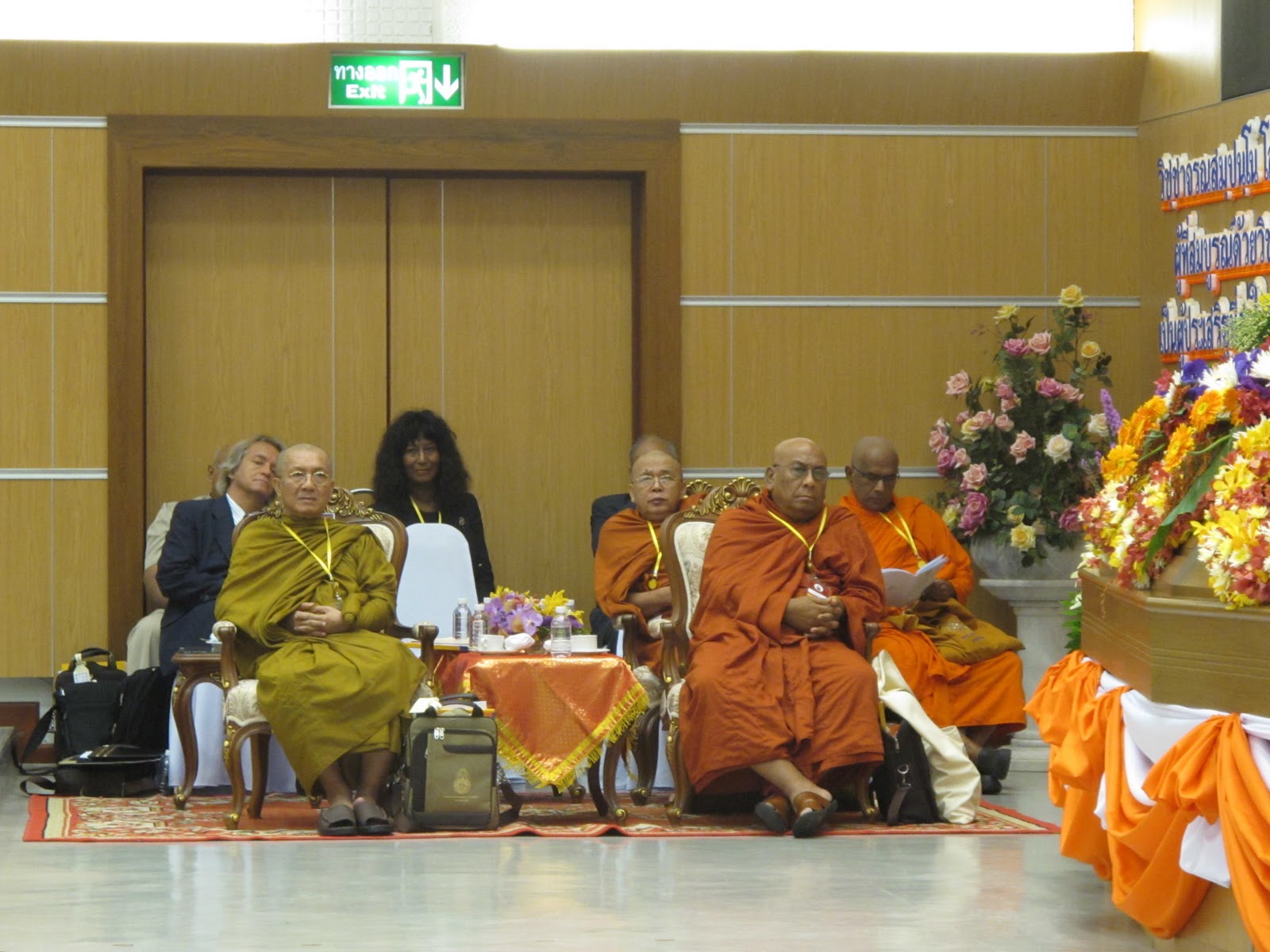
"I am begging you to give up obsession with ritual and custom," Richard Gombrich said to a gathering of Theravada monks and lay followers at an academic conference in Bangkok last week to discuss why this form of Buddhism is today less influential in the world than its cousins, Mahayana (Zen) and Vajrayana (Tibetan).  "Ritual has no intrinsic value and must be jettisoned if it gets in the way of living the Dhamma.  We must acknowledge that Buddhism is for all, including foreigners and women."

Gombrich, author of numerous books and founder of the Oxford Centre for Buddhist Studies in England where he teaches Pali and Sanskrit, took the Thai Sangha of monks to task for its "parochial nationalism," its failure to condemn violence against Buddhists inside and outside Thailand, and for its treatment of women.  These failures can be traced to an obsession with ritualism which ignores the Buddha's teaching that "ethical value lies in intention alone...the point of ritual lies in doing, not in intending."  If there is nothing wrong with the message, than the failure of Theravada Buddhism's influence must be due to the messengers, he said. 

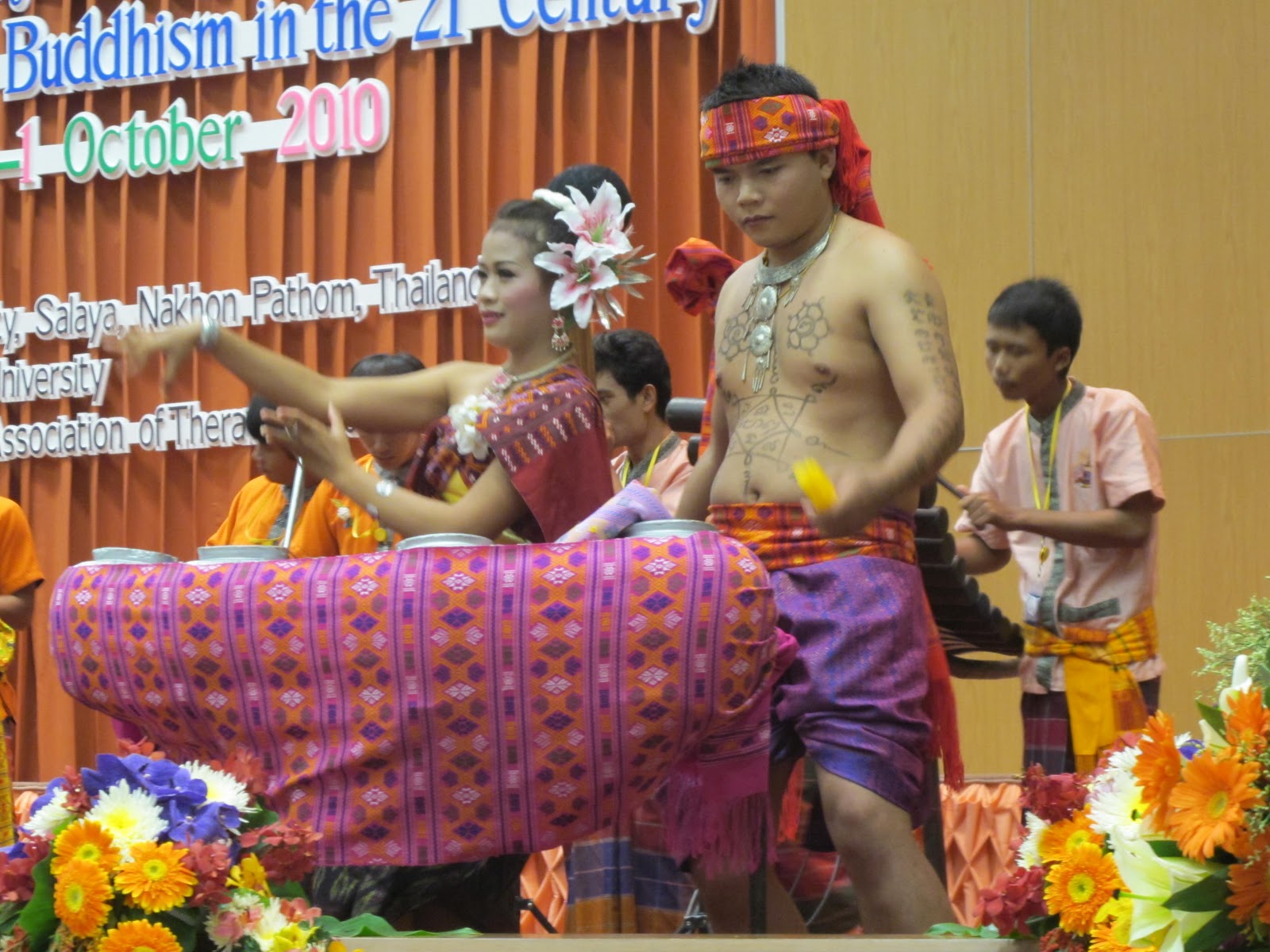
Most modern religions, Gombrich told his audience, see their purpose as offering comfort to believers, but "the founders of religion and the great reformers felt the  need to challenge their audiences, to criticise the status quo and to demand that people improve their own lives and the lives of those around them."  Last year, on a similar occasion, the birthday of the Supreme Patriarch of Thailand (now 97 and hospitalized for a long time), I heard Gombrich deliver a scathing condemnation of the Sangha's misogynistic treatment of women and its refusal to ordain nuns.  The applause then was as lukewarm as it was last Thursday at Mahamakut Buddhist University where Gombrich delivered the keynote address on the conference theme, "Dissemination of Theravada Buddhism in the 21st Century." 

The Oxford academic describes himself as "not a Buddhist, but I very much admire Buddhism and especially Buddhist ethics. I am not a Buddhist in a technical sense. In one way, you could say I am more of a Buddhist than most Buddhists, because I believe that the Buddha was an intellectual genius and had some extraordinarily interesting things to say. This is something that most Buddhists simply don't take any interest in."  Unlike many modern deconstructionist commentators, Gombrich believes it is possible to read the original Pali scriptures in order to understand what the Buddha actually thought and meant.  He faults the Buddhist Theravada religious establishments (in Sri Lanka, Burma, Laos and Cambodia as well as in Thailand) for their failure to study the texts and for their ritual changes based on custom rather than scripture. 

"I am perpetually horrified by the failure of the Buddhist establishment to understand the Buddha's message, to teach it and to act upon it," Gombrich told his audience, and he called it a "tragic and culpable failure."  The majority of Theravadins, he said, consider only Buddhists of their own nationality to be true Buddhists, and believe Mahayana monks and nuns are "not true Buddhists because they do not prohibit taking solid food after midday."  Mahayanists, on the other hand, consider true Buddhists to be vegetarian (which Theravadins are not).  Buddhism, he argued, "which measures action by ritual and custom can never spread anywhere."  The Buddhist government in Sri Lanka refuses to recognize the Dalai Lama, "the person whom the world regards as the greatest living Buddhist," and the Sangha on that island has never tried to disseminate the Dhamma to its Tamil minority or in mainland India. The Thai Sangha has failed to criticize the persecution of monks in Myanmar where the government treats protesters as if it "were merely squashing a few mosquitoes."  One of the main things that "attracts people to a religion is when it produces figures who are prepared to speak against cruelty and injustice," and he asked where are Theravdin leaders comparable to the Dalai Lama and Thich Nhat Hanh.  (I would suggest Sulak Sivaraksa in Thailand fills that role).

"If I am a sincere Buddhist, how can I ask the state to kill on my behalf?" he wondered.  And yet only two Buddhist states anywhere, Bhutan and Cambodia, have no capital punishment.  In Thailand recently, "people seeking refuge in a monastery in the heart of Bangkok were killed by what some call the forces of law and order," and he also mentioned the military coup four years ago and the far south which is not at peace.   By keeping Buddhist monks out of politics when they should be advising leaders on morality, the Sangha's silence fails to persuade people that Buddhism is a religion of non-violence.  "Is it the duty of the Sangha to lead on moral issues, or to follow the crowd?"

Like his talk last year, Gombrich reserved his strongest words for Thai Buddhism's treatment of women.  Only Thai and Burmese Buddhism have a notion of female impurity during menstruation, but "they are going against the Buddha, befuddling themselves with superstition, and in the process insulting women."  This is not the worst crime, however.  "In Thailand the Vinaya has been changed in a grotesque manner, so that the monks may not only not touch a woman, but may not receive anything directly from a woman's hand...from babies to centenarians." This is not just a misguided ritual obsession, but "true misogyny, a horror and dread of women, a fear that the slightest contact with a female is seductive and may inspire lust."  And finally, the rule that the Bhikkuni order of nuns cannot be restarted because it died out is the product of "obsessive neurotics."  Reinstating the order of nuns would be "the one development which, I believe, has the power to preserve Theravada Buddhism for many future generations."

Gombrich presented the Theravadin Sangha monks with a strong challenge that I'm afraid most of the leaders will probably ignore.  The missionary effort of Theravdins in the past has been to establish cultural centers in different countries which service South Asian immigrants rather than reach out to the indigenous populations as Tibetan and Zen monks and teachers have done most successfully in the past.  Western women are often repelled by the patriarchal and even misogynistic rituals and attitudes they encounter in Buddhist countries and have gone on to reinterpret Buddhist teaching to incorporate women when they go back home.  Much of what Gombrich argued was taught years ago by that great Thai reformist monk Buddhadasa Bhikku but his ideas have not yet  spread fully to the laity where I have been told by Thai women that only male monks can achieve enlightenment.

The Buddhist religion I have observed in Thailand is mostly devotional and involves elaborate rituals that include animist and Hindu elements.  It probably provides more comfort than challenge to its adherents.  But this is not to deny that the teachings of kindness and compassion are not part of Thai culture in a deep way.  I find Buddhist piety in Thailand to be deeply moving and impressive and I have only begun to understand and participate in it personally.  As a lover of ideas, I find these discussions about Buddhism stimulating and enlightening.  But I also recognize that ideas are the tangible coin of intellectuals and academics and not of much use to the bulk of devotees who are seeking in their lives to be good and happy people.  When Nan prays before the altar in our home, or when making merit in a temple, she prays the metta prayer, that all be happy.  It's as simple as that.

Wednesday, September 29, 2010

Goin' to the Thai Chapel of Love

Love and marriage, love and marriage,
Go together like a horse and carriage.
This I tell you, brother,
You can't have one without the other
--Frank Sinatra (Cahn/Van Heusen) 

Nan and I were married this week. It was a simple ceremony performed at the Registry Office in Bangrak (rak fortuitously is the Thai word for love), one of Bangkok's many sub-districts.  We'd been living together as man and wife for over a year.  I gave her an engagement ring last January and recently I've begun wearing a gold band on my left hand.  Nan's mother had given us her blessing.  Now, with my departure to the states only three weeks away and an uncertain future, we wanted to declare the permanence of our union to the world.

Goin' to the chapel and we're
Gonna get married,
Goin' to the chapel and we're
Gonna get married,
Gee, I really love you and we're
Gonna get married,
Goin' to the chapel of love
--The Dixie Cups (Greenwich/Berry/Spector)

Marriage in Thailand is a matter of state rather than religion.  While weddings, particularly outside of large cities, can be complicated social affairs that might involve the blessing of a monk or two, the glue that binds two people together here is paperwork and an army of clerks is required to perform the paper shuffling that constitutes the civil ceremony.  The process is similar to getting married by a Justice of the Peace in America, as I did with my first wife, but it involves many more layers of bureaucracy.  First, I went to the U.S. Embassy to get two documents that certified I was divorced and now single and free to marry, each simply an affidavit from me and officially notarized at a total cost of 3300 baht ($100 each).  These I took to a translator at a booth in the MBK Shopping Center and a few days later picked up Thai documents that had been stamped by a government office, for a steep fee of 4000 baht.  Early Monday morning we took a boat and taxi to the Registry Office only to learn there was a problem with one of the documents.  Ms. Wannapa, our translator, rushed to the rescue to smooth things over ("I know the Registrar," she said, "so please don't worry.") 

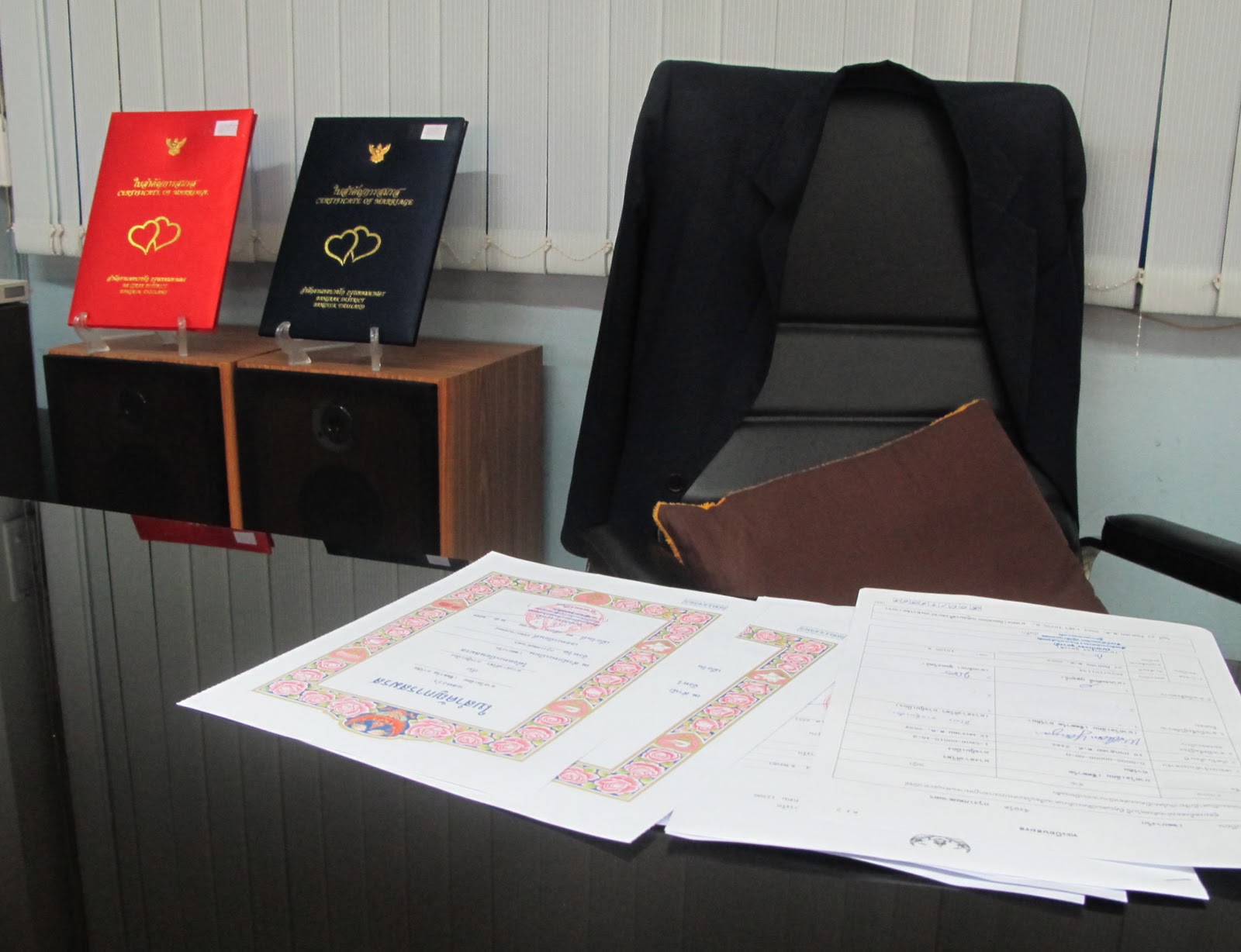
There were other couples waiting to be hitched alongside us, and the busy office processed two pairs of betrothed at a time.  Numerous additional documents were prepared, information was entered into a computer, and colorful marriage certificates were printed.   An eagle-eyed clerk scanned each paper carefully for mistakes.  We signed several of them.  Next we were passed to a higher official (I could tell this because he wore a uniform) who was even more careful about approving the growing pile of documents which I could not read.  The fee for all this?  Fifty baht, less than $2.  There were nice binders on sale, in blue or red, for 450 baht; we chose red.  The official assembled our copies of the documents into the binder and handed them careful to us.  "I wish you a long life together and a happy marriage," he told us, according to Nan.  This was at, the moment of marriage in the Thai chapel of love.  Tucked in the corner of the office was a rickshaw in front of the floral display that you can see above.  We asked a secretary to take our photo with the his-and-her marriage certificates.  "Happy?" Nan asked.  "Oh yes!" I answered.

Afterward, we took a bus to Wat Yannawa, a large Buddhist temple on the Chao Phraya River near Nan's office where in our courting days I used to meet her after work.  It's most notable aspect is a large cement junk that memorializes the Chinese merchant ships that used to ply their trade on the river.  More recently it has added a very tall statue of the Chinese Buddhist goddess Kwan Yin.  We offered a prayer to her on the occasion of our marriage, and then went inside the main hall to make an offering to the monk on duty which included some chanting, a copiously sprinkled blessing with water, and the pouring of now sanctified water from a cup into the bushes outside.  Next we also said a prayer in front of a large icon nearby of Ganesha the elephant-headed god, "remover of all obstacles," my favorite Hindu deity and one whose help I could use at the present time.  Then we walked outside and down to the dock to feed the fish with several loaves of bread, a form of symbolic generosity toward the natural world (the fat river fish cannot be all that hungry) that is one of the nicer rituals in Thai Buddhism.  

In the evening we met a dozen Thai and western friends at Baan Klang Nam 1, a picturesque riverside restaurant in an old wooden house not far up river from the port of Klong Toey.  Nan wore a beautiful dress she inherited from her glamorous aunt Ban Yen and she insisted that I wear my yellow shirt to match her with my yellow elephant tie.  It's the end of the rainy season and the river level is rising rapidly, so water was lapping at the floorboards as we dined.  Nan invited several of her co-workers, two with husbands and one single man.  One couple came with their two-month-old daughter and 5-year old son.  I invited my long-time friend Jerry along with Tony, a Canadian studying for a master's degree in Buddhist studies at my university, and his Thai girlfriend Renu.  The feast was magnificent, with all kinds of delicious seafood, from fresh fish and crab to scallops and shrimp

It turned out to be a stormy night, with constant thunder and lightning over the river and whitecaps on the water.  The open-air portion of the restaurant was closed but we stayed dry under a high roof.  The language barrier divided the table but bilingual Nan presided over our celebration and we were all united in our enjoyment of the good food.  The newlyweds were grateful recipients of the good wishes of all.  Nan's co-workers gave us this glass icon of two love birds and Jerry's wife Lamyai, who could not attend, sent us some beautiful material hand-woven by her family in Surin.  Jerry, a long-time resident of Bangkok and Surin whose friendship brought me to Thailand back in 2004, traded stories with my newer friend Tony who was a journalist in Canada as well as Korea before coming to Thailand three years ago for a serious study of Buddhism.

It's my third marriage and Nan's first.  She was engaged to marry once before but her fiance got another woman pregnant which soured her on young Thai men.  Her aunt had a child with a New Zealand sheep rancher but he was already married.  Because my tubes are tied, Nan cannot have children with me and she says that's not a problem for her.  She's keeping her full name rather than go through the trouble of changing her ID card, bank account and passport.  Some of her friends think marriage to a farang is a ticket to America, but I've told her I cannot afford to take her there and I have no intention to live anywhere now but in Thailand. My trip to California is under duress.   I've heard that the Embassy takes a dim view of differences in ages as great as ours and would automatically suspect something fishy were Nan to apply for a visa.  While there may be some benefits to marrying a foreigner for a young Thai woman, the difficulties and uncertainty I'm currently experiencing would make them moot.

After four months of indecision, I've finally purchased a ticket back to the U.S. and will arrive in San Francisco three weeks from today.  This afternoon I was reflecting on my current ride on the roller coaster of emotions and I noticed that the same imagined future event can be experienced in a variety of ways, depending on perspective and state of mind.  Occasionally a "what if" thought experiment leads to paralyzing anxiety and the inability to see straight.  But at other times the same possibility evokes a mai pen rai response, the Thai version of "whatever will be will be."  Dark impersonal forces are arrayed against me, determined to classify my life as a statistic and stamp out the felt sense of whom I am and any freedom of choice.  Inflexible rules reduce the power of compassion.  Am I a victim of fate or the pawn of chance?  I cannot believe in a God that pulls my strings or law of karma that reduces my particular bliss or pain to infinite cause and effect.  Unfortunate random things happen.  I do know that loving Nan has given me life in the midst of death, and that I no longer can be destroyed by the cancer I carry within or the bureaucratic and legal rulings from afar that have stolen our sense of stability and certainty.  Whatever happens, however long I'm forced to stay away, the rare and joyous love we have found together will endure.


Tuesday, September 14, 2010

"Freedom" is Just Another Word

Freedom's just another word for nothing' left to lose
Nothin' ain't worth nothin' but it's free

I've never quite understood these lines from Kris Kristofferson's song "Me and Bobby McGee" that Janis made into a hit, but then the notion of freedom has always been a puzzle.  The lyrics at least echo my disenchantment with the notion that has been so debased by political rhetoric in the 21st century.  This has been the week of reading Jonathan Franzen's new Freedom: A Novel (actually I finished it in three days) and it has prompted a renewed interest in understanding the attraction of what can seem from some perspectives an impossible dream.

Franzen's last best-selling book, The Corrections, which I also loved, came out right before the September 11 attacks.   "Operation Iraqi Freedom" (originally named "Operation Iraqi Liberation" until the unfortunate acronym was noticed) was begun by President Bush during the gestation of his new novel and was ended by President Obama the week Freedom was published when he announced, "It's time to turn the page."  We've also been told that Obama bought a copy of Freedom on his vacation at Martha's Vineyard the same week that Franzen graced the cover of Time where he was described (I cringed for him) as the "Great American Novelist."  In his new book, Franzen observes that "the personality susceptible to the dream of limitless freedom is a personality also prone, should the dream ever sour, to misanthropy and rage."  Is there a lesson here for Iraq, Obama, and the Tea Party libertarians?  For Patty, whom Franzen portrays as the perfect mom of St. Paul, Minnesota, who married her second choice, a decision around which the novel rotates, "all she ever seemed to get for all her choices and all her freedom was more miserable."  Freedom is like that.

Franzen (who spends summers in Santa Cruz and winters in the Big Apple)  didn't need the tsunami of promotion, a publicist's dream.   Freedom is an absorbing, somewhat old-fashioned tale (as in Tolstoy's War and Peace which is mentioned several times), of families and love triangles with characters who become fully fleshed when described from within as well as without by the author.  Patty, her "nice" husband Walter, and his best friend and her lover, Katz the rock star, are all seen as both heroes and villains at different points of the narrative.  Their drama and inner motives mirror the zeitgeist of the turn of the 21st century when the personal and the political intersect in so many ways.  The words Franzen puts in his characters' mouths are head turning good, both believable and insightful.  You'll find everything mentioned here, from cotton diapers to iPods, to teens wearing flipflops and substituting credit cards for cash.  Environmentalism is at the center of Franzen's target, with a big greedy corporation led by a wealthy Texan establishing a wildlife sanctuary after removing the top of a mountain to allow for mining, and also profiting from selling shoddy equipment for the Iraqi freedom campaign.  One climax (there are several) comes when a partially drugged Walter experiences a Howard Beale moment from the movie "Network" by shouting "WE ARE A CANCER ON THE PLANET!" as the cameras are rolling. He's a hit on YouTube.

Walter and Patty are angry and depressed despite the many choices their middle class lifestyle allows them because their pasts won't let them go.  Patty was a young basketball star, unappreciated by her do-gooder parents, who blew out her knee and was date raped in college.  Walter, the son of a small-town drunk, gave up his ambition to act and make films to become a lawyer for 3M to support his growing family.  Katz finds popular success a drag (like Franzen when he blew off Opra).  Joey, the Republican son of Walter and Patty, pursues wealth until it challenges the morality he perhaps got from his environmentalist father with whom he rarely speaks.  The freest person in the book is Walter's alcoholic brother Mitch "who exhibited no trace of a sense of responsibility," and who worried sometimes about his kids but figured out that "I'm only good at taking care of me." Despite Franzen's clear pessimism about politics and environmentalism and modern culture in general, he ends his novel with redemption on both the personal and the political level.  His universe like ours, is peopled with flawed and confused creations who do their best to make sense of it all. 

I sometimes wonder what a poor Thai farmer would make of the American ideology of freedom.  He probably has very few choices between different courses of action to take and his life is often determined by forces beyond his control (like the weather or the price at which he can sell his crop).  What people do in traditional cultures like Thailand's is constrained by superstition, religious belief, and earthy wisdom.  Only the children have a chance to change if they can get an education and a job that pays a living wage.  Too many drop out of school to work in construction or prostitution in the capital.  Few aspire to a higher station in life like the characters in the nightly TV soap operas who are universally portrayed as rich and well-dressed.  Poor Thai children could never imagine becoming prime minister.  To rise in business you need connections that don't grow in the country.

Freedom, freedom,
That's what I want
--Jimi Hendrix, "Freedom"

Popular culture is full of the praise of freedom.  Bob Dylan during his protest singer phase wrote of the "chimes of freedom flashing."  In Freedom, Patty disparages of the music of Dave Matthews for lyrics that say "I want to be free" and little else.  Crosby, Stills, Nash & Young sang that we could "find the cost of freedom buried in the ground." Neil Young ridicules patriotism and the earlier optimism of Dylan in "Flags of Freedom."  Richie Havens chanted "Freedom" at Woodstock to a multitude who knew they'd achieved it, if only for a day or two.  Tim Hardin's "Simple Song of Freedom" was a 60's plea for no more war, as yet unfulfilled.  The Isley Brothers defined it this way:

Be what you wanna be
Join what you wanna join
Well, well, well, that's freedom
Yeah, yeah, freedom, yes sir

Lately I've become enamored of podcasts and iTunesU.  In addition to Democracy Now, I walk around Bangkok with earphones inserted listening to NPR shows Fresh Air, Speaking of Faith and This American Life, in addition to Philosophy Bites and Buddhist Geeks.  I discovered at iTunesU a talk on freedom by Cambridge don Quentin Skinner in which he provides a fascinating history of the concept from Hobbes, Mill and Locke, through Marx and Freud, to contemporary philosopher Charles Taylor.  Hobbes thought freedom was threatened by external agencies, while Mill suggested the self might undermine its own interests (as in "love is blind").  Hegel, on the other hand, asked what freedom is for; "freedom from" is only the negative pole of the dialectic.  Some have compared freedom to self-realization, to have the ability to take part in public life or to serve God.  The question that interests Skinner is what makes the slave unfree.  He believes it's a form of dependence on the will of others.  This could range from the psychology of servitude adopted by the oppressed to the colonized who are taxed without representation, and it also could include the dependency of women on men prior to achieving the vote and the right to control property.  Is freedom an absence of interference or a form of independence?  Is the main threat to freedom coercion or dependence?  Quentin believes there are a variety of notions of freedom and some are incompatible with others. 

Morality in Freedom requires a relinquishment of individual freedom for the sake of the greater good.  As an environmental crank, Walter tries to persuade his neighbors to keep their pet cats indoors to protect the songbirds on his property.  Joey forsakes war profits to grow organic coffee.  Patty learns that erotic love is less dependable than growing old with a nice man.  In my life, I have rarely sacrificed my dreams for the happiness of others and now in old age I can see that I purchased freedom with the the illusion of independence.  This is not strange for an American whose culture promotes the self-sufficiency of its young with a maximum of help from parents and a minimum of gratitude required.  I also had the freedom of my class, the ability to conceive of impossible goals and switch jobs at will (my father was horrified at my lack of company loyalty).    I never feared or faced poverty, except for one day in Greenwich Village when I ate bread and jelly before my paycheck arrived.  Of course, the dreams rarely came true; I never acted in films and my writing has rarely been in print (which is why the invention of the blog has given me so much delayed satisfaction). 

Last week, some of my students participated in a debate at our university's Wang Noi campus.  Four monks joined four students from South-East Asia University to debate in English the motion: "A Life of Luxury is Better than One of Contentment."  I was asked to be one of the commentators along with a teacher from the other school.  They used European rules of debate unfamiliar to me but I recognized the "pro" and "con" positions taken from my days as a debater at Pasadena City College when the motion that year had to do with nuclear testing (our team interviewed Linus Pauling to hear his views).  I was curious to see how Phramaha Weerasak and Samanera Shin would argue for a life of luxury, it being totally contrary to a monk's vows.  Interestingly, they proposed that wealth would enable one to help others and cited the charity work of Bill Gates and the funding of disaster relief.  Unfortunately, it was their only interesting argument (except for the claim that money enabled the construction of planned cities like Dubai, a dubious achievement in the desert).  The "con" side quickly argued that happiness can only come from the heart and challenged the idea that food in an expensive restaurant would taste better than a dinner among friends and family.  As commentator, I suggested that the question could be rephrased as: "It's better to have money than not to have it," and said that I thought the real question was, "How much is enough?"  I was very pleased to see how well my students had learned to express themselves in English and felt like my efforts had achieved something.

Freedom is perhaps more on my mind these days because of the diminishing choices I have now that my Social Security income has disappeared and it does not look as if I can make up the shortfall from additional teaching.   A friend noticed that what has happened to me is not all that different from people accused of dealing in drugs whose property (boats, cars, houses) is confiscated by the law before a court conviction.  People are quite often guilty before proven innocent.  Another practice that seems to defy the rights of individuals is entrapment, routinely practiced at all levels of law enforcement.  Judges have condoned this ignominious practice.  In order to find criminals, undercover agents plan crimes and then encourage susceptible people to commit them.  But getting angry about injustice is counter productive.  Since Social Security refuses to discuss their decision in my case, I have no choice but to return to California in the hope of dealing with the arrest warrant and presenting Social Security with what they desire in order to restore my retirement income.  My current challenge is finding a temporary place to stay.  I'm looking for motels with weekly rates and not too many (other) criminals in residence. 

Monday, September 06, 2010

Death and Taxes

Learning that your major source of income has been terminated by legal and financial shenanigans beyond your control is a little like receiving a death sentence.  The end is coming but your know not when, only that when your current resources run out, that's it.  It's all over.  When the Danish philosopher Kierkegaard's inheritance ran out, he died (it wasn't necessarily connected but it was convenient).  Death, like taxes, is certain (as Ben Franklin and others have pointed out).  Only the timing is unknown.

I stopped paying taxes a few years before I left the states.  Social Security alone did not qualify as enough income.  Other seniors in higher tax brackets still have their yearly financial report to prepare for the government, although the global financial meltdown might be leveling that playing field.  Since settling down permanently in the Land of Smiles, I've neglected to report my presence to the U.S. Embassy.  It's one less fetter to worry about.  But when I began to raid a small savings account set up by my university before retirement, a percentage was retained by the fund for federal and state taxes for each withdrawal.  I did this several times, finally exhausting the account last month.  Call me crazy, but I have refrained from filing a tax return to claim the deducted amounts.  Maybe Obama can use my abandoned tax refund to save the economy.

All my life I've never been very good with money.  I left jobs with the promise of financial success when they became boring, and I never missed the chance to squander an opportunity or fail to capitalize on possible profits.  I put the windfall earnings from my share of my ex-wife's house into a savings account that drew little interest while friends urged me to invest.  I've probably paid too much for the luxury items in my life, the cars and electronic gadgets that have become necessities.  Other people learned early about the benefits of airline mileage (and before that Green Stamps) but I never kept track.  I come from solid middle class roots, my father a salesman, one grandfather an architect, but the roller coast ride of my career path never peaked at what some saw as my potential.  Despite this almost neurotic disregard of financial success, I managed to qualify for over $1,000 a month in Social Security benefits.  And now, without any apparent effort on my part, that's gone.

Being an expat is expensive, I've learned.  Not long after I arrived, the banks began charging 150 baht for every ATM transaction using an international card.  That's $4.81 at the current exchange rate.  I should add that the dollar is plunging against a strong baht and that charge three years ago would have been only $4.55.  And that's just on this end.  U.S. banks tag on an additional charge for overseas transactions.  Recently I withdrew 18,000 baht from a neighborhood ATM.  The Thai bank charged me 150 baht for a total dollar value of $578 and my U.S. bank charged me an additional $5.78 fee.  When charging items with a credit card, merchants typically add on a 3% fee.  But then the U.S. card companies tack on their own fees.  Chase Visa added $1.33 to one $45 bill.  Master Charge added $9.12 to the $304 cost of a cell phone.  I haven't even begun to consider the interest fees from credit purchases which I'm sure have increased since the bank bailout and feeble federal regulations were put in place.  If you want to retire in a tropical climate, bring cash, lots of it, and hope that the native currency doesn't rise up to make it relatively worthless.

 Outwardly, as the countdown to poverty continues, out life style does not seem much changed.  Yesterday was Sunday and Nan and I went for lunch at a popular Asia buffet and followed it with a Thai movie at the cinema next door.  It had the English title of "A Little Thing Called Love" and thankfully there were subtitles I could read (with the occasional humorous grammatical mistakes).  It was a love story which began in high school and ended ten years later in which neither the boy nor the girl were aware of the other's feelings.  Cute, funny and romantic.  I only dozed off a couple of times, and I cried at the end when all turned out well.  The movie tickets were $4.49 each for reserved seats.  Afterward we visited our favorite gold shop in the basement of Central Pinklao where I bought Nan a ring.  She's expert at determining value by weight, design and the day's gold price and can easily negotiate discounts with a smile.  Now she has a total of "two baht" worth of gold jewelry, an amount calculated mysteriously to me, which would qualify for a marriage ceremony according to the custom here of bride price (plus a quantity of cash).  Despite the absence of a ceremony, we consider ourselves married now.  The ring was not so much a present as a hedge against an uncertain future, an investment.  Gold more than land constitutes wealth here.  After the gold transaction, we walked down the street to buy our week's groceries at the Tesco Lotus store, about $38 worth of food. This month my credit card debt exceeded the remaining savings left in my California accounts. 

Staying awake at the movie was challenging because of the long day I spent Saturday in Cha Cheung Sao, a province east of Bangkok.  My colleague Dr. Sman has hired me to teach English on four Saturdays at the Mahachula Buddhist University campus next to Wat Sothorn.  I rose before dawn and took a taxi part-way across the city to meet him at a gas station where fortunately there was a small cafe serving cappuccino and sweet rolls.  The drive in Dr. Sman's classic Mercedes took an hour and a half in light traffic.  MCU's classes are held in a new five-story building in a large empty lot next to the wat's high school and down the road from it's spectacular new temple.  Dr. Sman is in charge of the graduate program in public administration and the 35 students, mostly monks and a couple of lay people, are working toward a master's degree with weekend classes.  The large building was quite empty and the department is trying to save money so air conditioning in our fourth floor room was turned off.  With the windows and doors open, however, there was a cooling breeze.  Outside it was overcast with occasional rain showers.

My job was to get them to speak in English.  Most had had little training but the class was mandatory in order that these future administrators would know at least a little of the global business language.  Put a microphone in my hand and I suddenly turn into a stand-up comic with unlimited energy.  I posed questions to the students, asking them to tell me about themselves and their families, and I asked each to stand and speak clearly into the microphone.  On the board I suggested a form for their answers, and by the end of five hours of encouraging and cajoling, I had them all speaking more English than they had probably ever uttered.  They told me their ages, their nicknames, the number of brothers and sisters in their families, their favorite food (bananas won hands down) and their experiences as a monk or a worker or a parent.  I was exhausted yet full of energy, and while Dr. Sman taught another class, I walked down to the temple where hundreds of Buddhists were lighting candles and applying gold leaf to dozens of icons, and took lots of photos.

Last week I turned my class over to the other professor who teaches Wednesday afternoons after learning that most of my good students were absent, the classroom had not been cleaned, the white board was black with unremoved marker ink, and the office, where I have not been paid for two months, was closed.  Sometimes the difficulties of teaching in a culture where different rules prevail gets just too frustrating.  Today, however, I hope to be paid for the five evening classes I taught at the Language Center in Wang Noi before my English class was canceled for lack of students.  And tomorrow, I'm off to Wang Noi to attend a debate in English sponsored by the Foreign Language Department in which several of my students will participate.  The motion they will be debating is: "A life of luxury is better than one of contentment."  I told them that when I was in junior college I was a member of the debate team, and now I am receiving desperate emails from my students asking me what they should say.  I've tried to explain that debaters argue either "con" or "pro," against or in favor of a motion, and that their arguments should consist of a list of reasons, supported by some evidence, to persuade the judges of their truth.  I was also at some pains to let them know that debaters do not have to believe what they are arguing, and can in fact present a argument contrary to their own values (like most politicians).  It will certainly be difficult for monks to argue in favor of a life of luxury.  It should be an interesting day.

Death and taxes?  I think I've shown that it's possible to avoid taxes if you're too poor to owe any.  As for death, life is definitely a terminal condition.  But whether the loss of income is equivalent to death has yet to be proven.  Stay tuned.  

Thursday, September 02, 2010

Social In-Security

Social Security seems too good to be true.  When I reached retirement age a number of years ago. I  gratefully accepted the monthly benefit checks deposited into my bank account as a modern miracle, manna from heaven.  No matter that the FICA deductions from my salary over nearly 50 years of a working life were mandatory.  The end result was economic freedom at a time when age made me relatively unemployable.  I was lucky.  My income was a bit over $1,000 a month.  Although it kept me above the poverty line, you can't do much with that amount, just enough to pay rent on a tiny studio apartment, food and some entertainment.  The savings I had managed to put away, however, allowed me to travel, and eventually to move to Thailand where my monthly income was kingly.

Several weeks ago the Social Security Administration (SSA) celebrated its 75th birthday.  Congress passed the authorizing act as part of Franklin Delano Roosevelt's New Deal and it was signed into law in 1935.  According to one commentator, "The hope behind this statute is to save men and women from the rigors of the poor house as well as from the haunting fear that such a lot awaits them when journey's end is near."  It provided benefits to retirees and the unemployed and a lump sum benefit at death and was financed by a payroll tax on current workers' wages with half paid by employers.  In the beginning for various reasons most women and minorities were effectively excluded from benefits.  In 1937, after FDR packed the Supreme Court, the act was declared constitutional.  Payroll deductions went into a trust fund managed by the Secretary of the Treasury and coverage was gradually extended during the next thirty years. 

Social Security is an insurance program funded through payroll taxes.  In 1939, taxing provisions were taken out of the act and placed in the Internal Revenue Code and renamed the "Federal Insurance Contributions Act" (FICA) The main part of the program currently is Old-Age, Survivors, and Disability Insurance (OASDI).  For over 28 years, workers have paid in more than retirees have received and the extra money has gone into a trust fund that holds government bonds.  The OASDI trust fund had $24.5 billion in 1982 and it has ten times that much now, $2.45 trillion as of last year.  It is predicted to grow to $4.2 trillion in 2024.  More than 58 million people receive some sort of benefit from SSA which paid out nearly $700 billion to elderly and disabled Americans last year.  Sounds secure, right?

The average retired-worker benefit is nearly $14,000, a few thousand a year over the official  poverty guideline for a older single person, and nearly 15 per cent of retirees depend on Social Security as their sole source of income.  And yet that security net is threatened by politicians in Washington who see the Trust Fund as a resource to be plundered and earned benefits as carrot that can be extended or withheld to promote a hardline criminal justice agenda.

Just recently, Alan Simpson, the cantankerous retired Republican senator from Wyoming, called Social Security "a milk cow with 310 million tits."  The 79-year-old Simpson, certainly wealthy enough not to need to feed at the public trough, is co-chairman of President Obama's National Commission on Fiscal Responsibility and Reform,  which is tasked with the job of putting the faltering American economy back in the black.  The government has been borrowing recklessly from Social Security's Trust Fund for years, a legitimate debt which must eventually be paid back, and some fiscal conservatives seek to blame the $13 trillion national debut (increasing at $1 trillion a year) on social programs like Social Security and Medicare.  They want to cut benefits or raise the retirement age, and a few continue to seek privatization, arguing that the Trust Fund will be empty in 2037.  According to economic commentator William Grieder, the government "borrowed the money from us and spent it on other things.  Starting with Ronald Reagan, the federal government ran massive deficits on its own budgets and borrowed the savings from Social Security to pay for wars and military buildups, regressive tax cuts for the wealthy and corporations among other things."

Republicans, libertarians and others have long stoked fears that Social Security will soon go bankrupt.  Most seniors like me are concerned but believe that eventuality will probably not occur until long after we are out of the system.  But there is another reason why retirees could lose their supposedly secure income years before bankruptcy.  The SSA is currently denying benefits to seniors with an outstanding felony warrant on their record, a flawed policy now being challenged in the courts by public interest law groups.  Rosa Martinez, of Redwood City, CA, had her benefits stopped in 2008 when her name and birth date matched that of another woman sought by a 1980 drug warrant in Miami.  But she had never been to Miami and the fugitive was eight inches taller.  A Florida man lost his benefits because of a Texas warrant for a $300 bounced check, classified as a felony because the state had not updated the old law to account for decades of inflation.

The policy of denying Social Security income to "fugitives fleeing to avoid prosecution" is the result of the congressional welfare overhaul reform of 1996.  It was extended to include disability and old-age benefits in 2005.  Hundreds of thousands were targeted by matching names and Social Security numbers to a national warrants database.  In addition to denying future income, SSA billed for "overpayments" from the date the warrant was issued.  Those so accused were also billed for Medicare and lack of funds meant termination.  However, due to errors in the database, many were neither fleeing nor felons.  The first time most of them learned of the warrant was in the letter from Social Security informing them that their income had been suspended.  The National Senior Citizens Law Center (NSCLC) filed suit in Oakland in 2008 in the name of Rosa Martinez on behalf of an estimated 250,000 Social Security recipients who had lost $700 million in benefits, and argued that the database was filled with errors and the existence of a warrant proved neither flight or guilt. 

They won in Federal Court.  But that unfortunately is not the end of the story.  In the "Martinez settlement," the SSA agreed to deny benefits to an individual only if the outstanding felony warrant was issued for one of the following offenses: Escape, flight to avoid prosecution, confinement, etc., or flight-escape (each with a different offense code on the national database).  According to the settlement, benefits cannot be suspended only because of a felony warrant.  Besides actually escaping from custody, the warrant can only be for a violation of probation or parole.  Court decisions, however, are easier to make than to be enforced.

I received two letters from Social Security in May.  Although they were dated in March and April, they had been forward to me here by my son in California.  Besides informing me that I no longer had an income, the SSA  requested $7,047.40 in "overpayments" received since a warrant for me had been issued last November, and billed me $386 for three months of Medicare payments.  That deadline was yesterday, and now I've been terminated from the medical system for non-payment.  I've been told by Social Security representatives that there is no way to appeal the decision; only resolving the warrant will do, a prospect now made impossible by the loss of income.  I've been told by a lawyer for the NSCLC that I should be included in the Martinez settlement and my benefits returned, but there is apparently no means of enforcement.  The SSA is clearly evading the settlement by continuing to suspend benefits for a wide variety of felony warrants not limited to flight from prosecution.  If I were living in California, I would have easy access to legal aid societies and public defenders who might take up my case.  There is apparently nothing available for an expat determined to remain in the country of his choice.

I did not intend this to be a debate of the details and merits of my case, but rather to serve as a warning to those who think Social Security, despite the distant threat of bankruptcy, is secure.  If it can be used as an arm of the police, retirees could have their benefits suspended for a variety of violations, real and imagined.  Do you owe money to creditors, or perhaps back taxes?  In your youth did you fail to pay child support or money to an ex-spouse?  Once Social Security becomes politicized, it can be used as a weapon for numerous causes.  Despite AARP and numerous social services agencies, people surviving on Social Security tend to be weak and almost powerless.  Many are frail and feeble without any help to challenge City Hall.  As the suit by NSCLC noted, a large number of those denied benefits are the poor and people of color who are disproportionately represented in the criminal justice system.  They came for me today.  They could come for you tomorrow.

Thursday, August 26, 2010

Welcome to Bangkok


I love being a tour guide.

Francois and Danielle and their daughter Zoe stopped off in Bangkok last weekend on their way home to Paris after a month in Vietnam.  Nan and I met them at the Navalai, a boutique hotel I had recommended on the Chao Phraya River not far from Khao San Road and our own apartment, and we took them to dinner at the cavernous barbecue restaurant across the river for a little different experience of Thai food, one usually left out of the cook books.  My reward comes when visitors realize that Bangkok is not just a big city with bad traffic jams and polluted air and water, but a vibrant metropolis with exotic scenes and adventures around every corner.

My tours always involve a lot of walking.  After dinner the first night we strolled down Khao San Road to see the perpetual carnival of backpackers.  The several stalls selling fake IDs surprised them by even offering a fake degree from the Sorbonne in Paris.  The next morning we walked through Thammasat University and into the amulet market where monks and laypeople examined the small wares on display with magnifying glasses as if they were valuable stamps.  Passing the walls of Wat Mahathat, we turned right at Sanam Luang, the large parade ground that is under renovation for the next year, and the magnificent Grand Palace came into view.  We looked inside one gate in the wall, large enough for an elephant to pass through, and I explained that the entrance fee of 350 baht for tourists (free for Thais) was too rich for my blood.  Besides, Wat Pho next door was more interesting.  It contains the giant gold reclining Buddha, one of the city's more spectacular icons, and a number of colorful temples and chedis or stupas.  From there we walked through the dried fish market and got on a river taxi at Tha Tian Pier.  We disembarked at Saphan Taksin Bridge and took the Skytrain, with its elevated views of the skyline of Silom and Sathorn,  to National Stadium, the BTS stop for the giant MBK shopping center.  It was time for lunch and my destination was MBK's cheaper food court where the selection was more traditional and less gourmet that the other, pricier food court.  My guests were delighted, except for Zoe who had ordered number 12 on a menu but got something completely different.  After eating, we strolled through a few of the seven MBK floors, looking for jeans for Zoe and an iPhone to replace the one Francois lost in Vietnam.  Then we walked up Phaya Thai Road and got into a boat on the Saen Saep Canal for a fast and splashy ride that few tourists take.  We got out near the Golden Mountain temple and walked across the bridge to Ratchadamnoen, the broad boulevard King Chulalongkorn modeled after the Avenue des Champs-Élysées he saw in Paris in the 19th century. The new Rattanakosin Museum was unfortunately closed, so we ended the day's tour at a secluded coffee house behind Khao San Road.

Our friends were off the next morning for the 11-hour flight home.  Before their visit, the big event of last weekend was a birthday party for a friend of Nan's from her school days in Phayao.  It was to be a reunion of people now working in Bangkok that she had not seen for several years, a party of some significance for her.   She wanted to show off her farang.  The day before, I met her after work at Central Pinklao and we went to the gold shop where we were remembered as a good customer.  I bought a ring which would match the diamond on Nan's finger to tell her friends that we were married.  When Francois asked, I told him we were married "informally," without ceremony.  Thais recognize people that live together as husband and wife.  The birthday party was held at a large karaoke center in Sukhumvit with numerous sound-proofed rooms for private parties, dozens of shoes outside each door.  We were liberally supplied with delicious Thai food, whiskey and mix, and a non-stop selection of loud sing-along videos, in Thai of course.  I'd been nervous about meeting Nan's peers but they were welcoming and friendly and several wanted to try out their English.  A couple worked for Japanese companies and one woman was a prostitute who bragged about leaving a man from Singapore at his hotel to come to the party.  Several had lovely voices and a couple could not sing on key.  After a couple of hours Nan was ready to go home, happy to have seen her friends and even happier to be my wife.

The party and the visit of my friends from France were a welcome distraction from continuing financial and legal problems.  The English class I had been teaching two nights a week at my university's Language Center in Wang Noi, an hour out of the city, was canceled because only one student had paid the fees (and a minimum of 12 were needed).  Now I am struggling to get paid for the classes I did teach.  The interview I had to teach tutorial classes to Thais applying to enter western universities did not apparently bear fruit.  Fortunately I am scheduled to teach English on four Saturdays next month to a group of graduate students in public administration.  But the hourly rate I was originally quoted has been cut in half (a clerical error, I was told).  The teacher who hired me for that job requested a curriculum vita so he could secure me a position at that school as a "special" (a euphemism for over retirement age) lecturer.  When the second school year term begins in December at the school where I have been teaching for nearly three years, I'm hopeful that I might get more classes.  All of this may help to keep the wolf away from my door for a few months.

The news that my income has been cut off far away by bureaucrats (or maybe even a blind computer) who understand little about my life has been paralyzing.  I tackle the mountainous problem in brief flurries of activity separated by long spells of lethargy and ennui.  Letters remain unwritten, phone calls go unmade.  While I think of myself as in relatively good health, a spry old man for 71, I can imagine the difficulties this situation would cause for the elderly and infirm unable to understand and incapable of setting things right.  I'm told that a court case in November may result in a decision that could end the policy of suspending earned benefits.  Former friends who are lawyers fail to respond to my emails, a referral service for attorneys has no one who can take my case pro bono.  The appeals process to challenge the cut in benefits is confusing and complicated. I hesitate to begin it by myself.

While I'm tempted to feel sorry for myself, I also read about the plunge in the housing market in the U.S. and how many are losing their homes to foreclosure.  Politicians are zeroing in on Social Security like vultures around a promising meal and it's unlikely that our children will even receive one check after they retire.  Too many are out of a job in America and some have even given up on looking as factories move their manufacturing overseas where desperate people work for slave wages.  I am surrounded by the most abject poverty in Thailand and every day see evidence of the struggles people go through to survive that make my worries seem petty by comparison.  This is the time that challenge one's faith in the future, in goodness, in interdependence, in compassion and kindness.  Here in Thailand, hundreds of people are in jail for their political views, held without trial for months, threatened with the death penalty for what the government deems "terrorism." Meanwhile, I live like a king on the 9th floor of a luxury condo, surrounded by books, music and a wealth of riches on the internet.  What me worry?