Friday, May 21, 2010

The Aftermath


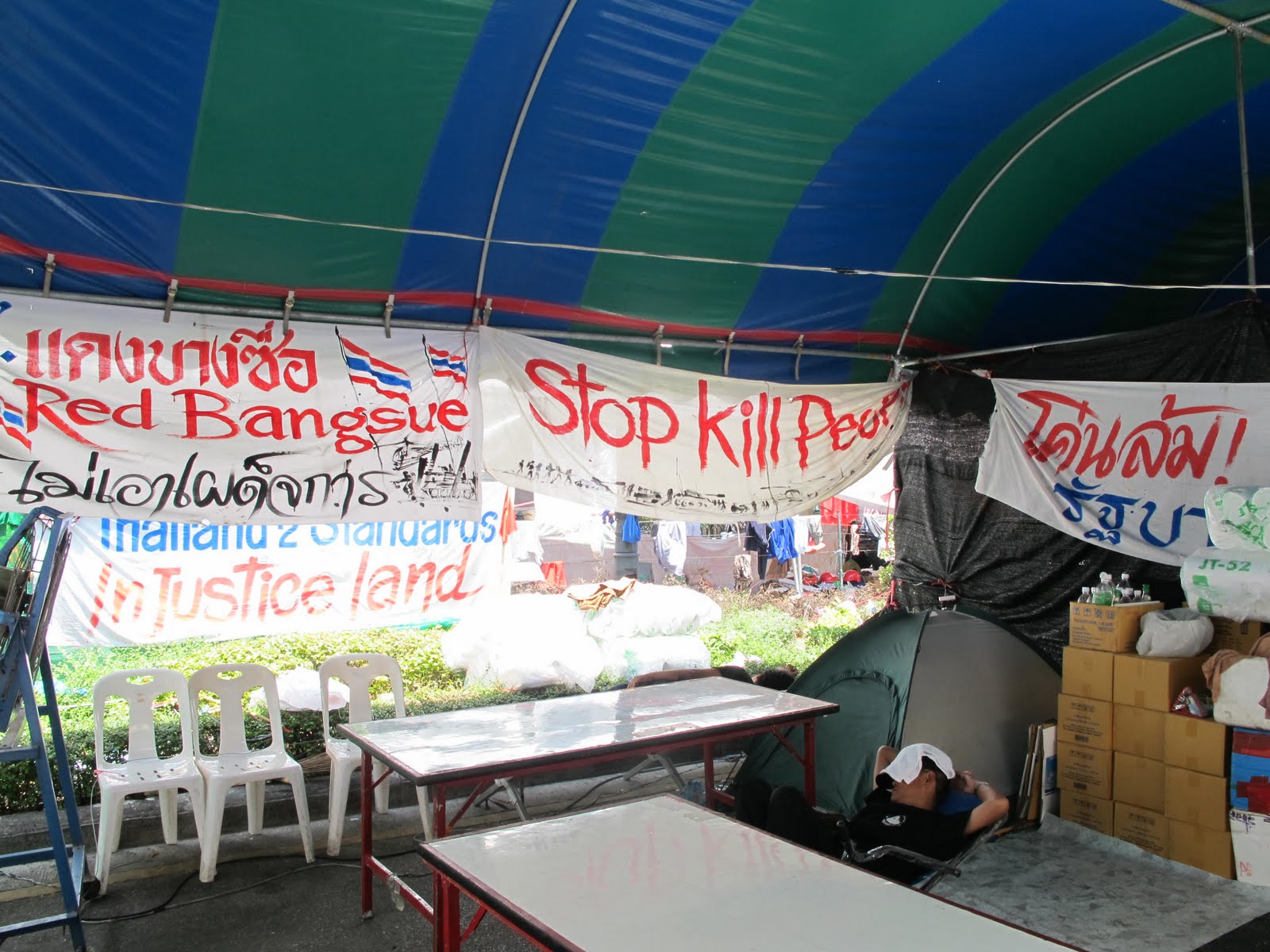
When I wrote about living with uncertainty a week ago, I had no idea how fast uncertainties could multiply. This past week has been a roller coaster ride out of control. The impact of Bangkok's political troubles on me, however, has been minimal compared to the sufferings of the 52 that died and over 400 injured in six days of street fighting. Since the military dispersed the anti-government demonstrators from the city center on Wednesday morning (with less than feared casualties), angry mobs have torched over 30 buildings in the city and town halls in several provinces. I watched from my 9th floor window as plumes of smoke rose over the Bangkok skyline. Transportation remains extremely limited and many stores and banks are closed. We've had two nights of curfew that silenced the city. Birds could be heard singing before dawn this morning.

During the Battle of Bangkok I remained mostly rooted to my couch, watching the often horrifying scenes unfold over Thai TV without understanding much of the commentary. Twitter has become the news source of choice for instant comment on dangerous events, although the wild rumors often outweigh verified facts. I regularly read the tweets of several dozen people in Bangkok, many of whom were in the midst of the fighting and sent out incredible photos from their mobile phone cameras. I used Google Reader to keep track of over thirty bloggers in Thailand and the local English press, and these sources along with twitter often provided links to important articles in newspapers and online sites all over the world. On Facebook I frequently posted comments and links to numerous stories and coverage of events. Many videos of the fighting were instantly available on YouTube. The journalistic output was astounding and overwhelming, as was the plethora of incredible photos available online of the action on the other side of the Chao Phraya River not that far from my apartment.

Because so much as been written and photographed, I won't attempt a synthesis, or add my two cents worth to the chronology. In the videos I've seen of the fighting, sometimes there are more press photographers and cameramen with their green arm bands than combatants. Bangkok has been a magnet for prominent conflict journalists who roam the world looking for trouble. With digital photography and cell phones, everyone today can be a journalist. But it's also very dangerous. Several reporters and photographers have been injured or killed while covering the anti-government protest in Bangkok since the first major battle with fatalities on April 10th. Many rumors claim journalists are even targets, some say of the reds and others blame the military. One of the first buildings set on fire was television Channel 3 even though their coverage has been relatively balanced, and the staffs of The Nation and Post were evacuated from their buildings due to the danger.

Despite the widespread news coverage of events in Bangkok since the protest started on March 12th, it's hard to know whom to believe. Thai politics and social relations are so complicated that nothing is what it seems. "Black shirts" or "third hand forces" have been blamed for the deaths of five soldiers on April 10th and for numerous attacks since then by bombers and snipers. Although almost all of the 83 fatalities and over 1,800 injuries since April 10 have been civilians, the government continues to label red shirt factions as "terrorist" (as many as 500) and blame them for much of the killing. Why would reds kill reds? You might also ask why Thais would kill Thais, as many Thais are doing, and there are no easy answers.

Jerry is stuck in Sukhumvit and I doubt that I can travel across the city to visit him since the conflict area blocks my path and the military continues to restrict access. His wife wants him to take the train to their farm in Surin. But since the banks are closed, he can't get to his money. I have to take a van from Wat Mahathat to my university in Wang Noi near Ayutthaya this afternoon for a conference this weekend and hope that I encounter no difficulties. The Immigration Office is closed all week which gives me only a few days next week to secure a renewal of my visa and work permit. The skytrain and subway remain shut down, but if the power brokers have their way, perhaps the road in front will be cleared and Siam Paragon will open its doors this weekend. The curfew is in force again tonight, from 9 p.m. to 5 a.m., and the city's massage parlors, bars and strip clubs are in crisis. Tourists are fleeing for the flights home from Souvarnabhumi Airport and many are vowing never to return again to the city of angels.

For some, the supreme tragedy is the destruction of Central World, Bangkok's largest luxury shopping mall and the second biggest in Asia (top photo). It stood alongside the main protest site at Ratchaprasong, the intersection surrounded by five-star hotels, stores patronized by the wealthy, and several important Brahmin shrines. Before 9-11, it used to be called the World Trade Center. That name was changed along with a major facelift several years ago. Now the building is in ruins, as is a large Big C store across the street and Center One, a major shopping complex near Victory Monument. Some protesters were seen stocking up on HiSo supplies before the flames spread. While Bangkok residents and tourists bemoan the demise of this landmark, others comment on twitter and Facebook that the many deaths and injuries were more important than a palace to consumption, and that those who value buildings over people are misguided at best.

I was a supporter of the red shirt cause as I understood it, true democracy in Thailand and an end to double standards. I've read enough about Thaksin Shinawatra to believe that he was an unsavory politician who made his fortune feeding from the public trough. But he wisely empowered people in the north and northeast of Thailand to believe they could have a stake in running the country. A military coup in 2006 and several dubious court decisions disenfranchised them, taking away the results of several elections. The current administration of Prime Minister Abhisit is a minority regime of royalists and militarists with the backing of the fascist yellow shirts who closed down the airport during their street demonstrations in 2008 (and were never punished for the damage they caused to Thailand). But when the Bangkok demonstration began in March I had a bad feeling about it. While the stated goal was simply new elections (which the reds were certain they would win), it didn't seem to me that confrontation with the military could ever succeed. Thailand's enemies are mainly internal and the military, a regime unto itself, is very well armed. I suspected that the real goal was to create martyrs in an attempt to sway the middle class in Bangkok to their side.

While there are now plenty of martyrs, the reds, perceived by many in Bangkok as ignorant rural savages (racism is linked to skin hue in Thailand), made numerous tactical errors that have angered their potential supporters as well as allies whose jobs were lost when the rally site among the shopping malls was selected. No one likes their lives disrupted for no clear reason, and although early on the reds engaged in several symbolic actions that brought a degree of visible support throughout the city, the long shutdown of business and facilities only increased the perception that the country was invading the city and the privileges of the better classes were threatened. This destroyed any hope of a compromise between the pro-democracy movement and the middle class who were active in the political demonstration of 1992. The government's spin doctors increasingly succeeded in isolating the reds as "terrorists" and enemies of the monarchy. By the day of the crackdown May 19, few were willing to stay the hand of revenge.

It's hard to know what will happen next. Certainly the roads will be cleared and cleaned of any evidence that the reds were there. The malls still standing will be opened, and those destroyed will be torn down and rebuilt, for Bangkok thrives on tourists who need their shopping fix. Pockets of rioters will probably continue to harass the authorities in Bangkok, but sabotage no longer has any achievable aim other than mindless destruction. At their peak, perhaps 200,000 participated in the red movement in Bangkok with many more supporters back home or working in the city and unable to take part. It's hard to know whether the government will engage now in reconciliation or revenge. Abhisit's spokesmen take over the TV airwaves frequently to announce milestones in their witch hunt against terrorists, the finding of hidden arms and financial restricts for suspects. The red leaders are in jail and some will be charged and tried for terrorism which carries a death penalty. It's certain, however, that the rage against the regime will simmer in the provinces and in the sois of Bangkok. Unless someone seriously engages in diplomacy and compromise, the Battle of Bangkok will begin to look like the beginning of a civil war in Thailand.

And yet...I continue to love my life and the people here. They deserve better. While I'm angry at the mobs rioting in the streets, I feel I understand their discontent and rage and sympathize with what I saw as the long term goals of true democracy and an end to double standards. Some have pointed out that the red movement never had a political program, and some splinter groups were homophobic thugs like the reds in Chiang Mai who forced the cancellation of a gay pride parade. Maybe the two-month campaign in Bangkok was just too simplistic. But it spoke to the rising expectations of a disenfranchised group of Thais, perhaps even the majority. So its call must be heeded by the powers that be here or the future will be very uncertain (and this is where we began).

Thursday, May 13, 2010

Losing Control and Loving Life

A good friend with serious age-related physical problems bemoans that “it gets harder and harder to keep control--health, money, body, sanity.I fear death. But more I fear being immobile, flat on my back, unable to move, paralyzed for some reason.” Without being in control of our lives, he seems to say, we are little more than a lump of meat, subject to the whims of others. Freedom is movement under our own steam. I responded that, “in many ways, I'm more fortunate than you. I may be long in the tooth, have prostate cancer and arthritis, weird skin growths and heat rashes, and I may be overweight with sagging pecs, a knee that threatens to blow, high blood pressure that reddens my face, and a libido that needs chemical assistance, but I still can walk and am fairly mobile.” Nevertheless, I too experience the suffering and anxiety that comes from a lack of control over my life.

Daily existence in Bangkok is good practice in living out of control. Uncertainty -- learning to live without knowing what comes next -- is the norm when the lingua franca is strange, street signs are unreadable, and cultural values go against the grain. I’m continually off balance at my university where the bureaucracy seems inefficient and Byzantine, and my requests for information are often ignored or misunderstood; only in the classroom with my monks eager to learn English do I feel at home. This is the time of year for gathering documents from the school to renew my working papers and I still don’t know if I’ll make the deadline on time.

In addition, I may be forced to make a quick trip to California to resolve financial and legal issues that threaten my retirement income, something I mistakenly believed was perfectly safe. This comes only a couple of weeks before the start of the new term and this year I’ve agreed to teach both 3rd and 4th year undergrads, four classes a week at two different locations. Preparation will be the key to making everything run smoothly. On top of all this, I was invited to serve as secretary for a panel on “Global Recovery through Buddhist Ecology” at the 7th United Nations Day of Vesak celebration co-sponsored by my university, which begins in 9 days time. Even though Thailand is currently having a heat wave, with temperatures as high as 40 Celsius/104 Fahrenheit, I feel like I’m skating on thin ice.

The idea that it couldn’t be otherwise, that existence is inherently uncertain, is strangely consoling. If total control is an impossible dream, then we can’t be faulted for failing. The Buddha taught that impermanence -- the fact that nothing created can last -- is one of the three characteristics of life. “At the heart of Buddha’s awakening,” writes Stephen Batchelor, my current favorite Buddhist teacher, “lies a counter-intuitive recognition of human experience as radically transient, unreliable, and contingent.” Accepting that this is so is nirvana, the blowing out of the fire of existential discontent. “Embracing contingency,” explains Batchelor in Living with the Devil: A Meditation on Good and Evil, “requires a willingness to accept the inexplicable and unpredictable instead of reaching for the anesthetic comfort of metaphysics.”

Metaphysics” is a code word for Batchelor which represents the view that pleasure can be prolonged indefinitely, pain can be avoided, and the eternal soul within and the omnipotent god without are all that matter. It is the fantasy of a non-contingent reality where truths are eternal and absolute. The Buddha’s awakening, he writes, “is only intelligible as a response to the diabolic contingency of the human condition.” Batchelor once called the absence of metaphysics agnostic and/or secular, but now confesses that his Buddhism is atheist in a new book with that title, and describes his interpretation as “theology without theos.”

The other two characteristics of our experience, the Buddha taught, are the all-pervasiveness of suffering and the absence of a self. Suffering ranges from the natural (birth, sickness, death) to the self-imposed, particularly the pain we feel when our hopes do not come true or when our life spins out of control. The self that Buddha denies is the metaphysical self, the eternal soul separate from the physical body that incarnates briefly and survives death. But rather than dismiss the self as a fiction, he presents it as a “project to be realized.” Batchelor describes this as a “performative conception of self” which allows for freedom of choice and hence an ethics. “The self is thus neither nonexistent nor eternal but created by one’s acts,” he writes. It’s not a fixed thing or personal essence, but “a tentative and confused story hastening towards its conclusion,” what Batchelor calls in his more recent book a “functional, moral self that breathes and acts in this world.” And one of its acts that can result in awakening to the non-metaphysical truth of existence is to embrace that very lack of control that seems to declare our impotence.

Batchelor’s Buddhism sets the doctrines of karma and rebirth aside and focuses on living this life, awake and aware. This is an approach I like despite his critics who cry: “Heresy!” “Rather than seek God – the goal of the brahmins, “ according to Batchelor “Gotama suggested that you turn your attention to what is most far from God: the anguish and pain of life on this earth…To embrace the contingency of one’s life is to embrace one’s fate as an ephemeral but sentient being. As Nietzsche claimed one can come to love that fate.”

“Heresy is the way to salvation!” In Batchelor’s recent book I learned of the British Anglican clergyman and retired Cambridge professor who makes this startling claim. “I have a greater affinity with Don Cupitt than with any living Buddhist thinker, Batchelor wrote in Confession of a Buddhist Atheist. I’ve just finished Cupitt’s slim 2008 volume, Above Us Only Sky: The Religion of Ordinary Life, and it’s a bomb thrown into the heart of institutional religion. “The only religion that can save you,” Cupitt writes, “is one that you have made up for yourself and tested out for yourself: in short, a heresy.” He adds, “On the day this book is published, I call finally and sadly terminate my own lifelong connection with organized religion.”

Cupitt the ex-priest, more than any other thinker I’ve read, brings religion down to earth. The task of religion, he writes in Above Us Only Sky, “is to give us the courage and strength to commit ourselves wholeheartedly to life. Only we create the world, and only we can redeem it. By solar love of life we can inject meaning and value into life for everyone.” What he calls “solar living,

teaches us to accept one-way linear time, life’s contingency, and death, without complaint. Instead, we should cast ourselves heedlessly into the flux of existence. We should burn, burn and burn out with love for life, a love that tries so far as possible to be everywhere affirmative, and nowhere allows itself to be turned into disappointment, resentment and hostility.

I will leave aside his devastating critique of the world religions, which he believes rely on metaphysical fantasies to keep their followers in chains, and just briefly mention the 27 brief slogans in 7 sections that preface the book, Cupitt’s “short systematic theology of the religion of life” which he claims is already in place (he hints that it might be what was once called “The Kingdom of God”). He says it’s what people the world over, and particularly post-Christians, already believe. Despite “The Limits of Life” (section 3), “we should simply love life and say Yes to life until our last day.”

My friends and I are suffering the inevitable indignities of old age and are fearful of the vagaries of events. I haven’t even mentioned the troubling political conflict in Thailand that threatens at any moment to spin out of control into civil war. “There is no stable real world and no enduring real self,” Cupitt says, and “our world is our communal, partly-botched work of folk art.” Despite this apparent nihilistic view, “this situation is not one for despair: it offers us the freedom to remake ourselves and the world.”

I know that this is true, that creative expression in the service of loving life can lift concern over losing control of the consequences of our actions . I find my outlet in writing this blog; my friend with the severe physical disabilities continues in spite of them to write brilliant short stories, essays and books, his fertile imagination constantly at play. Cupitt is right: “Continuous letting-go and renewal creates joy.”

Tuesday, May 04, 2010

A Cooling Off Period

We left overheated Bangkok for the hills and waterfalls of Kanchanaburi province on Saturday morning and found a brief respite from the stress of political uncertainty in the waters of Erawan Falls. Scads of holidaying Thais joined us on this three-day (Monday was Labor Day) weekend.

The trip was a treat for Nan's brother Nok who has been visiting us. Most of the time he stays in our room, playing his guitar and talking on the phone with his girlfriend back in Phayao. If he were home during this school vacation, Nan says, he would be required to work on the farm. So he's happy doing nothing in Bangkok. Surin, his sister Ann's boyfriend, drove us to the mountainous province on the border of Burma, three hours northwest of Bangkok. Thankfully, we skipped the "Bridge Over the River Kwai" (a reconstruction for tourists) and the controversial Tiger Temple, and headed for a couple of scenic temples before stopping at a government guest house near Srinagarind Dam in the Erawan National Park.

Wat Tham Seua (Tiger Cave Monastery) and Wat Tham Khao Noi (Little Hill Cave Monastery) are cheek-by-jowl on a pile of rocks not far from the Mae Khlong Reservoir at the confluence of the Khwae Yai and Khwae Noi rivers (prounced "kway" rather than "kwhy"). We took a cable car to reach the top but had to hike up another nine floors in the chedi to appreciate the impressive view of the surrounding countryside. While both temples are Buddhist, Tiger Cave follows the Chinese tradition (Mahayana) and the other one is Thai (or Theravada). It was brutally hot and we passed up a visit to the caves which required yet another climb. Everyone paid their respects to the large golden Buddha while I took photos of the architecture and religious images. A half dozen large tour buses had disgorged hundreds of pilgrims just before we arrived, but by the time we left they were all gone. Surin took us to a waterside restaurant for a feast of fish, sheltered from a passing shower.

We checked into the government guest house which is owned by the Electricity General Authority of Thailand (EGAT) and features a conference facility, a large garden, and many other amenities. You have to know someone to stay there (I saw no other Westerners or signs in English) and Surin is a regular. Some of his old friends were there, and, since he is married, I was asked to pose as the ajahn, Nan, Nok and Ann's English teacher, to provide cover (he and Ann have been together for four years). We had a lovely house with three separate bedrooms (each with toilet and shower). It was a short walk down to the reservoir, but the water was low due to the current drought. Srinagarind is one of the largest dams in Thailand and provides electricity to Bangkok (we couldn't visit the dam because guards were worried about red shirt sabotage and blocked access to the public).

The next morning we drove the short distance to Erawan Falls which consists of seven separate waterfalls. It was a good hike in from the parking area and we settled on the 3rd waterfall as our destination. Hundreds of Thais and a sprinkling of Westerners chose likewise, bringing children and carrying water toys and provisions of food. On the walk in we saw warnings about snakes and "fierce monkeys" but never saw either, to my disappointment. At the pool I quickly realized where the current craze of fish spas as an adjunct to massage parlors got its inspiration. Tiny fish (and some not so small) immediately began nibbling on our feet and legs. It was a regular piscine banquet. Negotiating the rock and root shoreline was not easy for me, now that my balance is challenged by age. But the crowded water was delightful and I stuck my head under the falls to get a mock shampoo. Surin dozed while resting in the water and the rest of us played and took photos.

Getting away from the strife was restful. Nan has noticed that the computer connected to the internet is my cocaine, my yaba (Thai speed). I am addicted to twitter and Facebook and depend on them to know what's happening, in Bangkok and far away. But I found it quite easy to let the computer go and even enjoyed its absence. We ate well and I found rural and hilly Kanchanaburi reminiscent of the Sierras in California. This was my second trip to the area, the first a meditation retreat at a riverside resort several years ago. Along the highway to Erawan park, I saw many large and colorful boulders on display for sale, some of them carved. Not marble, Surin said, and Nan told me the rocks were "bombed" out of the hills. I saw many mounds with huge gouges out of them. Apparently the ubiquitous round tables with benches can be shaped from the stones. The trip home Sunday night was quick, for Surin is a fearless (and scary) driver. I noticed how difficult it is for me to give up control, but in Thailand it is a constant practice. And of course I turned the computer on as soon as I got home.

The day before our trip, I visited the areas of central Bangkok controlled by the red shirts. First I took the Skytrain from the river to Chid Lom and got off to examine the barricades set up there and a block east at Phloem Chit. Dr. Holly lives nearby and I dropped in on her for coffee and conversation before heading several stops east on the BTS to Kinokuniya at the Emporium for some book browsing (what I wanted was in stock but missing and could not be found). The Emporium is getting all the business lost by Siam Paragon and Central World several blocks away which have been closed by the protest. From there I returned to Chid Lom and descended into the red encampment. It was midday and hot, so the presence of protesters looked sparse until you examined the shady areas. On the stage singers entertained the crowd with Thai folk music. My last visit to the red city was before we went to Krabi, before the violence began. Since then, 26 people have been killed and more than 1,000 injured in several incidents. Pictures of the martyred red shirts were everywhere, on the stage backdrop and at improvised shrines throughout the encampment; the one of the woman with half her head blown off is especially gruesome. But, as before, I found the protesters to be friendly and high-spirited. Thais do everything in a spirit of sanuk (fun), even what some have called the beginnings of a civil or class war. Food and revolutionary artifacts were on sale everywhere. And although the demonstrators no longer exclusively wear red, that color was dominant in the landscape.

I walked from Rajaprasong, the intersection where the main stage is located (and an area filled with five-star hotels and luxury shopping malls, all closed now) down Rajadamri Road, past Lumpini Park where many reds were resting under the shady trees, to Rama IV Road where a large "Mad Max" barricade with tires and sharpened bamboo sticks separates another red encampment surrounding the Rama VI statue from the business district of Silom. All of the long road is occupied, a virtual tent city, with many people resting in the shade of the overhead Skytrain track. I saw people selling food and eating it, playing checkers, getting their photos taken for official red ID cards, and selling souvenirs like sandals bearing the photos of government enemies. There were slingshots for sale with bags of marbles for amunition, and piles of rocks on the sidewalk ready for throwing when necessary. There were monks in a portable temple receiving tam boon, and I saw another monk hosing off a hospital tent to keep the patients inside cool. Walls and signs everywhere were covered with graffiti I couldn't read as well as personal photos, photos of the martyrs, and of Saint Thaksin and his nemesis, Abhisit, looking a lot like Hitler. A demonstration this large must take incredible organization. I saw large containers of potable water and enough basic provisions for an army. And I saw a pile of portable toilet seats, apparently unused, and long lines of port-o-potties to take care of the needs of this small city. I also noticed there were many elderly people and numerous children which must give pause to the authorities who wish to forcebly remove this revolutionary installation.

Last night the Prime Minister announced that he would call for elections in six months, on Nov. 14. It's a slight compromise from previous statements and indicates that negotiations might be continuing in secret despite recent bellicose pronouncements of government agents warning that a crackdown was imminent. Also worrying is the government's claim to have uncovered a conspiracy to overthrow the monarchy, a desperate maneuver reminiscent of McCarthyism in America. Even so, there is some small sign of hope that the current impasse may be resolved. Today I am going to a luncheon meeting at the Foreign Correspondents Club to hear a discussion about the current crisis led by Dr. Thitinan Pongsudhirak, a respected scholar whose newspaper columns have been impartial and insightful. He is returning from a stint at Stanford. The FCCT clubhouse is high above the Rajaprasong intersection so I'll get another look at the encampment this afternoon.

Thursday, April 29, 2010

Does Thailand Need a Superhero?

How is comic book action like a war? I went to see "Kick-Ass" (above) last night to escape the gloomy news yesterday of a soldier killed by "friendly fire" in a battle with anti-government forces in a northern suburb of Bangkok. It's a film about the impact of comic books on an impressionable teen who yearns to be a superhero despite the absence of any real powers. So he begins his adventures by buying a colorful wet suit and mask from eBay. And he gets hurt. It reminded me of the scenes this week of soldiers in their helmets and camouflage outfits and the police in their Robocop suits carrying plexiglass shields, many with guns, and I wondered about the impact of violent and bloody Thai action films (its most popular genre) on their expectations of war.

Real war, as writers tell us and photographs depict, is hell. The above photo shows one of the injured after several grenades exploded near a crowded Skytrain station last week. As of this morning, 26 people have died and over a thousand were injured in several violent episodes over the last 19 days. Tens of thousands of security forces face off against tens of thousands of demonstrators occupying nearly five kilometers of streets in central Bangkok where they are protected by large "Mad Max" barricades of tires and sharpened bamboo sticks. For many days, the newspapers and internet have predicted a sure-to-be bloody crackdown on the protesters' encampment which would certainly spark a civil war throughout the country.

"Kick-Ass" is an enjoyable and fast-moving farce on many levels, but it begins with the premise that in an imperfect world (the hero-to-be lives in a very gritty neighborhood of New York City where he is routinely mugged), we are encouraged to believe in saviors like the ones we see portrayed in comic books, on TV and in films. In a world of bullies and gangsters, we feel someone has to stand up and eliminate the bad guys. Outside of our cultural fantasies, this mantle of a righteous savior was most consciously adopted by George W. Bush and his gang of crusaders who waged war on the "Evil Empire" by invading Afghanistan and Iraq, and whose successor, Superfly Obama, is poised to punish Iran for being uppity. In Thailand there are many heroes lined up to save the country, from Prime Minister Abhisit and PAD (yellow shirt) leader Chamlong to the UDD (red shirt) panel of leaders -- Veera, Nattawut and Dr. Weng -- as well as numerous looser cannons like Seh Daeng and Arisman.

In "Kick-Ass," the pretend superhero, awkward Dave, meets the real thing in 11-year-old Mindy (aka Hit Girl) and her trainer/father Damon (aka Big Daddy), a disgraced cop out to get revenge on the gangster he blames for putting him in prison and the suicide of Mindy's mom. The foul-mouthed Mindy was raised to kill and she slaughters numerous rooms full of bad guys before enlisting Dave's help in the finale. Manohla Dargis at the NY Times says the film "at once embraces and satirizes contemporary action-film clichés with Tarantino-esque self-regard — it’s the latest in giggles-and-guts entertainment." The distinguished Roger Ebert called it "morally reprehensible." Dare we suggest that it's just a film of what began as a comic book which takes the influence of comic book morality seriously?

I won't pretend to know what Thais read but I know that action TV dramas and films and stories about evil ghosts are extremely popular, and I've seen many people reading cartoon and manga books on public transport and in cafés and restaurants. There are two ways that young Thais who can't afford to go to college can escape the country's pervasive poverty: join the military or police, or become a monk. Most soldiers are conscripted (I expect the wealthy can buy their way out of service). Aside from a long-lasting violent Muslim insurgency in the south, the Army has it easy with relatively stable borders and no outside enemies. I doubt that soldiers receive much training in crowd control (the last riot was 18 years ago). They are very well-equipped because of the bloated military budget (much increased after the 2006 coup) but untrustworthy since it is believed many are "watermelons" (green outside but with red sympathies within). Some say there is enmity between the Army and the police. The bloody battle April 10 was a rout for the misguided troops; some were even captured by the stone-throwing reds and their weapons and uniforms confiscated. Most of the dead and injured that night were civilians, but a mysterious group of "men in black" targeted a troop command post with deadly accuracy and some believe it indicates rebellion in the ranks (the reds denied they used lethal weapons). The explosions in Silom were likewise apparently committed by a shadow "Third Hand." The government claims the reds did it, and put in charge of the investigation a forensic "expert" who recently touted the value of fake bomb detectors purchased by the military for an outrageous sum.

Yesterday a caravan of 2,000 red shirts (actually, they have abandoned red now for a less identifiable pallet of colors) on their way to meet supporters in a northern suburb were met by a large force of soldiers and police who blocked the road. Without warning they fired live rounds as well as rubber bullets into the crowd, injuring 19. Protesters threw stones, shot metal balls from sling-shots and launched fireworks in response. The soldier killed was riding a motorbike toward police lines when he was shot and another was wounded. The battle was cut short by a torrential tropical storm and the red caravan retreated to central Bangkok. In videos shown on TV last night, those with guns can be seen firing wildly. There seems no organization or method in the violence, just as on April 10 when soldiers attempting to close down a protest rally site got caught in their own tear gas and fired their guns aimlessly while retreating. I watched it on live TV and it was not a pretty sight. But I also want to consider the mind of the young cop or recruit who has little knowledge of war beyond cartons, movies and video games. The Thai Army is top-heavy with generals but apparently few officers schooled in leading their troops.

In an amazing serendipity, the nemesis of Kick-Ass in the film is another amateur superhero who calls himself Red Mist. He's the nerdy son of the gangster HG and BD want to put out of business (by dramatically killing all employees and their boss). Although this isn't intended as a film review, he's played with aplomb by the delightful Mclovin' from "Superbad." I say "serendipity," because the day before the Times of London ran an editorial about Thailand headlined "Red Mist" in which it was argued that "
Mr Abhisit must accept the Red Shirts’ proposal of new elections in three months, a wholly reasonable proposal that he rejected out of hand." According to the editors "He must acknowledge that he has become part of the problem, and step down immediately — not for exile, as the Red Shirts demand, but for an honest fight at the ballot box." In "Kick-Ass," Red Mist survives to, no doubt, appear in the sequel. If Abhisit resigns, I doubt he will be back, and that's probably the root of his stubbornness (when in opposition, he urged the government, faced with yellow shirt protests which closed the international airport, to do what he refuses to do now).

Unfortunately, there are no superheroes at the moment in Thailand. Abhisit gave interviews yesterday to CNN and BBC in a unconvincing attempt to make his intransigent position seem reasonable to an international audience. At home he has smeared red leaders and the opposition Puea Thai party with the anti-royal brush, claiming that they are involved in a conspiracy to topple the monarchy. It's the ultimate card in Thai politics, and can justify any sort of repression against the nation's enemies (many are comparing it to 1973 when protesting students were beaten, slaughtered and lynched, as seen in videos currently available on YouTube). It reminds me of the reprehensible McCarthy and the witch hunt for un-Americans. On their side, red leaders here constantly vilify their enemies from the encampment stage, comparing Abhisit to Hitler and worse. Chamlong and his yellow shirts, whose street campaigns brought down Thaksin and his successors, has warned Abhisit that his group will soon take matters into its own hands if the Army cannot end the red rally.

Saturday, April 24, 2010

Human Kindness is Overflowing

It's raining in Bangkok in the early morning today, something not all that common for this time of year. I can see dark clouds over the city from my 9th floor window. Lightning strikes unexpectedly close by and thunder rattles the walls. When it rains here, it really pours, but not for all that long. I love it. I stick my head out the window and let the downpour give me a shampoo.

Broken windows and empty hallways
A pale dead moon in the sky streaked with gray

No one writes bittersweet lyrics better than Randy Newman. He hands you strong medicine and gives you a sweet melody to wash it down so you don't notice the taste. Whether writing about slavery ("Sail Away"), short people, rednecks, consumption ("It's Money That Matters"), Hurricane Katrina ("Louisiana 1927"), the final solution for an ungrateful world ("Political Science"), a polluted river ("Burn On") or the U.S. Empire ("A Few Words in Defense of Our Country"), Newman stands the truth on its ironic head. What would he have to say about the mysteries and illusions that plague Thailand now?

Scarecrows dressed in the latest styles
With frozen smiles to chase love away

I can add nothing new to explain the political troubles here that have claimed more than 25 lives and injured nearly a thousand protesters, soldiers and innocent bystanders since the military's botched attempt two weeks ago to close down the anti-government red shirt rally that began March 14. Army Gen. Anupong has apparently refused to remove the demonstrators whose encampment has paralyzed the shopping and business centers of the city. He's in favor of a political solution to the standoff but the politicians seem incapable of solving anything. An emerging pro-government movement, led by the same yellow shirts who occupied Parliament for four months and closed Bangkok's airports in 2008, gave Prime Minister Abhisit seven days to end the demonstration or else (the deadline is tomorrow night). Many countries have issued travel warnings for Bangkok and the tourist industry is in the toilet. Last night, however, there was no reported violence and today the wet weather must be putting a damper on the conflict.

Lonely, lonely
Tin can at my feet
Think I'll kick it down the street
That's the way to treat a friend

Since returning from our vacation a week ago, I've stayed close to home. The areas of trouble are a good distance away, even though I can spot the tall buildings around Silom and Ratchaprasong from my window and watch the military helicopters when they fly over on observation missions with my binoculars. Last Thursday night the Foreign Correspondents Club held a panel discussion on the crisis and a fellow expat asked me to join him there. But the FCCT is located on the top floor of a building in Chid Lom close to the main gathering of red shirts and a stone's throw away from the stage where a procession of speakers have inspired their forces for several weeks. Going there seemed risky to me, and I used Nan's fears for my safety as an excuse to stay home. Sure enough, just as the meeting was scheduled to begin, several grenades exploded near the Sala Daeng Skytrain stop in Silom where a secondary confrontation was taking place between red shirts behind an improvised "Mad Max" kind of barricade and a large group of yellow shirts throwing bottles and stones at them from across the street. There were numerous casualties, including the death of a Thai woman.

Bright before me the signs implore me
To help the needy and show them the way

No one knows for certain who lobbed the grenades or from where, although the government spokesman said they came from behind the red barricade and the reds claim that a "third hand" force is trying to frame them. Silom was crawling with soldiers providing security who saw nothing. The same mystery envelopes the April 10 shoot-out when most of the casualties were red shirts. Who shot who, why, and and from where, cannot be answered convincingly for everyone, even though a movie actor tenuously connected to the reds has been arrested and has apparently confessed his involvement at the behest of red leaders. Too often significant crimes remain unsolved and unpunished in Thailand. No yellow shirt has been prosecuted for the chaos they caused in 2008, no culprits have been nabbed for a month's worth of random (and, until this week, harmless) bombings around Bangkok, and even the attempted assassination of yellow leader Sondhi Limthongkul was never solved. Thailand has an extremely well-funded and equipped police force and military (despite few external threats), and yet they seem incapable of maintaining a rule of law.

Human kindness is overflowing
And I think it's going to rain today*

The bombings in Silom confirmed my worst fears. I was certain that it was the beginning of a civil war. I was more afraid of the yellow shirts (hiding behind a "multicolor" banner) than the numerous security forces. Composed of mostly the discontented middle class from Bangkok, they are threatened by the uppity protesters and appeared belligerent and angry on the TV news, carrying signs and yelling impolite slurs (comparing the reds to water buffalo, lizards and other animals, the equivalent of "nigger" in America) at the darker-skinned invaders from the provinces who now proudly refer to themselves as "phrai" (peasant). Some commentators believe the royalist yellow shirts are guilty of fomenting violence in order to provoke a military coup that will preserve rule by the privileged Bangkok elite. They have openly advocated increasing the non-elected portion of government. What a contrast with the United Front of Democracy Against Dictatorship (UDD), the red shirt organization, which actually lives up to its name by advocating democracy! The UDD wants to increase elected representation and is calling for a new election to undo to the damage to democracy caused by the illegitimate 2006 military coup that overturned an elected government.

If I were not with Nan, I would probably engage in more risky behavior, but now I know that she worries about me, understandably. Several westerners were injured in the Silom blasts. On Friday my monthly political discussion group was holding an urgent meeting in Sukhumvit across the city. I've been a faithful participant for six months. It would require me to cross through or over the demonstration sites, at least the main one in Siam. So I declined. By yesterday afternoon, it was apparent that all was quiet, negotiations were rumored, the military was not going to begin a crackdown against the demonstrators, and I felt like a wimp for not attempting to join my friends. Second-guessing is a foolish taskmaster.

*I prefer the version by Nina Simon, but others, by Newman himself, Judy Collins, Bette Middler, Joe Cocker, Dusty Springfield, and, more recently, Norah Jones, are also fine.

Monday, April 19, 2010

The Power of Water

Nothing under heaven is as yielding as water.
And yet in attacking the hard, the unyielding,
Nothing can surpass it. Nothing can take it's place.

--Tao Te Ching (trans. by Sam Hamill)

Three days after the bloody clash between soldiers and anti-government protesters in Bangkok, tourists and Thais were throwing water at each other on Khao San Road, a block away from the intersection where over 20 people died and more than 800 were injured. The battle with water was a celebration of Songkran, the traditional Southeast Asian New Year, when Thais splash water and colored powder on each other. The photo above was taken last Tuesday on the main drag of Ao Nang, a tourist destination on the Andaman Sea where Nan and I spent a very wet and wonderful week, with many ups and a few downs..

It was hard for me to leave Bangkok a week ago Saturday because the government had obviously chosen that day to remove the red shirted demonstrators from their rally at Phan Fa Bridge in the old city of Rattanakosin. On live TV, large numbers of troops could be seen moving toward the site in the afternoon. Although soldiers were supposedly supplied only with shields, truncheons, tear gas and rubber bullets, across from the United Nations headquarters some of them were pointing their guns at the crowd and one reporter showed where a real bullet had hit her car. The reds fought back with sticks, stones and water bottles. From my apartment window I could see a helicopter across the river circling above them. Thousands of red shirts at the other rally site in the heart of Bangkok's shopping center were in a tense standoff with police. But it was time to go.

The Southern Bus Terminal was filled with people waiting for their buses home. Most Thais who live and work in Bangkok have family elsewhere and they usually return home for major holidays: January's New Year celebration, Songkran, and Loi Krathong in November. Many like us choose to take a holiday. Plane, bus and train tickets sold out weeks ago. We ate in a packed food court while watching a Thai comedy on the overhead TV. I didn't bring my laptop with me and only learned about the bloody battle several days later from an English newspaper at Starbucks in Ao Nang. The last time I traveled to Krabi a year and a half ago, it was by plane. This time we took an overnight "VIP" 24-seat bus for about $29. The steward passed out water and snacks and it was relatively comfortable, but I was unprepared for the arctic air conditioning. The TV featured a bloody Thai historical video with the volume turned on high, but I blocked it by listening to the new Sade CD on my iPod. Around 11:30 were were awoken when the bus stopped at a huge restaurant to feed us a set meal along with hundreds of other travelers.

At the beginning and end of my first trip to the Andaman coast I stayed in the nondescript provincial town of Krabi but spent most of the 12 days on the islands of Ko Phi Phi and Ko Lanta. I visited Ao Nang only to take a long tail boat from there one morning to the beautiful landlocked Railay Beach. It's a town devoted to tourism but not obnoxiously so like Pattaya or Phuket, and it offered a variety of sea excursions like the two we took from Ko Samui. Two months ago we found Ao Nang Mountain Paradise on the internet and prepaid for six nights. After our early morning arrival, we found it in the shade of a large cliff. Our room was not yet ready so we set out for the beach and soon realized that it was a very long walk ("1 minute," claimed the web site). The pool was green and slick with algae. The shower handle was attached by gravity rather than a screw On our second night there, the electricity failed in several of the bungalows including ours. The apologetic night manager said it was a problem at the power plant but I suspected faulty wiring. After two hours in the hot dark battling mosquitoes, we rented another hotel room up the street. In the morning the electricity was back and we took our first speed boat excursion. That night about 10, the electricity gave out again. This time we told the embarrassed employee that we had to leave, and he told us to come back in the morning for a refund. It was too dark to pack, so we found another room and returned in the morning. The unsmiling day manager said refunds could be only given by the online agent. She said we would have to pay for the two nights we slept in another hotel since we left our belongings. I angrily refused to return the key when we left. Later she called my mobile phone and threatened to summon the police, so Nan took the key back. Our hotel for the next three days, Pranang Flora House, was exceptionally comfortable.

Fortified by 50 SPF sun block, Nan and I spent our days on the beach (in the shade where we could find it), in the surf and on board the speedboats operated by Baracudas Tours Krabi. We signed up for two trips, the 4 Islands tour on Tuesday and the Phi Phi Islands tour on Friday. The Andaman seascape is dominated by numerous karst rock formations that rise up out of the water, whether pillar or island. On the first excursion we joined an extended family from Trang, stopping first at Pranang Cave on the Railay peninsula where the local spirit of a princess is placated with phallic objects offered by fishermen hoping for a good catch. From there we traveled around Chicken Island (which looked more like a turkey to me) and stopped at a small beach where we had a set lunch in a tiny restaurant constructed from driftwood. At low tide, you can walk from that beach to the nearby Tup Island, our next destination, to snorkle and swim. Our final journey was to Poda Island with a wide white sand beach and shady trees inland.

It was Songkran and there were large crowds at every stop, almost all of them Thai (or at least non-European), which surprised me. All of the guests at Ao Nang Mountain Paradise had been Thai, while the two main streets of Ao Nang were filled with farang tourists and businesses that catered to their perceived needs (tacky souvenirs and identical beachware on sale in every shop). When our speedboat returned to the beach at Ao Nang, the Songkran festivities were in full swing. Revelers of all ages strolled the boardwalk, squirt guns in hand, and pickup trucks filled with Thais drove slowly, looking for likely targets on which to pour buckets of water. Two years ago in Chiang Mai I noticed that tourists love Songkran. There the watery holiday lasted a full week. In Ao Nang, only a few foreigners kept up their water fights the next day.

One sunset Nan and I discovered the Moon Terrace restaurant on a small beachfront alley where numerous places specialized in fresh seafood. The view was spectacular as we sat outside to eat on the deck. We returned again on our final night. If I were a Colman Andrews or an Ed Ward, two friends who specialize in writing about food, I could describe the dinners. Suffice it to say that each were divine. Early in the week we explored Railay with its magnificent beach on the east and mangrove-studded shoreline on the west. We sipped cold drinks at a restaurant with a view on the western hillside and watched students pulls themselves up the face of a nearby cliff at one of the many climbing schools in the Krabi area. In between island trips, we spread our mat on the ground in the shade of the treeline and enjoyed the main Ao Nang beach watching the tide roll out, from high in the morning to low in the late afternoon. Of course we occasionally worried about a possible tsunami, since Ao Nang was struck by the big one in 2004 (you can read about its impact on Ao Nang and see photos here). One day we walked to the southern end of the beach where there are numerous massage pavilions and each of us received a pummeling for 200 baht. And in the evening we had a delicious do-it-yourself barbecue dinner at a packed sidewalk restaurant (this is one form of Thai food farang can only find here).

Our final speedboat trip was to the Phi Phi islands, Phi Phi Don and the smaller and uninhabited Phi Phi Lay. It was a larger crowd which included a couple of farang, a bigger boat, and only one passenger threw up (a couple of them looked distinctly unhappy). I'd stayed a few days before on Phi Phi and found it small and crowded. Much had been rebuilt after the tsunami which was particularly destructive there. Our first stop was to go snorkling in the channel off Bamboo Island. The fish were abundant and the coral lovely in the turquoise blue waters. Next we headed with a fleet of tour boats to tiny Phi Phi Don with its hidden inlets, lagoons and beaches. Our first stop was Viking Cave (misnamed, obviously), now privately owned, where bird nests are collected for the famous soup. We continued on to Lohsamah Bay and Pileh Bay but the many boats made the water too rough for snorkling. Finally, the pièce de résistance, Maya Bay where "The Beach" was filmed. We were warned when the tour guide describe the beach as "a market."Numerous boats had anchored in the lagoon and hundreds of visitors milled around on the sand or in the surf. Many sought shade in the lee of a cliff. All were taking photos. Since it was high tide, there wasn't much of a beach. Back at home, I compared scenes from the film with my photos and saw that the filmmaker had hidden the entrance from the sea with a cg effect, but the lagoon, minus people, would be no less beautiful.

After a short trip to a remote side of Phi Phi Don where monkeys live in the trees along the shore, lunch was another set meal at a restaurant on Ko Phi Phi's Ton Sai Bay where the boats dock. Since we had 40 minutes to spare, I walked Nan through the twisting lanes of tourist shops to the lovely beach on Loh Dalam Bay. I doubt that any Thais vacation on Phi Phi. It's a backpacker's paradise, with bars, shops selling banana shakes and pancakes, and videos of American movies showing in the evenings. We stopped for drinks at D's Bookstore, much expanded now with a terrace on the other side, where I used to sip cappuccino and browse the book titles in the late afternoon during my last visit. Back on the boat, our final stop was Bamboo Island with its broad white beach and good snorkling close to shore. A group of Muslim girls were enjoying the water while fully clothed, head to toe. After more swimming, we ate absurdly high priced ice cream bars in the shade of a grove of pine trees before heading back to Ao Nang.

It was a wonderful vacation and eminently suitable for Songkran since we were wet most of every day. As the days lengthened, I began to suffer withdrawal from the internet and tried to catch up on the news that I'd missed with the hotel's computer. I found copies of Bangkok's English papers at the local Bookazine, but the news was old by the time I read it. Mysterious and unknown elements were believed responsible for the worst of the violence on April 10, whether rogue soldiers or renegade reds no one seemed sure. Abhisit called them "terrorists" and hinted them someone wanted to radically change Thailand's government (code for overturning the monarchy). The red shirts consolidated their demonstration at Rajaprasong, continuing the shutdown of five-star hotels and luxurious shopping malls, while the military positioned snipers in surrounding buildings. Arrest warrants were issued for red leaders but an attempt to capture a couple backfired and several of the police were held hostage. The fascist yellow shirts began a demonstration, first calling themselves people of no particular color and then yesterday demanding that Abhisit end the red rally or they would take to the streets again. The Prime Minister put General Anupong, the military commander-in-chief, in charge of ending the anti-government protest even though earlier the soldier had said that only a political solution was possible for the protracted conflict.

Back home, with swollen feet and ankles after another 11-hour bus ride, I watch the tweets from Bangkok closely and search the relevant blogs and web pages for news and information. It's hard to synthesize since events are moving rapidly towards some kind of a conclusion. I agree that only political negotiation can lead toward a settlement, but it seems obvious that the different sides are not willing to listen to each other. "In the facile political taxonomy we use to categorize nations, Thailand is considered a democracy," wrote one writer in Time Magazine. "Yet the country remains, if not a banana republic, a juicy, messy mango republic." Pavin Chachavalpongpun wrote this morning in the Bangkok Post, "Thailand has long lived in a fairy tale world in which the supposed ideal of perfection effectively eclipsed the huge differences and fragmentations in society." But he predicted that out of the current struggles a new Thai identity would emerge. The red shirts, he said, "are seeking to reinvent a national identity of their own. They are eager to reject the top-down process of identity making, while campaigning for a bottom-up way of how Thais should express their nationhood."

Water is powerful. The 2004 tsunami and the Grand Canyon are proof of that. Can Thailand's politicians learn from the wisdom of the Tao?

But the muddiest water clears as it's stilled,
and out of that stillness, life arises.

-Tao Te Ching (trans. by Sam Hamill)