Friday, September 29, 2006

How to Earn Your Wings

Communion Reflection

First Reading: Revelation 12:7-12AB
Responsorial Psalm: 138
Gospel: John 1:47-51:

Today, on this feast day of the Archangels – Saints Michael, Gabriel and Raphael – we are surrounded by angels.

Here in this mission chapel, an icon of St. Michael the Archangel looks over our heads at the work to be done. The other day I asked someone about that statue and was told it might be St. Catherine, although not the Catherine from Siena. Perhaps it was the long hair. But while researching the archangels this past week, I learned that Michael is usually depicted with a sword in one hand for driving the Devil out of heaven and the scales of justice in the other for weighing the souls of the dead on Judgment Day.

You heard of that war in heaven this morning from the book of Revelation. St. Michael, “captain of the heavenly host,” battles the dragon, who is also known as the Devil or Satan, and throws him and his army of dark angels down to earth. Today the readings are remarkably consistent on the topic of angels. For our responsorial Psalm, we declared: “In the sight of the angels I will sing your praises, Lord.” And in the reading from the Gospel of John, Jesus chooses Nathanael to be his disciple and tells him that he will see “the angels of God ascending and descending on the Son of Man.” What are we to make of all this?

Here is another angel. This one is a glass Christmas ornament like the one you might put on your tree. We instantly recognize this figure as an angel because of its wings and the halo, although our icon of St. Michael has neither. In the classic Christmas film, “It’s a Wonderful Life,” we hear that “every time a bell rings, an angel gets his wings,” and Clarence, the bumbling guardian angel, earns his wings by helping Jimmy Stewart to discover how precious his life is.

Hollywood and Hallmark have constructed many of our modern images of angels. According to one book I read, one out of every ten pop songs has the word “angel” in its lyric. Millions of TV watchers were “Touched by an Angel” during its long run and, years before, by “Charlie’s Angels.” Before he published The Da Vince Code, Dan Brown wrote another best seller called Angeles & Demons, and Tony Kushner’s Pulitzer Prize-winning play, “Angels in America,” featured an angel who ministered to a dying AIDS patient. A Time magazine cover story on angels a few years ago said that over
70 per cent of Americans believe in their existence. But New Age authors and artists have largely trivialized the messengers of God. According to Time, “The terrifying cherubim have become Kewpie-doll cherubs. For those who choke too easily on God and his rules, angels are the handy compromise, all fluff and meringue, kind, nonjudgmental. And they are available to everyone, like aspirin.”

But the angels in our Scripture are not always so cuddly. For the German poet Rilke, every angel “is terrifying.” They punish and execute judgment in Ezekiel and Revelation. These angels call us to obedience and worship, and to sacrifice and service. The angel Gabriel’s announcement to Mary forever transformed her life. When Jacob in a dream saw a ladder with angels ascending and descending between heaven and earth, he was afraid, crying out: “How awesome is this shrine! This is nothing else but an abode of God, and that is the gateway to heaven!” Jesus uses this image in the reading today, but he himself is the ladder on which the angels travel, linking heaven and earth.

Our Catechism tells us that existence of angels is a “truth of faith” based on the “witness of Scripture” and the “unanimity of Tradition.” The angels do, indeed, surround us. According to St. Augustine, “angel” is the name of their office, what they do, and not of their nature, which is pure spirit, incorporeal, and probably without gender. Rather than have a theological debate about how many angels can dance on the head of a pin, I would prefer to listen to what these divine messengers have to tell us. And the Gospel message is always the same: love God and your neighbor, feed the hungry, welcome the stranger, clothe the naked and comfort the sick.

Notre Dame theologian Laurence Cunningham has little use for literal representations of angels. If people want to get in touch with their angels, he said, “they should help the poor…They’d be a lot better off working at a soup kitchen.”

What are the angels telling you?

Thursday, September 28, 2006

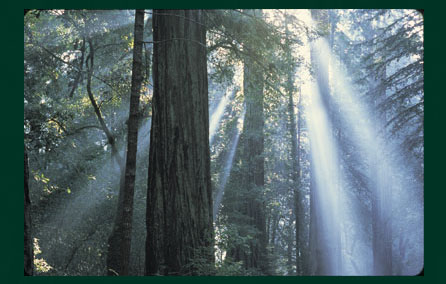
Valley of the Redwoods

Some years ago, when I was suffering from a broken body and heart, I sought healing along the river pathways and among the cathedrals of tall trees in Henry Cowell Redwoods State Park. The 1,750 acres of redwoods, riparian forest, sandhill and grassland communities were practically in my back yard in the Santa Cruz Mountains and it did not take very long to reach the burbling waters of the San Lorenzo River, the park's sun-kissed meadows and the calming shade under redwoods, sycamores, bay laurel and oaks. Even before that, I had often celebrated Christmas Day with a family hike along Fall Creek and up to the ruins of a lime kiln in the northern unit of Henry Cowell, a 2,390-acre section added to the park in 1972, over 40 years after Henry Cowell had first been established as Big Trees County Park.

As parks go, Henry Cowell is dwarfed by the much larger state and federal redwood parks in northern California, and it sits in the shadow of Big Basin State Park, its cousin to the north, the first state park in California established in 1902. The preservation of the redwoods in Big Basin was the subject of my doctoral dissertation in 2002, and research from that study was used in the writing of The Sempervirens Story, a book I produced for the 100th anniversary of the Sempervirens Fund in 2000 with the help of Denzil and Jennie Verardo.

But Henry Cowell has its unique delights, and a new book co-authored by Robert W. Piwarzyk and Michael Miller, Valley of Redwoods: A Guide to Henry Cowell Redwoods State Park, does a wonderful job of telling its story. What is particularly interesting about the way Piwarzyk and Miller present the park is their inclusion of cultural history on a par with natural history, something you don't see that often in park guides. In fact, when the property of Nisene Marks south of Santa Cruz was deeded to the state for a redwoods park it was specified that all cultural traces should be removed before the park was open to the public. And the fact that Nisene Marks was logged almost to extinction by a city of workers, complete with homes, stores and schools, was largely hidden from a public conditioned to seeing nature unadulterated. But just as new generations of nature lovers have spurned dance floors made out of tree stumps, and deer feeding for the benefit of campers, visitors to California's parks today are learning that nature and culture are inextricably combined. Piwarzyk and Miller's new book makes a major contribution in this respect.

Valley of the Redwoods, which is published by the Mountain Parks Foundation, begins with natural history, starting with a geological review situating the park on the east side of Ben Lomond Mountain in the gorge of the San Lorenzo River near the town of Felton, 13 miles north of Santa Cruz. There is a good map of the main park (but the Fall Creek section is lamentably missing). Four natural aspects of the park are described (and beautifully illustrated): Redwood Forest, Riparian Corridor, Sandhill Community, and Grassland Community. Both flora and fauna are included.

Cultural history in the park goes back 10,000 years and for most of that time the Ohlone Indian people lived in relative peace. The authors trace modern history from the arrival of the Spanish in 1769 through the settlement of the San Lorenzo Valley in the mid-19th century when loggers and tanners, as well as paper, gunpowder and lime producers, found the area to their liking. The history of the park itself begins with Lt. John Charles Fremont's fabled visit in 1846 when he slept in the hollow of a redwood tree which forever bears his name. The small redwood grove remains preserved only because its value for tourism exceeded the profit that might have been made from logging. A succession of tourist destinations, from Welch's Big Trees Grove to today's Roaring Camp, have educated generations of conservationists.

Until the publication of this handsome book, Henry Cowell Redwoods State Park had publicized its riches through mimeographed and cheaply produced trail guides. And the book makes a welcome complement to new Visitors Center which was recently given a magnificent makeover by the Mountain Parks Foundation. Piwarzyk, who wrote the text, once discovered a lengthy shovel used in a lime kiln buried under a pile of dirt and straightened it for the Visitors Center. He has written extensively on local history and his work will be included in Lime Kiln Legacies: The History of the Lime Industry in Santa Cruz County which will be published by the Museum of Art & History next spring. Miller took many of the photographs and collected additional drawings and photographs from notable area artists and photographers. He also was responsible for the design and production. Piwarzyk and Miller's efforts will make a visit to the park much more enjoyable and informative. And if you're in need of healing, the park is a wonderful physician.

In Memoriam
Claude A. (Tony) Look, who was responsible for envisioning and putting together The Sempervirens Story mentioned above, died in August at the age of 89.

I treasure the time we spent together on the trail of the stories of Big Basin's redwoods and the members of the Sempervirens Club who saved the last remnants from destruction by logging at the turn of the last century. Tony was a pharmacist from over the hill who led hikes for the Sierra Club. And when he learned in the 1960s that developers were trying to carve up Big Basin for resorts and condominiums he helped organize the Sempervirens Fund to take over the work of the then defunct club. And the Fund continues today to add land to Big Basin and Castle Rock state parks.

"I'm enamored with the natural state of anything," Tony told me during an interview, and that love of the natural motivated him and his photographer friend Howard King to almost single-handedly make Big Basin and Castle Rock the wonderful monuments they are today.

A celebration of Tony's life and the dedication of a tree to honor his memory will be held by the Sempervirens Fund on October 8 in the Campfire Circle of Big Basin Redwoods State Park at 2:30. For more on Tony, click here.

Tuesday, September 26, 2006

Die-ing for Peace

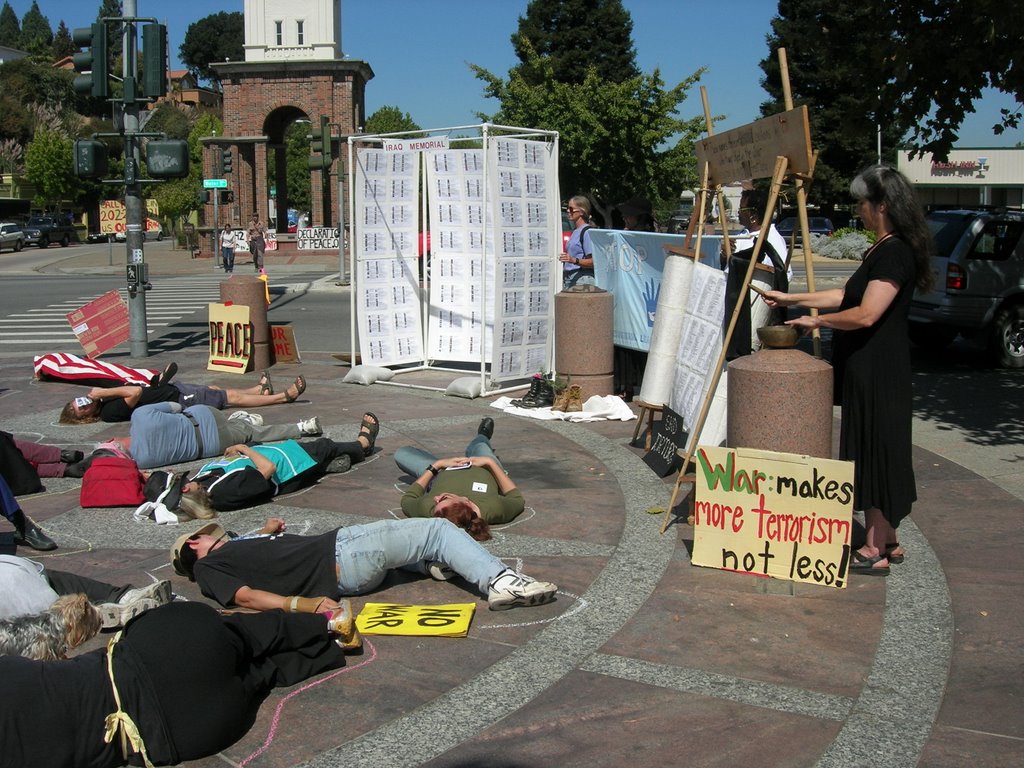
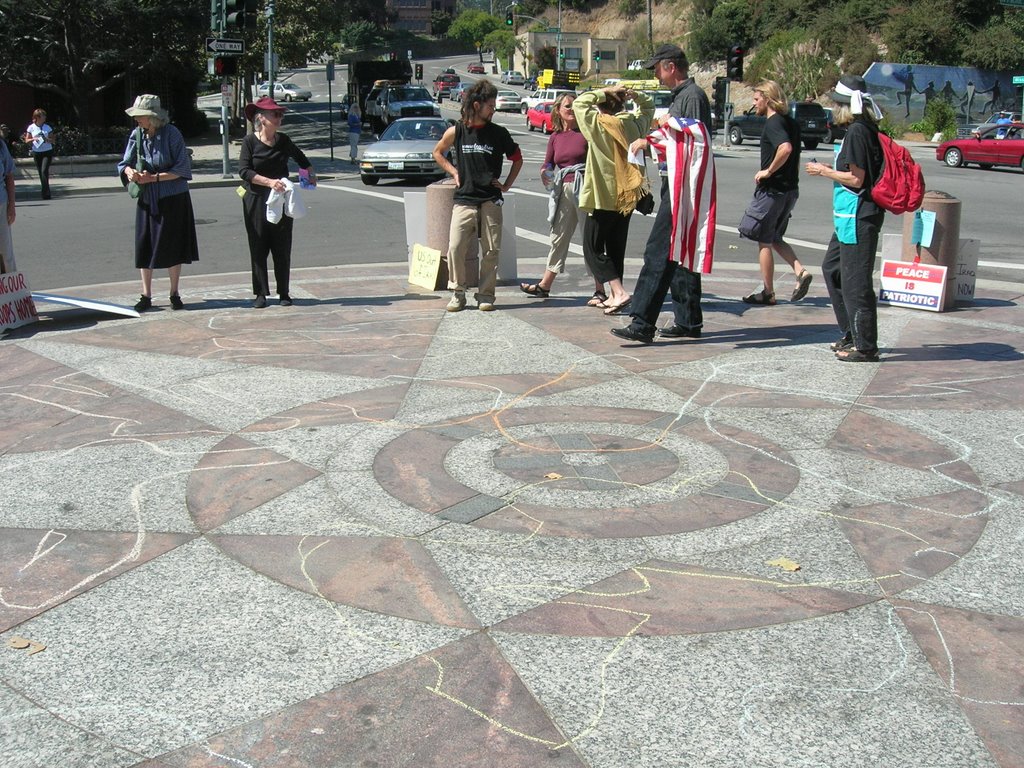
Today I participated in a "Die-In for Peace" on a central street corner in downtown Santa Cruz. Shortly after noon, about a dozen of us lay on the ground to symbolize the thousands who have died, soldiers and innocents, in the occupation of Iraq. We held in our hands photographs of someone whose life was taken in this senseless war. I was given the picture of the child you see here with the wide-open eyes, looking into a future that would never come. I had no idea that this event, part of the Declaration of Peace's week of actions to pressure Congress to end the occupation, would be so emotionally charged. All around me on the ground, people holding similar pictures, were weeping. The abstraction of war had suddenly become personal. The dead Iraqi child's face haunts me.

We lay on the ground while midday traffic whizzed past the intersection. People on their lunch breaks stood by respectfully in silence while Kathleen walked around the circle of bodies slowly ringing a bell. Others chalk marked our bodies as they do at crime scenes. But there is not enough chalk in the world to highlight the thousands of tragedies in the Middle East caused by our government's murderous policies.
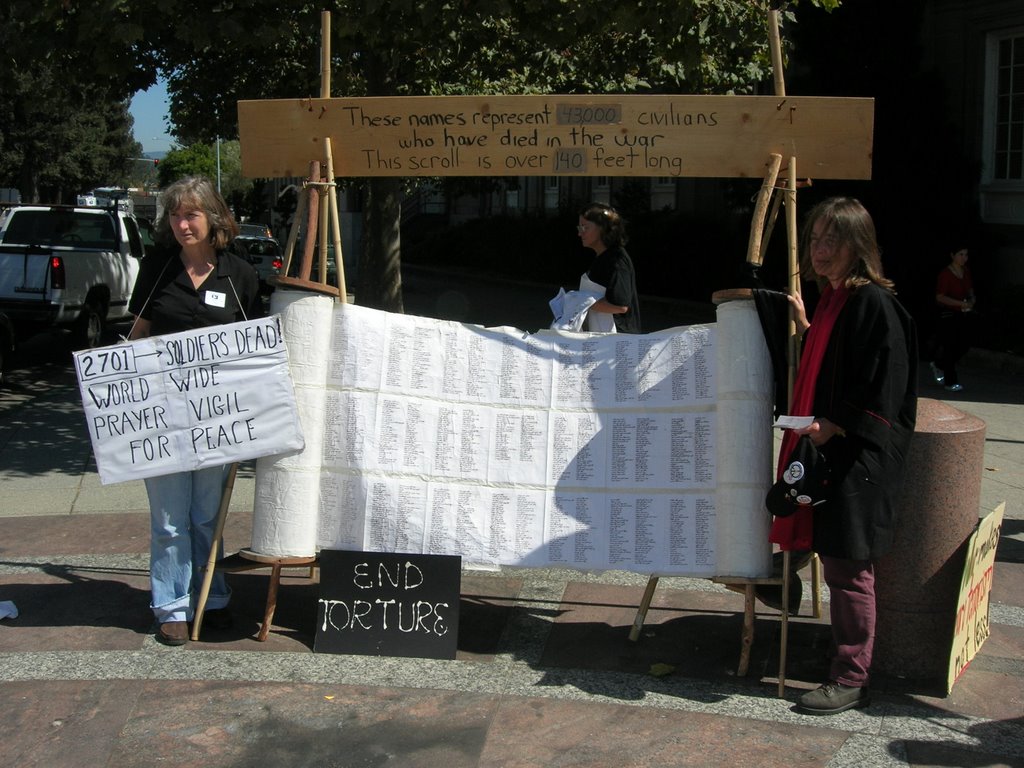
Earlier in the morning, we set up an exhibit prepared by the Buddhist Peace Fellowship which displays the photographs of U.S. soldiers, men and women, who have been killed in Iraq, along with information about where they were born and where and how they died. That number has now passed the count of people killed in New York on 9/11. In addition, the BPF prepared a scroll with symbolic names in Arabic for the estimated 43,000 people who have died in Iraq, an increase of 13,000 since the last time the scroll was unrolled several months ago for a peace march.

The Die-In for Peace & Rally to End the War in Iraq did not attract throngs of people. And the deadline of Sept. 21st that the Declaration of Peace had set for action in Washington to end the occupation had passed with barely a ripple of acknowledgement or support from legislators. Our own congressman, Sam Farr, did indeed sign the congressional pledge, but he made it clear at a recent Town Hall meeting that unless the Democrats take control of Congress in November, all of these efforts to contest the Bush regime's misdeeds will be doomed.

Please let the eyes of the dead Iraqi child above bore a hole into your heart. Put off the paralysis of despondency and stand up for peace in any way you can, peace in your community and around the world.
If we don't, who will?

Saturday, September 23, 2006

Standing Up for Peace


Seven of us stood on the four corners of a busy interesection in Santa Cruz during rush hour yesterday and held up signs and flags that expressed our wish that our soldiers would come home from Iraq NOW. Small groups like ours with homemade signs were taking part in Stand-Up for Peace in Iraq on over two dozen street corners in Santa Cruz, organized by the local Declaration of Peace campaign.

The response was overwhelmingly positive. Car after car beeped in support, and only an occasional middle finger was raised to express displeasure. One young woman exiting the shopping center near where we were standing screamed something indecipherable that indicated a definite lack of agreement with our efforts, but she was in the minority.

Russ Brutsché, who is a terrific artist and singer, brought some unique dynamic signs that he had designed, inspired by the cards fans wave at football games. One requiring three participants read "End the War Now," and the other, which needed four, read: "Boys Back From Iraq" (I must have a word with Russ about today's army which includes girls as well as boys). We got the thumbs up from a number of drivers who saw our performance as they waited for the lights to change.

Afterwards we met at Lulu's coffee house and traded stories. Some of the groups consisted of neighbors who had been contacted by their friends. They stood on street corners near their homes. We heard of people so impressed by this homegrown witness for peace in Iraq that they ran home, made a sign, and returned to join them. People of all ages called out to the Congresspeople in Washington to end this terrible occupation in Iraq and bring our troops home immediately.

Will they be heard? The cynic in me says "I doubt it." But, as Jim Wallis told us when he came here recently, the cynic is always struggling in us with hope for domination. And Martin Luther King Jr. told us to "keep hope alive!"

Today we join together in a silent march for peace through the downtown organized by the Buddhist Peace Fellowship. And this afternoon I'm going for a hike in Wilder Ranch with someone I recently met through Craig's List. Keep Hope Alive!

Friday, September 22, 2006

Ripped Off on eBay

I entered my first and last auction on eBay several weeks ago. It was a painful and humbling experience.

I successfully bid on and bought an Apple G4 iBook for $570 , which seemed a good price, from a company called Dealtree based in Tustin, CA. Then I learned that shipping expenses would be $24, a bit high I thought, and that I would be paying California sales tax of 7.75%. That computation came out to $63.14 which didn't seem correct, but I let it go. I paid the entire amount that day by credit card.

The computer arrived eight days later, without a power cord. I looked at the fine print and saw that a power cord was indeed not included. At Dealtree's urging, however, I gave them positive feedback on the eBay form. Big mistake.

I ordered a power cord from Amazon which arrived a few days later. I charged the laptop and began reviewing its programs. Everything looked fine, except that within about ten minutes the cursor froze. I had to turn the computer off and on. After a few more minutes, it locked up again. I recall this happening on a computer I had a few years ago and it was a memory problem (not enough). So I tried again. The third time the cursor froze.

Since the laptop had been advertised as "working," I sent an email off to Dealtree and complained. The customer service person emailed me some questions: "Are you using a USB or PS2 Mouse? Have you updated the drivers for your chipset?" I responded that I didn't know what he was talking about. Then I was told: "Well, attempt to update the drivers for the computer. If it is a driver issue only, or the problem could not be duplicated here, we would charge a restocking fee for the return." I replied that this was beyond my ability. And besides, I thought I'd bought a "working" computer? Dealtree authorized an "RMA" (whatever that is) and sent me a UPS shipping sticker to send back the computer to Mckinney, TX. I thought this odd since I had assumed the computer originally came from California (else why was I paying CA sales tax?).

Ten days later I was notified that the computer had been received. The following day I got an email that said Dealtree would credit my credit card with $497.54. When I protested that $159.60 of my original payment was missing, I was told: "'Unit was fully functional and we were unable to produce ANY issues. 25% restocking fee."

Ah, that "restocking fee." My first response was angry and will not be repeated here. My second was to send the following message:
I wanted a laptop that works for a gift. But, as I explained in previous emails, the laptop you sent me locked up on me. The cursor would not move. This has happened to me on previous computers and I believe it's a memory issue. My current laptop, which I've had for three years, has not done this.

I don't understand why you think I'm not telling the truth about this. I would much rather have kept the laptop I paid for then go through the hassle of returning it.

I don't understand how you can justify charging me $159.60 and giving me nothing in return. How is this not a form of theft?

Please give me a phone number and the name of someone I can talk with about this.
That was several days ago. There has been no response. And no refund of any amount has been credited to my credit card.

I tried for some time to figure out how I could complain to eBay about one of their sellers, or if I could change my original favorable response about Dealtree. No way, Jose. If I'd used my Pay Pal account I might have had some recourse, but I chose to use another credit card instead.

Life is too short to chew over an upset like this. But what's a blog for if I can't vent my spleen?

I know lots of people like eBay and they've not encountered problems like this. But all I can say is: be careful. You won't find me there again.

Sunday, September 17, 2006

Disconnected Threads

There are times when religion, sex and politics mushes together into an indecipherable mess. I can't make sense of any of it.

The dead bodies of two women have been found here in the last week, one in an abandoned storefront near the Boardwalk and the beach and the other on a dirt road in the Santa Cruz Mountains. The first has not yet been identified and the second, a cashier at a supermarket in Ben Lomond, was six months pregnant. Causes of death are so far unknown or unannounced. Before I moved here in the mid-1970s, Santa Cruz was called the "Murder Capital of the World" because of three serial murderers who had been captured and sent to prison a few years earlier. I am sure people are fearful, wondering if something like that could happen again.

A week ago, agents of the Immigration and Naturalization Service (new name: U.S. Immigration and Customs Enforcement) swooped down on Santa Cruz and San Benito counties in the early morning hours and carried off 107 people without the proper citizenship documentation. Most were Mexicans but a few came from El Salvador, Guatemala and India. Some were parishoners at Star of the Sea Catholic Church, and I've heard horror stories of cases where one or both parents were taken, leaving children born in this country behind to fend for themselves. Understandably, members of the immigrant community here are terrified. It sounds so similar to Nazi Europe when unwanted people were taken from their homes in the dark of night.

Religious leaders have been speaking up: "It is clear that we have reached a point where we need legislation that will produce a viable path to citizenship for undocumented persons residing in our nation and one (law) that protects the integrity of families and the safety of children," said Monterey Bishop Sylvester Ryan at a press conference at Resurrection Catholic Community Church in Aptos. But the Homeland Security goons need to show they can protect our violated borders to boost Bush's ratings in the polls. Once deported, these immigrants, many of whom have lived here for years, with homes and businesses, will never be able to return. More raids are promised by the Feds.

And in Washington, El President Bush is pressuring legislators to legalize torture in the bogus War on Terror (and is not torture a form of terrorism?).

On the other hand, Sojourners founder and editor Jim Wallis, a self proclaimed progressive evangelical Christian, came to Santa Cruz last week and filled the pews at First Congregational Church. Wallis, who is stocky and feisty in a prophetic sort of way, could easily be called a white Martin Luther King Jr. He has the charisma for it and his message is the same: end poverty and violence in the name of moral values derived from religious faith. Wallis is constantly on tour to promote his current book, God's Politics: A New Vision for Faith & Politics in America, now out in paperback, and his talk was polished to a fine shine.

On his journeys he said he saw a hunger in America for spirituality and social justice, "and the connection between the two is one the world is waiting for." While he thinks the monologue of the religious right is over, Wallis said "it's easier to be gay in Boston than religious in the Democratic Party," and he called for an infusion of moral values in partisan politics. In the 19th century evangelical Christians were abolitionists. "People of faith have done big stuff before; it's time we do it again." He advocated replacing the "politics of blame and fear" with the "politics of solution and hope," and he said the choice is not between belief or secularism but between hope and cynicism. In attendance at Wallis's talk, sponsored by the Resource Center for Nonviolence, was an hopeful mix of followers from various faiths, Jewish and Muslim, Christian and Buddhist, mostly united in the belief that poverty and nonviolence were more important issues than gay marriage and abortion.

Wallis is an inspiring cheerleader for peace and social justice and serves as an example that the religious right has not hijacked religion totally in this country. His talk, however, while heavy on aphorisms and slogans, did not contain any clear solutions to the obvious crises in America and the World. And where are all the the rest of the faith-filled people who are "mad as hell and not going to take it any more"? A week ago about twenty of us were standing on the corner by the Clock Tower with our homemade peace signs during the weekly interfaith Vigil for Peace when a passing car skidded to a stop and a small man with a tall wife at his side ran up to us and started shaking hands. It was Congressman Dennis Kucinich of Ohio, the tireless campaigner for peace, on his way to a local Democrat fund raiser, and he was thanking us for what we were doing. Next week I expect to see Michael Moore or Al Gore drop in to encourage us in our lonely protest against the madness in Washington and the Middle East.

Maybe it's just pissin' in the wind, but we do keep trying. Next week a a local group working on The Declaration of Peace campaign will launch a national week of actions, Sept. 21-28, to end the U.S. occupation of Iraq with a series of events here in Santa Cruz. On Monday we are getting together to make signs. On Thursday, Sept. 21, the International Day of Peace, Quakers will lead a silent vigil at the Town Clock from 5:30 to 6:30, followed by the lighting of candles all over the nation, and on our coast the Night Light display. On Friday small groups all over town (at least 100) will stand on street corners and bear witness to their wish that the troops come home from the Middle East NOW. The next morning, at 10:30, a silent peace march will start out from Mission Plaza and wend its way through town. On Monday, Sept. 25, there will be a "Die-In" in front of the Post Office to graphically illustrate the tragedy of U.S. involvement in the Middle East. The Raging Grannies will be there to lead us in song and the Buddhist Peace Fellowship will set up their display of the photos of dead U.S. soldiers. It may not end Bush's war on terror but it will certain help strengthen our resolve to oppose the regressive regime in Washington.

And what about sex, you may ask? Last week, in a continuing search to find like-minded friends and companions of the opposite sex, I put an ad on Craig's List personals (no, I'm not planning to reprint it here). I was amazed at the response. Even though I proudly announced my age as 67, almost twenty people found my self-description interesting enough to reply. Personal ads on internet singles sites tend to be depressingly similar and sad, particularly for those over 50 like myself. The challenge to be genuine and real, and particular rather than general, is daunting, and quite humbling. And then there is the matter of a photograph. The camera can often be brutally honest. I included a picture of me dancing the tango in Buenos Aires, even though I stumbled over the poor lady's toes and it's been several years since I've gone dancing here in Santa Cruz.

As I tell all who will listen, I love the unencumbered single life. And yet...I will say no more.

Tuesday, September 12, 2006

The Day After

I didn't want to write about September 11th.

What is it about anniversaries, really? The death of almost 3,000 people in the World Trade Center towers was a tragedy that moved me to tears at the time that it happened. I was particularly affected by media coverage of the unsuccessful searching by survivors for their loved ones. But why commemorate it again and again, on the 1st anniversary, the 3rd, and now the 5th? Does that make their deaths any more meaningful? Will the world someday celebrate the centenary of 9/11?

What upset me yesterday was the thought of all the other people who have died in the aftermath of 9/11, whose deaths have not been memoralized by speechs and photo ops, the deaths of innocent civilians in Afghanistan, Iraq, Palestine and Lebanon. When will they have their day in the media? How can I remember the stockbrokers and firemen who perished in the fall of the twin towers and not also think of Rachel Corey, crushed to death by an Israeli tank, or the children maimed by cluster bombs made in the USA and dropped from Israeli planes. It doesn't seem fair.

So my way to mark the anniversary of September 11th was to join over 500 Santa Cruzans at a screening in the Rio Theater of "Loose Change 2nd Edition," the documentary that claims to detail how our government either mishandled or fabricated the so-called "terrorist attack" on New York's symbols of world capitalism five years ago.

Now, conspiracies theories involving the government make me uncomfortable, for two reasons: One, our government is too incompetent (e.g., Iraq, the Katrina debacle) to pull off a conspiracy of great magnitude, whether 9/11, UFOs or the Kennedy assassination. And, secondly, conspiracies involve many people sworn to secrecy; sooner or later one of them will crack and it will all spill out. I'm still waiting for someone to tell me who really shot Kennedy.

Since 9/11, I have been too preoccupied and upset by the very real consequences of the event -- war in Afghanistan and Iraq, unqualified support for Israel and suffering for the Palestinians, the sacrifice of our rights and freedoms for the sake of "security" -- to pay much attention to the new conspiracy theorists. But last nightI got an earfull and an eyefull. I concluded that there are two theories, or perhaps a continuum: On one end are theorists pointing out omissions and lies in the official 9/11 Commission report, and on the other are those who say that 9/11 was an "inside job."

The range of accusations are amazing. The collapse of the towers was not caused by the planes crashing into them and burning fuel but by additional explosives, a "controlled demolition." The Pentagon was not hit by a plane because the hole was too small, and almost everything -- plane parts and bodies -- disappeared. The same lack of physical and human evidence proves that Flight 93 did not crash in Pennsylvania; it was reported as landing in Cleveland. Most mysterious is the collapse of Building 7 which was not touched by the planes or collapsing towers. It fell -- another controlled demolition -- all by itself. Could the fact that offices of the CIA and the Secret Service were there have anything to do with it? And why was there no attempt to shoot down the highjacked planes even though they were identified as such over a half hour before the first crashed?

Even the official theory, put forth by the 9/11 Commission, is a conspiracy theory. In this story, a dedicated band of 19 (or 20) fanatical Muslims, directed and funded by Osama Bin Laden, hijacked four commercial airplanes and flew three of them into their largely symbolic targets, all because, according to El Presidente, they "hate freedom." Theirs was the most successful symbolic gesture in history and its consequences have been more far ranging than the assassination in Sarajevo that started World War I or the firing on U.S. ships in the Tonkin Gulf that legitimized the Vietnam War in 1964.

But wait a minute. That last event in the waters off North Vietnam never happened. It was fabricated by our government to justify the war that killed 50,000 U.S. troops and millions of Vietnamese soldiers and civilians. Reagan invaded Granada under false pretexts and the sinking of the Maine in Havana harbor in 1896, which started the Spanish-American war, was probably an inside job to justify America's overseas imperialist ambitions. That supposedly democratic governments lie to guarantee the support of the governed is a foregone conclusion.

David Ray Griffin is a retired professor of theology who was one of the first to write about the lie of 9/11 in his book The New Pearl Harbor, named after a Neocon Republican document in 2000 that says "the process of transformation, even if it brings revoslutionary change, is likely to be a long one, absent some catastrophic and catalyzing event -- like a new Pearl Harbor." Griffin believes that 9/11 was an example of "governmental lawlessness," and that the truth would reveal the danger of the present world system with its "anarchical competition between nation states." The Big Lie, pioneered by the Nazis, has become "sacred myth," says Griffin.

The lobby of the Rio Theater was full of conversation after the film. Good friends assured me that all of the surviving firemen and police in New York now know that the official story was a lie. The fire of true belief burned in their eyes. Fliers were handed out for the next event, another documentary, "9/11: Press for Truth," to be shown in October.

And yesterday, in several solemn events, President Bush claimed "we are safer, but we are not yet safe," and said, despite all common sense as well as evidence, that the "safety of America depends on the outcome of the battle in the streets of Baghdad." It is obvious to anyone with their head out of the sand that we are far less safe than we were five years ago, and the danger may be closer to home than the chaos in the Middle East.

Monday, September 11, 2006

Against Atheism

Many of us saw religion as harmless nonsense. Beliefs might lack all supporting evidence but, we thought, if people needed a crutch for consolation, where's the harm? September 11th changed all that. Revealed faith is not harmless nonsense; it can be lethally dangerous nonsense: Dangerous because it gives people unshakeable confidence in their own righteousness. Dangerous because it gives them false courage to kill themselves, which automatically removes normal barriers to killing others: Dangerous because it teaches enmity to others labeled only by a difference of inherited tradition: And dangerous because we have all bought into a weird respect, which uniquely protects religion from normal criticism. Let's now stop being so damned respectful! –Richard Dawkins

A reader offered me this quote from the respected evolutionary biologist and popular intellectual in the Gramscian tradition who has often provided a Marxist perspective on political and scientific issues that I appreciate. Here he echoes Sam Harris, the outspoken atheist I wrote about the other day who believes that September 11th proved that religion is dangerous and a threat to life on this planet.

While I believe there are dangerous people in the world, from Osama and his followers to President Bush and his cronies, I do not share the hatred of religion and aggressive atheism of Dawkins and Harris. Into this mix I will add Brian Flemming, director of the documentary film "The God Who Wasn't There" which I saw the other night. And I've also discovered numerous blogs by atheists on the web who largely repeat the insights of Harris that 1) religions are based on myths which are not true; 2) religious identity distinguishes between those who are with us, the believers, and those who are not, the unbelievers; and 3) religious scriptures, which believers declare to be literally true, frequently advocate the killing of unbelievers.

All of this is unarguable. But it's not the whole story. Harris, et al, make their case against religion by setting up a straw believer, a fundamentalist Christian or Muslim, and declaring that he/she is typical of all who consider themselves religious. It allows for little difference. And like many of my non-religious friends, Harris is sure who knows who is a Christian: "You cannot be a Christian if you're not convinced of the core dogmas of Christianity," he said in a recent interview. Oh? And what of those who think the story of the virgin birth may be a fairy tale but who are so impressed by the idea of loving your enemies that they become Christians (i.e., particpate in a Christian community of some sort) by studying the teachings of Jesus about caring for others and trying to put them into practice?

I don't associate with any fundamentalist Christians who claim to believe in the literal truth of the Bible and who condemn to hell anyone who does not take Jesus Christ as his personal savior, whatever that means. I know these people exist, because I read about them and see them on television. There are those who call themselves Christians that hate homosexuals and abortionists, to the point of wanting to kill them. But I've read the Bible and the Gospels and I simply do not understand how they can draw conclusions so different from mine. The Jesus I follow preaches the Gospel of love and compassion for all one's neighbors.

Simply put, there is no such entity as "Christianity." There are many christianities, may ways that people have chosen to interpret the religious texts and put them into practice. I believe that fundamentalists are in the minority, although I do not have any statistics at hand to prove that. I suspect also that there are many islams, many ways to interpret the Qur'an and follow the will of Allah. Unfortunately, in the clash of civilizations that Samuel Huntington sees happening, the positions on the front line are taken by extreme fundamentalists. And critics like Harris think that's the whole story. They take the violent verses out of religious texts and point to them as evidence that religion is dangerous, and ignore the frequent admonitions to love one's enemies, care for the neighbors around you. Rather than see the ubiquitous presence of the Golden Rule in all religious traditions, they would have you believe that all religions place purity and orthodoxy ahead of alms giving and charity.

When I studied religion in Europe's middle ages, I learned that historians based their understanding of what people believed on written commentaries by the clerical elite. They were, after all, the only literate class and the common people who made up religious congregations did not write books. But when scholars like Carlo Ginzberg, author of The Cheese and the Worms, found ways to study popular spirituality, they discovered that there was no theological consensus among the masses, no matter what the clerics thought. It's the same today. Critics like Harris get their evidence from the Pat Robertsons and the Billy Grahams and the other talking religious heads, but they do not understand the diversity of faith or what it means. Statistics are no help; I suspect people tell the pollsters what they want to believe, not what is truly present in their hearts.

The atheists have my sympathy. Clearly the fundamentalists are a breed apart. But they do not represent the whole. Harris, according to a review of his first book in the New York Times, singles out Islam as the reigning threat to humankind which unfortunately links him to the views of some Christian commentators, like Ann Coulter. He also apparently attacks the war against drugs along with pacifism and offers a defense for the use of torture in wartime. In addition, according to a review in the San Francisco Chronicle, Harris "quotes with approval a rhapsodizing comment about Israel's treatment of Palentinians." And the reviewer in The Nation says that Harris "advances a rationalist arguament in support of Bush's jihad," adding that "atheism can as easily propel one to the right as to the left."

I went to mass this morning. There were no blinding lights, bells and whistles; God did not speak to me. Just the usual liturgy, boring homily, and familiar music. The words spoken and heard were comforting, their very repetition instilling the idea that life is meaningful -- we are are not just meat in motion but flames of spirit in the midst of the mystery of life. The tools of reason are useful but not enough. To understand and celebrate the mystery we need the brilliance of Bach and the vision of Monet, at the very least. I don't recognize my faith and my spiritual practice in the acidic nay saying of atheism.

Thursday, September 07, 2006

Against Religion

We have names for people who have many beliefs for which there is no rational justification. When their beliefs are extremely common, we call them "religious"; otherwise, they are like to be called "mad," "psychotic" or "delusional"...it is difficult to imagine a set of beliefs more suggestive of mental illness than those that lie at the heart of many of our religious traditions.

Not since Madalyn Murray O'Hair has an atheist raised the flag of non-belief as high as has Sam Harris. Harris, who writes essays for Arianna Huffington's blog and for the Truthdig web site, has attacked religion and its followers in The End of Faith: Religion, Terror, and the Future of Reason, and in the soon-to-be-released Letter to a Christian Nation. What got my attention, however, was the interview with him in this month's issue of The Sun magazine: "The Temple of Reason: Sam Harris on How Religion Puts the World at Risk." I found Harris to be an articulate exponent of the rationalist secular position toward reality. The questions raised by his criticism of religion deserve to be considered by anyone who thinks of themself as religious.

Harris trots out the usual suspects in his writings: the persecution of the Cathars and the Spanish Inquisition, witch hunts, and the long history of anti-Semitism that led to the Nazis. His main target, however, is fundamentalism of any stripe which is -- fundamentally -- irrational, a belief without proof and proud of it. Fundamentalism, he believes, leads to 9-11.
The evil that has finally reached our shores is not merely the evil of terrorism. It is the evil of religious faith at the moment of its political ascendancy...The men who committed the atrocities of September 11 were...men of faith -- perfect faith, as it turns out -- and this, it must finally be acknowledged, is a terrible thing to be.

While his big guns are trained on Islam, a faith whose beliefs "belong on the same shelf with Batman," Harris is equally dismissive of Christianity's treasured tenets, like the virgin birth and the belief that "Jesus Christ can now be eaten in the form of a cracker. A few Latin words spoken over your favorite Burgundy, and you can drink his blood as well." But he is also dismissive of moderation and tolerance toward the irrational and unproveable "truths" of religion because it allows the extremists to flourish. "By failing to live by the letter of the texts, while tolerating the irrationality of those who do, religious moderates betray faith and reason equally."
Criticizing a person's faith is currently taboo in every corner of our culture...religious beliefs are simply beyond the scope of rational discourse. Criticizing a person's ideas about God and the afterlife is thought to be impolitic in a way that criticizing his ideas about physics or history is not.

Harris, who studied philosophy at Stanford and is currently a working on a doctorate in neuroscience, would like that to change. But unlike many critics of religion in general, Harris leaves space for mysticism, contemplation and meditation. In his youth he studied Buddhism and Hinduism and made several trips to India and Nepal. "Mysticism is a rational enterprise. Religion is not," he writes, and he calls spirituality "a natural propensity of the human mind." He believes that meditation practices, when divested of their mythology, offer measurable insights, which can be studied with the tools of neuroscience, that can provide support for ethics.
With Buddhism, you don't have to believe anything on faith to get the process started...I think Buddhists have to get out of the religion business altogether and talk about what the human mind is like.

I find Harris's critique of religion refreshing. It's healthy to reexamine the faith-filled motivations for our actions in the world. There is a reason why increasing numbers of people are identifying themselves as "spiritual, not religious." Religion has come to stand for division, your god against my god, your church against my temple. And it is religious identity that is at the root of Harris's critique. "The problem with religion is that it is the only type of us/them thinking in which we posit a transcendental difference between the in-group and the out-group." Religious identities are divisive and these differences are the source of wars which are increasingly dangerous because of modern weaponry.
I think the human urge to identify with a subset of the population is something that we should be skeptical of in all its forms. Nationalism and tribal affiliations are divisive, too, and therefore dangerous. Even being a Red Sox fan or a Yankees fan has its liabilities, if pushed too far.
No religion is immune. In Sri Lanka, Buddhists and Hindus are slaughtering each other again after a twenty-year truce. Muslims in the Middle East are killing each other as well as trying to kill Jews and the Christians who get in the way. It's not a pretty picture.

But is this the whole story? I was captured by the Gospel message of Jesus to help the poor and feed the hungry, no matter who they are. I don't believe Jesus intended to start a new religion. In fact, if Br. Martin at Shantivanam in India is correct in his theology, Jesus explicitly criticized the religion of his time and warned against its excesses. People started churches and formed religious hierarchies to help strengthen and guide them in determining the "will of God": how to live unselfishly in the world. But these religious props and supports took on a life of their own, and came to justify themselves mythologically.

Harris is particularly critical of "divisive mythology," and he wants to replace it with reason and science. He views religion as "failed science, insofar as it makes false claims about the world." He calls for "secular rituals...a kind of scientific liturgy" because he sees there is "a power to ritual that is not understood in scientific terms." Harris even suggests, perhaps with tongue in cheek, that "it would be thrilling if we had a temple of reason that presented through ritual our growing scientific understanding of ourselves in the cosmos." This sounds like the work that Thomas Berry and Brian Swimme have done on coming up with a new creation story based on current scientific ideas.

I don't think all mythology is divisive. If we substitute poetic for mythological we might begin to understand the language of religion in a new way. The writers of most religious texts were not trying to present scientific truth, and we commit the sin of anachronism for seeing religious dogma as failed science. The Gospels (and the Bhagavad Gita, etc.) present the truths of reality poetically. And the message I hear when I read sacred texts is not one of division but unity. It's human beings, and the religious hierarchies they often use to manipulate and control followers, that divide.

Harris, of course, writes much more than I can report in this brief analysis based on reviews of his work and a recent interview. I want to read his new book which has been called "a bold attack on the heart of Christian belief." There is nothing to be feared from serious questions. My faith was partially formed from reading and appreciating Nietzsche. A faith that relies on stale formulas from the past is dead. A faith that seeks undestanding is ever new.

Sunday, September 03, 2006

Requiem for Huggy Boy

Dick Hugg, Huggy Boy, is dead.

For any white kid growing up in Southern California in the 1950's, Huggy Boy's velvet voice on the radio late at night revealed to us to the world of black rhythm & blues. I used to listen to his show with the radio tucked under my pillow so my parents couldn't hear. Huggy Boy and fellow DJ Hunter Hancock (both of whom were white) could only play their R&B music late at night because the lyrics to many of them contained double meanings that threatened the sensibilities of the white folks who controlled the airwaves. One of my favorites (now on my iPod) was "Big Ten-Inch Record":
Got me the strangest woman,
believe me this chick's no cinch.
But I really get her going
when I take out my big 10 inch...
...record of the band that plays the blues
Huggy Boy broadcast his show live after midnight in the front window of Dolphins of Hollywood, a record store at the corner of Vernon and Central in the predominantly black area of south Los Angeles. But he was so popular that hoardes of white kids would drive down to the store, where the aisles were full of stacks of ten-inch 78 rpm records, to appear on his show and dedicate songs to their friends. I was one of them on a night in 1954 or 1955 and I'll never forget the thrill of meeting Huggy Boy in person. I recall him as being tall and slim with slicked-back black hair.

The first R&B song I ever heard was "Gee" by the Crows and its catchy refrain (and inane lyrics) still sends shivers up my spine as I remember what it was like to be 14 years old and as responsive as a tuning fork to the sounds around me. Then there was "Earth Angel" by the Penguins, and "One Mint Julep" by the Clovers. Huggy Boy and Hunter Hancock introduced me to Chuck Berry, Fats Domino and Little Richard, not to mention B.B. King, Big Jay McNeeley and Joe Houston.

Paul, my best friend in junior high school, emailed me last night to tell me about Huggy Boy's death at the age of 78 in Los Angeles. Another old friend tells me that her tenth grade class of 1956, the year after mine, is having their 50-year reunion next weekend in La Canada at the Youth House where I played my clarinet and alto sax in a band for dances back in the mid-50's. She sent me a list of names of her classmates still living (an amazing number were now deceased), and a couple brought back vivid memories.

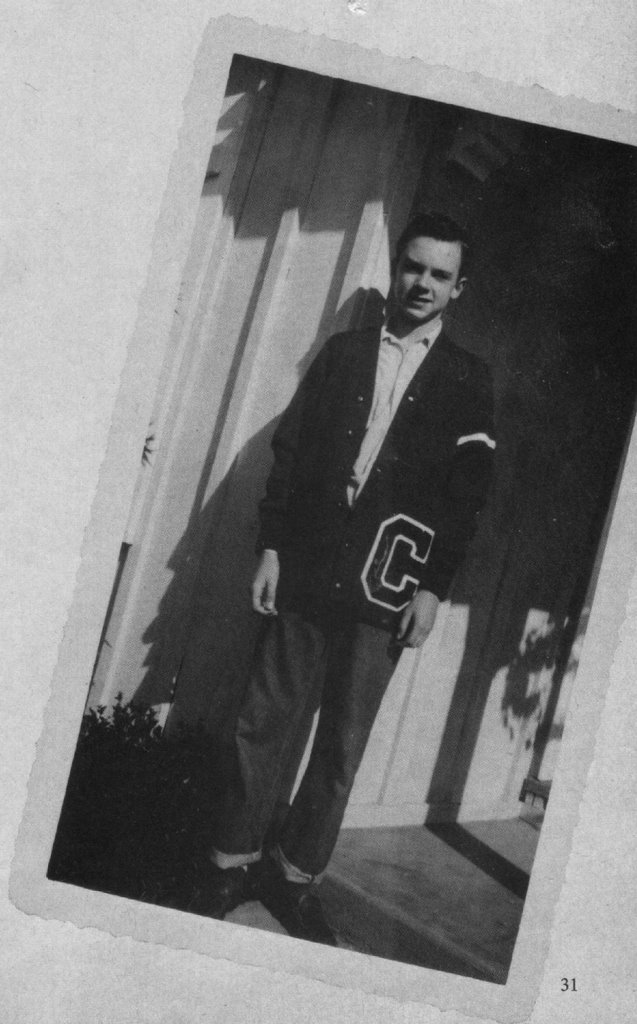
To recapture the past more fully, I dug deep in my files to find an article I had written in 1973 for Coast Magazine in Los Angeles. It was a special issue on love in various decades and I got to write about the Fifties. The stories are as real as my memory. It was entitled "High School Confidential" (and I've not attempted to update or correct anything):
To a cute necker. Good luck in 9th grade.
Jim B
Jim was the best "necker" in the eighth grade. His succinct entry in my 1953 junior high school annual told me I'd made the grade. Making out in the '50's was our religion and Jim was my guru.

Twenty years ago this month I migrated with my parents and younger brother in a new Ford, west to Southern California. I was 13 1/2 years old and a social Neanderthal. My puberty began and ended with songs; "Oh Happy Day" by Lawrence Welk and His Orchestra heard on our car radio traveling along Route 66 towards the land of orange groves started it all; and, four years later, there was Buddy Holly's "Peggy Sue" on the radio in my hospital room where I lay with a broken thigh bone after driving drunk into a candy store following a college fraternity rush party.

To a very wonderful guy.
Love.
Laurie


Laurie was my first steady girl (remember that phrase?) in the spring of our eighth grade. Jim's yearbook compliment resulted from his witnessing of my first fumbling attempts at passion with Laurie at a party. It was at that same party that Charlie P heard me emit a loud fart, during a corner embrace and humiliated me for weeks afterward by spreading the nasty rumor that my love-making was excessively noisy. Only the good Dr. Freud could have guessed what future havoc that trauma may have wrought.

I danced with Laurie at parties and at the eighth grade prom to "Song from Moulin Rouge." She was taller than me, classically beautiful in my memory, and I never laid hands on the forbidden areas of her body. I was a nice boy. My lust was confined to wet dreams. Several years ago I ran into Laurie at a coffee shop. She had married an undertaker and was dressed in the uniform of a middle-aged, middle-class matron. Only wide-open eyes and a giggly laugh remained of the girl I held hands with in her parents' living room.

Flashback: A few years out of college, Laurie and Carolyn lived in a hillside apartment in San Francisco, career secretaries by day, beatniks by night. I came over from Berkeley one evening for a party with Dick, who dated Laurie after me. Dick and Laurie and Carolyn and I fucked most of the night away and in the morning I went into Laurie's room and gave her a brotherly hug and kiss.

Lots of luck to a real cute guy.
Nancy R
A month after writing that, Nancy and I sat next to each other in a pew at the Church of the Lighted Window. Prompted by my guru, Jim, I passed her a note asking if she'd go steady with me. She accepted, and that evening I gave her a ring I'd bought at Woolworth's, a heavy 25-cent ring with the skull's head removed and replaced with my initials. Our affair lasted three weeks, three Saturdays at Jim's house where, while his parents worked, Jim and Judy and Nancy and I " made out" for eight straight hours, stopping only to get a Coke, to go to the bathroom, or to change the stack of 45's on Jim's RCA phonograph ("All Night Long" by Joe Houston, "One Mint Julep" by the Clovers, and more). "Making out" was hot and sweaty work but we were driven teenagers (that label, teenagers - an epithet or a badge of pride?). I hardly even minded Nancy's braces, which frequently sliced up my lips. And she never noticed that my Levis failed to fold the proper way in my crotch, a source of heartrending embarrassment to me. And my hands never touched the forbidden areas of her body.

Lest you think my hands remained virginal throughout junior high school, let me retell the events of New Year's Eve, 1953-54. Jerry and Addie and Melanie and I sat in the back of Jack's lowered Chevy during an aimless round-trip drive from Pasadena to Long Beach during which I managed to slip my shaking right hand into Melanie's pedal pushers, underneath the silky front line, and right onto the end-all and be-all for a 14-year-old boy/man. I hope the experience was as instructive to Melanie as it was to me. Not to be left out, Addie and Jerry enacted the same scenario besides us while Jack delicately tried to watch the road and the rear-view mirror (from which hung an enormous pair of angora dice) at the same time.

Your '40 is going to drag my '41 Chevy someday. Your (sic) going to have your (ass wiped). I'll have a G.M.C
Gary L (Lip)

Bill,

We have only had a ball together since 8th grade. Especially this past few weeks. I hope we only have a ball Wed. night and Graduation nite. I hope the fun we are having can last through the summer and even longer. I hope that you get your chance to be in that combo. Lots of luck next year.
My love always,
Judy

Judy, bless her often-available bare breasts, had forgiven me for that night the summer before when Jim had lured her into the darkened school hall from the dance at the community Youth House next door, right into the waiting arms of three scared but eager teenaged boys who plotted to punish her for being a "P.T." (prick tease). (Those breasts were only available to a select few then.) Two of us held her arms, another put his hands over her mouth, someone ripped her pants off and Jim lit a match. For no more than a second we stared at a thatch of genuine female pubic hair (blonde), and then fled in separate directions while Judy screamed for help, While several teachers on duty at the dance searched through the school for us, I hid under a bush and then ran home over back roads. Judy told on everyone but Jim (he was a charmer) and I was "grounded" (restricted to home base in the evenings) for a month by my parents.

Jim was our leader. He wore his wavy brown hair (bleached blond in the summer sun with liberal applications of lemon juice) in a duck tail (also "D.A." [duck's ass]), was the first to get a pair of black "pegged" (A-1) pants, had brown loafers with pennies in the front as well as the (mandatory) black 'cycle boots, and was the first (he said, we believed) to actually sleep with a girl. It happened, so the story went, the summer before I arrived in California, one night at the home of his girl friend while her parents were out (our middle, upper-middle-class suburb had a high percentage of party-going parent alcoholics). Mark corroborated the story. He was feigning sleep in the living room in front of the T.V. while Jim and ... (her name is lost in the fog of history) went at it in the bedroom. Stealing a glimpse, Mark witnessed moving white limbs and buttocks and heard decidedly gooey sounds. "Yep," said Jim, "we went all the way." Later, she allegedly got pregnant by another, went to live with relatives, and disappeared into a private girls' school some miles away. Sitting at our permanent table in the cafeteria, Jim told and retold his story and reaped the glory, and later Mickey would pull out a plug of chewing tobacco and we were off into another voyage toward adulthood.

Jim cultivated a friend a year older than he who had a car and a driver's license. He lunged ahead of us into the world of drive-in movies and lovers' lanes. The magical age those days was 15 1/2; that was when one became eligible for a learner's permit and a chance to use the family car -- as long as a properly licensed 16-year-old was around. (Everyone's 16th birthday was a rite of passage held at the Department of Motor Vehicles.) I paid $50 around my 15 1/2 "birthday" for a four-door 1940 Ford with baby blue primer paint, which sat in my garage, an apprentice auto mechanic's laboratory, for six months. Unlike most of my other friends, I was totally unable to understand the workings of a six or eight-cylinder automobile engine, but I did manage to drive the thing out of the garage on my 16th birthday. Not long afterwards, Jack talked me into letting him drive it in a drag race on a side street and when he floored the throttle the speedometer sped up to 120 but the car just rolled slowly forward, its U-joint or differential or something threaded. Jack tried to put a new one in later but only succeeded in snapping the rear spring. I think I got $5 from the junkyard. About that same time, Jim' persuaded his father, a car salesman, to buy him a nearly-new Oldsmobile.. A year or more later in high school, reportedly in the back seat of that car, Jim impregnated his girl friend and both were forced to drop out of school, marry and adjust to the stigma of being teenage parents. They failed and Jim ran off to Hawaii, married and failed again, finally returning to Southern California where he married the ex-wife of that same friend mentioned in the first sentence of this paragraph. (When last seen five years ago, Jim was selling office furniture and studying law at night school. His confident tone of voice had turned into a pitiful whine and he had sunk from being a leader to becoming a follower of conservative fashion, politically and socially.)

Jerry M was tall and funny, always the first to coin the latest password of slang, always clad in cycle boots and sloppily dressed, always dabbed with grime and grease from working on his '50 Ford (with his cutting torch he chopped the roof down to about a foot, so that he had to squint in order to see out of the windshield). In high school, Jerry got the girl I had desired in my dreams ever since the day she had appeared at an assembly in a variety show from a junior high school across town. My loss, and his good luck, were tempered by the eventual revelation that she only had one breast, the other having been permanently stunted when a shingle fell off her roof and hit her on the chest in childhood (the story always sounded a1ittle preposterous to me, but I wanted to believe it to salve my wounded pride). I saw Jerry five years ago and he had gone through the changes Jim had missed. Jerry was an automotive parts salesman (not a mechanic as we and he had predicted), immaculately and modishly dressed, had a girl friend who lived on a houseboat in Sausalito, and even admitted to having tried the illegal weed.

Jerry R, that sexual experimenter who had been beside me on that long New Year's Eve drive from Pasadena, to Long Beach and back, took Jim's place as my guru during the waning days of junior high school. Jerry taught me how to buy liquor: we'd wait in his car outside a liquor store in the black ghetto until an obvious wino staggered along, whereupon we would offer him an extra dollar to buy us something alcoholic (we didn't care what). On our first try, we ended up with a pint of apricot brandy and that became our steady drink for a few months.

Ellis L was 16 but looked 35 with a heavy beard that required shaving twice daily. He was famed for walking into Olson's Grocery Store, where he would buy a quart of Olympia beer, and then sit outside on the curb and sip contentedly, old Ellis, from the bottle still wrapped in a paper bag. Ellis became a lawyer and is reportedly practicing somewhere in Ohio. ,

Flashforward: At midnight, when I turned 21, I was sitting in a bar I had frequented all summer long with a couple of friends who, knowingly, broke into a rousing rendition of "Happy Birthday." I treasure the expression on the bartender's face when I proved my masquerade of age by showing him my driver's license, the real one and not the fake one we all laboriously fabricated from expired learners' licenses.

Barbara had slumber parties for her girl friends and, because her parents were always either away or so drunk they didn't care, my friends and I were usually invited over. We would pop popcorn in the kitchen with the top off the pot, a dozen of us running around with bowls trying to catch the kernels before they hit the floor. Girls in pajamas, boys in peggers and T-shirts, we would turn the lights off and dance cheek-to-cheek in the dark to "Night Train" and "Be-Bop Wino," arms around arms for the slow dreamy songs and to the fast ones doing the Dirty Boogie (the "D.B.') -- couples facing inches apart, feet planted firmly, right hands held, swaying back lasciviously until heads nearly touched the floor behind (the more daring guys allowed one knee to slip firmly between their partners' thighs).

Flashforward: Two years out of high school, Mark returned one summer from the University of Wisconsin to describe a "bad taste" party his fraternity had held. We organized a reasonable facsimile with wine served out of douche bags into urine specimen bottles, dildos fashioned from rubber-covered Kotex pads for favors, and costumes: loin cloths for the men, bra and panties for the women. Barbara, the Elsa Maxwell of the junior high school slumber party, ended up in my arms for a few hours of mutual regret at what we had failed to consumate years earlier. She ran off to Las Vegas for a quick marriage a few months later.

Making out in the '50's with Janet and, Sue and Pauline (when we kissed while lying on her couch listening to Jackie Gleason's "Music for Lovers Only" album she would blush beet red from her forehead to the top of her low-cut blouse; she too got pregnant by another and went away to a girls' boarding school) and Jackie (spurned for a ski instructor) and Sally and Gail and Cherry and ...

This bit of self-centered social history would probably be incomplete without a brief description of How I Lost My Virginity. It happened on the front seat of that same '53 Ford (by then repainted and engine overhauled) that had brought me and my family to California three years before. It was at a drive-in theatre and the movie was a re-release of "Bambi" which, no shit, was the first movie I had ever seen as a child. It wasn't exactly out of True Romance, but I was as proud that night as I'd been the year before when I'd won my letter in gymnastics by climbing the rope. And she didn't get pregnant.

We broke up four weeks later.

Thursday, August 31, 2006

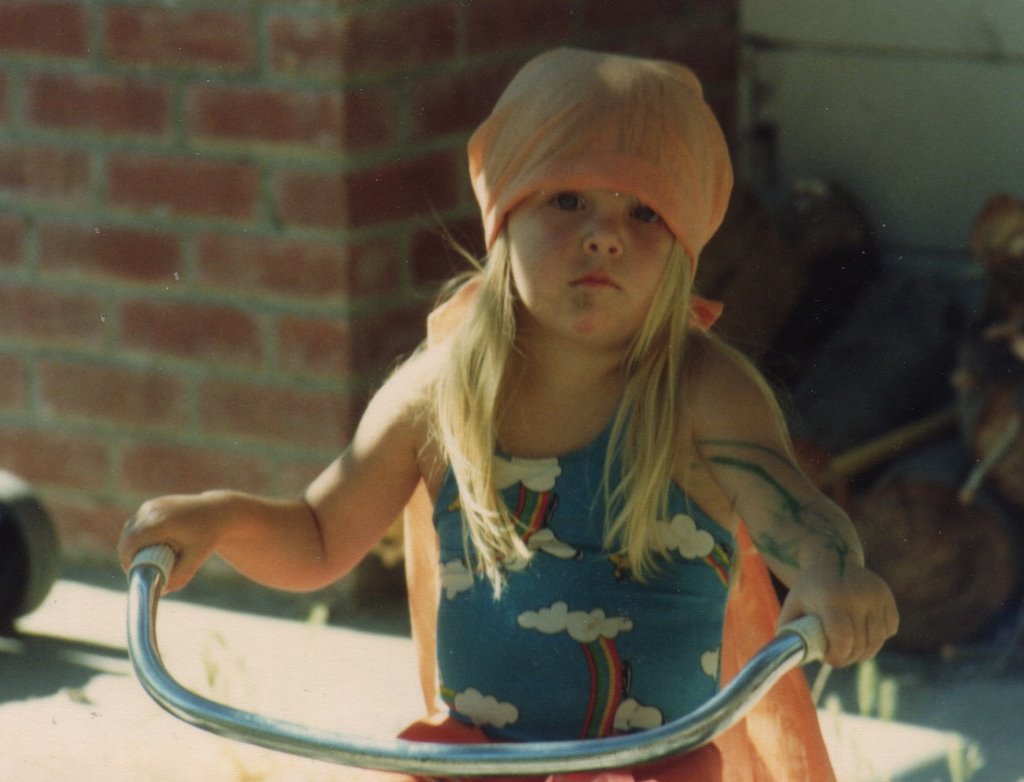
Happy 29th Birthday, Mol!


Last night I was invited to a surprise birthday party for my one and only daughter Molly who turns 29 today. It was organized by her girlfriend Tibi and her friend and housemate Tamara and we gathered in the kitchen of their rambling old Santa Cruz house to hang crepe paper, arrange flowers, and lay out fruit and chocolate treats while she and Tibi ate dinner at a nice restaurant downtown.
Besides the small group of her closest friends, Molly's parents were special guests. I haven't seen all that much of her mother, Cici, in the five years that we have been divorced, and sharing the honor of celebrating the birth of our daughter felt a bit awkward. But the focus on Molly filled the empty spaces and there was much laughter as we rehearsed how we would greet them when Tibi brought Molly into the house. Finally the car lights shone in the driveway and we hunkered down in dark silence as footsteps came down the hall.

"SURPRISE!!!!!!"

Molly stood in stunned silence, her hands fluttering around her face, tracing the smile that threatened to break out and fly around the room. "oooohh," is all I recall her saying. Then, when her voice returned, she told us that she had never had a surprise party before (her mother and I looked at each other, trying to remember childhood parties which may or may not have been surprising). She went around the room to hug everyone who came.

We feasted on rasberries, wine, chocolate and watermelon. Cici remembers eating alot of watermelon when she was pregnant with Molly and credits this with her daughter's addiction to the big fruit today. The watermelon was fresh and sweet.
I gave Molly my small present first, a copy of Sharon Salzberg's book, Loving-Kindness: the Revolutionary Art of Happiness. Several years ago, I had given her the Buddhist teacher's book Faith and Molly said that she was finally reading it and appreciating Salzberg's insights. I thought the classic book on loving kindness meditation was a suitable followup.

A little later I pulled out her big birthday present, an Apple G4 iBook. Molly has wanted a laptop computer for some time now, and after returning from Argentina I started looking online and eventually started bidding for one on eBay. The first half dozen or so I lost in the final minutes of the auction when someone invariably came along to trump my bid. I realized that to win you needed to act quickly. Last week I had my eye on two and their auctions were ending about the same time. But I failed to see that I'd won the first and bid up quickly on the second, winning them both. I chose the fastest one with the most memory for Molly and updated all the software. Her mother and I paid for a little more than half the cost of the computer. When I presented it to her, she hugged the white laptop like a newborn babe. That's my daughter!

After the food and presents, we all circled around Mol and appreciated her with stories. Samantha remembered working with her at the Herb Room ten years before and several friends recalled how Molly always greeted them with warmth and love. A couple met her in the performance group Urban Rennaisance and were awed when they heard her sing. "She opened her mouth and out came this incredibly beautiful black voice." It was so good to see Molly's beauty and strength through the eyes and words of her friends.

I remembered the day Molly was born and how her mother and I watched so carefully for signs of labor that we went to the hospital too early and had to pass the time with pizza and massages and tea with Godmommy Ann. Her water broke while we were lying on the floor of the house in Harvey West Park, right on the oriental rug, and we rushed to Community Hospital where Molly was born in the birthing center, in a room with a large brass bed. She came out with a full head of dark hair (which quickly turned blonde and stayed there) and I gave her a bath in warm water to ease the transition from womb to world. The three of us spent the night in the brass bed and went home the next morning to begin the loving relationship that continues today.

I remembered swinging with Molly in our hammock outside when she was a week old. And I remembered our trip across the country when Molly was five and how I tried to impress her with the Grand Canyon, arriving at dawn to the accompaniment of music by Bach on the tape deck. She got out of the car, took a look, and said: "It's just a big hole." Molly was born with a deep strong voice. She and I appeared together in Mountain Community Theater's youth production of "Fame" when she was perhaps eight; I played a music teacher and she channeled Bette Midler in singing "Wind Beneath My Wings" which brought me to tears at every performance.

But, as I told her friends, our relationship has not always been a bed of roses. Molly was always head strong and determined. We clashed often as she was growing up. I stood by helpless as she struggled with weight issues and Bell's palsy during puberty, and I often felt like an outsider, watching the circle of supportive friends gather around her and seeing with envy the close relationship she had with her mother. Molly's courage in the face of adversity was astounding. Unsure of what I had to offer, I tried unsuccessfully to teach her the joys of research when she was home schooled, and I surrounded her at home with recorded music of all kinds. The academic example failed, but I think she benefited by absorbing music into her very bones. And it was Molly of all my four children who heard the siren call of spirituality and has followed some of the paths I have taken in my long search for the divine.

And finally, at a concert last week where Marina sang songs from the 1940's and 1950's, Molly and I danced. Following the example of her mother, she has always been involved in movement, from yoga to African, Brazilian and other forms of dance. When she was a babe in arms, I used to dance her to sleep. Now, as adults, we danced together, twirling around the polished wood floor at the Pacific Cultural Center, and it was delightful.

Molly, I love you. Happy Birthday!

Wednesday, August 30, 2006

Jesus, Our Sadguru

"All we need is Jesus," the woman said. "Why do we need anything else?" she asked at the final session of Father Cyprian Consiglio's four-day retreat last weekend in the redwood-covered hills above Santa Cruz.

Her question deserved an answer, and Cyprian, who always diplomatically walks the razor's edge between orthodoxy and heresy, did not respond, other than to gently praise her faith in Jesus as the alpha and omega. The woman had seemed confused about all the talk of Hinduism and meditation during the retreat on the theme of "Spirit, Soul and Body: The Univeral Call to Contemplation." Much of Cyprian's theology is rooted in the writings of Fr. Bede Griffiths, a Benedictine monk who lived in India for forty years. Another man at the retreat was clearly upset by the video shown the night before on the life of Abhishiktananda, the French monk who came to India and put on orange robes and a swami's name. "I didn't hear anything about Jesus," he complained. Some of the retreatants come annually to the late summer weekend at St. Clare's Retreat House and were more used to the orthodox Christianity of George Maloney who used to give the retreat but died last year.

For those unused to the Eastern perspective on Christianity which Cyprian has been offering in public talks for several years, the distinction between meditation, contemplation and prayer was blurry. The man who could not find Jesus in Abhishiktananda's Asia journey claimed to have been meditating for 35 years. But it turned it his meditation was a technique for visualizing Jesus in the Gospel stories and not a method for setting aside discursive thought, even orthodox and very beautiful religious thoughts. Cyprian's talks came between periods of meditation, and each day began with yoga designed to lead into contemplation. Once we even meditated for three periods in a row, interrupted only by stretching to straighten out the kinks, awaken numb legs and massage sore knees.

Why, indeed, do we need to see Jesus and his Gospel message through spectacles from the East? Cyprian did not say that all paths lead to God, even through the emptiness of Buddhism. He did not say that other revelations leading to the formation of other religions were equally valid, and that Moses, Krishna, Buddhai, Lao Tzu, Mohammed, and other gurus, avatars and spiritual leaders were the equivalent of Jesus. In fact, he disavowed a "soggy synchretism" in which we would say of religions: "It's all the same." As if to demonstrate his orthodoxy as a Catholic priest, Cyprian told of his practicing of chanting the Psalms daily and praying the rosary. But he also spoke of his one meeting 15 years ago with Bede Griffiths at the Camaldoli Hermitage in Big Sur when he sat across from the tall, thin white-haired man dressed in an orange robe, looked deeply into his eyes, and decided: I want what he has.

"Christians need to open their hearts to Christ within, experience Christ within as their guru. This is the function of the ashram," Griffiths wrote. Sadguru is the name for the supreme teacher of Hindu devotees, the teacher who inspires us from within the cave of our hearts. And the monk Abhishiktananda, whose place Griffiths took at Shantivanam Ashram in southern India, was reported to have said: "I have often written that Jesus is my Sadguru. It is through his mystery that I have discovered God and myself, that I have caught hold of my identity."

During the retreat, Cyprian talked of the many young people who had left Christianity for the spirituality of the East. Bede encountered them in his ashram. They were ignorant of the depths of their own Christian tradition, of techniques of meditation thousands of years old and mystical wisdom from the Middle Ages that mirrored teachings in the Hindu Vedas and the Upanishads. It was to show them a bridge back to their roots, not an attempt to prove the superiority of the Christian revelation, that Bede and now Cyprian have dedicated their teaching.

I spoke up about my own experience. Raised in the Protestant faith, I drifted away from the church in my teens and explored a variety of philosophies and spiritual paths, including Theosophy, flying saucers, Subud and Transcendental Meditation, as well as Buddhism and Vedanta. The Christian God was too small, too culture bound, too locked into a language -- English -- that dogmatic followers claimed to be His (never her) words, the literal truth. Christians seemed to want to beat followers of other faiths into submission, into conversion. I wanted none of it.

In my middle years I discovered the writings of Thomas Merton, who led the way to a revitalization of Christian spirituality after the opening of Vatican II, and I decided that I wanted what that man had: I became a convert to Catholicism 20 years ago. But even then, I shuddered when one of my catechists said to me: "Buddhism and Hinduism, they're cults." Not long after my confirmation, unable to find kindred souls who shared my love of other spiritual faiths, I lapsed. It took a serious illness and a broken marriage to bring me back into the Church, and then I was able to find many who were on a journey similar to my own.

I could never believe in a God with a long white beard who lived in the sky, watching -- and judging -- our every deed. I could believe in a God who was the divine spirit indwelling within us all, and, indeed, in all creation. It is this Spirit which was the central topic of Fr. Cyprian's conferences in which he talked of the "anthropology" he borrowed from Bede, of spirit, soul and body. Soul and body are the ordinary dichotomy we think of as mind/body, the substances analyzed by Descarte. Soul, for Bede and Cyprian, however, is much more, and includes some of what is thought of as religious (visions, etc.). Cyprian's goal, along with the Apostle Paul, is the transformation of our minds so that we become receptive to the Spirit. But how to do this is the question. "God is in the details," a fellow monk told him, the "tremendous trifles" referred to by G.K. Chesterton.

Spirituality, Cyprian told us, is a practical science, and spiritual evolution is ongoing. He quoted Gandhi who said "my life is my message," and suggested that how we live is what we believe. Nelson Mandela said: "When we are liberated from our own fears, our very presence liberates others." A commitment to a spiritual life is what is important, not the constant monitoring of what progress we have made. Cyprian also talked about the solitude of contemplation and how in the depths of meditation we are "alone with the alone," no less a celibate monk than the nun or brother in a cloister.

Cyprian grew quite passionate when he talked of a Catholic who wanted him to be a gate keeper, to refuse the Eucharist to homosexuals and proponents of abortion. "I told him I wanted to be over there with the whores and tax collectors. I wouldn't make decisions to exclude anyone." And he was also passionate in discussing the environmental crisis. "Humans are the keystone species; we should be the priests of creation, taking care of it rather than desecrating it." How we treat our bodies, i.e. with junk food and TV, is how we care for the earth, he said. An individual transformation of consciousness, he believes, can lead to a social transformation, one person at a time. I don't totally share his faith in this gradual kind of change, thinking that it might already be too late for gradualism, but I agree that transforming our own consciousness may be all we can individually accomplish.

When I am alone with the alone, my soul talks incessantly, mostly of inane things, but sometimes it regurgitates memories and constructs imaginary scenarios that are disturbing. As a single older man, I find thoughts of sex an unwelcome and constant companion, and the vindictiveness I often feel towards a former spouse is an insurmountable barrier it seems to union with God. How can I experience the love of God if the preoccupations of my mind are so unseemly? I trust the words of Jesus, Cyprian, Bede, Merton and others: God's love is constant, the Spirit of God dwells in the cave of my heart (closer than our jugular vein, as the Muslims put it). But it is my stuff that gets in the way. I am not so much journeying to God as trying to find my way back.

Tuesday, August 22, 2006

Washington Comes to Santa Cruz

Our congressman, Sam Farr, held his annual Town Hall meeting at the Vet's Hall last night before a packed house of his constituents. We're fortunate to have a liberal and progressive (somewhat) Democract representing our interests in Washington, but I was not reassured by what he had to say.

Fiscally and politically, the United States is in deep shit (my word, not his). The Republicans in power, far from being fiscal conservatives, have turned out to be big spenders. At the same time as they were lowering taxes, the debt ceiling was raised to $9 trillion dollars. This was "reckless and immoral," Farr said, adding that "we're in the worst fiscal crisis in U.S. history. " Things are just as bad in the political sphere. In our electoral system, winner takes all, which means the end (winning elections) justifies any means. Because of Bush's narrow electoral margin and Republican control of the House and Senate, the Democratic party is effectively shut out of power. If we don't regain control of Congress in elections this fall, it's all over, folks (my pessimism, not Farr's).

The one sign of hope Farr mentioned was Lieberman's recent defeat in Connecticut. There the people made their discontent heard and defeated a pro-war Democrat.

On Iraq and Lebanon, Rep. Farr's positions are a mixed bag. He has been a consistent critic of the fiasco in Iraq and at the meeting signed the Congressional pledge offered by the Declaration of Peace to support legislation to withdraw troops and close bases. But when questioned about various bills and resolutions to achieve these aims, he seemed confused about details. As a minority party, he said, the Democrats have little chance of passing any of this legislation. The only solution is to win control back in November.

Farr is a consistent supporter of Israel and signed, along with most of the House, H. Res. 921 which puts most of the blame for the recent troubles on "terrorists," Hamas and Hezbollah. In his favor, the resolution was offered before Israel's disproportionate destruction of Lebanon and the slaughter of innocent civilians. And he said to one questioner at the meeting that debate on the issue might have been much more intense if the resolution had come at the end of Israel's shock and awe bombing campaign instead of at the beginning. But he made little attempt to explain his blanket support of Israel other than to point to an extension of remarks which simply repeats his criticism of Hamas and Hezbollah without any criticism of Israel's heavy handed methods which are supported and financed by the United States. He seems unable to connect rising terrorism in the Middle East with our policies there, in Iraq, Afghanistan and Israel.

One man stepped up to the microphone and said he hoped Farr would help put "some spine" into the Democrats. Farr protested that the news media, which has been concentrated into the hands of a few, was not covering what Democrats were saying, making it seem that nothing was said and Democrats were spineless. This, he said, was not the case. But the internet now makes possible a wide variety of news sources and blogs, and it is not at all apparent to me that any particular Democrats are challenging the status quo. After all, the Democrats under Clinton pushed corporation-sponsored globalization policies that have hurt poor people everywhere, and their support of Israel was just as myopic and short-sighted as Bush's.

I think Farr is correct that our winner-takes-all system makes it difficult if not impossible to protect minority (even 49%) interests. De Tocqueville warned long ago of the "tyranny of the majority," and that indeed is the case today. It remains to be seen if democracy, as a system of government in which each citizen has a stake, can survive in the United States. I am not very hopeful.

This morning in a discussion on NPR a constitutional lawyer voiced his fear that the groundwork is being laid for a dictatorship in this country, justified by an unending war on terror. All it will take is another attack of the caliber of 9-11 and the freedoms we have taken for granted for generations will be gone. King George is polishing his crown.

I was surprised that the local Israel lobby, which staged a demonstration at the Town Clock several weeks ago in support of the slaughter in Lebanon (they claimed they had a permit and would not allow dissenting voices on their corner), was not in evidence at Farr's Town Hall last night. Perhaps they know that he is safely in their pocket.

Wednesday, August 16, 2006

Coming Home

"You can't go home again," Thomas Wolfe wrote, and boy was he right. "Home," that figment of the imagination, somehow moved while I was away in Argentina. Everything looks the same, but I feel as if I'm still on the airplane and we're turning, turning, turning.

Yesterday evening, after watching Woody Allen's frivalous "Scoop," I walked down Pacific Avenue, drifting along with the crowds, into the book stores and down to the record store. Wherever I go in the world, I think of Santa Cruz as paradise, the urban sanctuary hippies dreamt of in the Sixties, a progressive and liberal, free-thinking bastion of freedom and hope for all the disenchanted and marginalized in Bush's America. But last night all I saw was ugliness and misery, tension and anger. Nothing overt, mind you. It was in the faces, in the dress and the posture of the people I passed, particularly the young. I know some residents are fearful of walking past the Catalyst and the bus depot where today's disaffiliated and rootless poor tend to congregate, but not until last night did I feel afraid. "Money for pizza," one young bearded man in mufti growled at me. An overweight young woman shouted nonsense syllables at people passing by. Tattoed and pierced people, their heads hid in dark hoods, wheeled bikes down the sidewalk, daring you to challenge them. A trio of young girls, stomachs agressively bare, walked by, speaking a foreign language (it was not Spanish) in squeaky voices. Was this MY Santa Cruz?

At my son's house in Sonoma not long after flying in to San Francisco, I picked up an issue of Rolling Stone and read a riotous rant against the modern world by that prophet of the absurdities of life, Kurt Vonnegut. Now in his 80s, he said "I'm forced to suffer leaders with names like Bush and Dick and, up until recently, Colon." Calling himself Jeremiah, he ticked off the sins of our age: We're "killing the planet as a life-support system with gasooline...This is the end of the world...Of course, the lunatic fringe of Christianity is welcoming the end of the world as the rapture. So I'm Jeremiah. It's going to have to stop. I'm sorry." But when pressed for advice he might give young people who want to help, he replied: "There is nothing they can do. It's over, my friend. The game is lost." In my most pessimistic moments, I agree. But is this an epiphenomenon of geography? If I had remained in Argentina, or lived in on a beach in Thailand as I sometimes dream, would the future of the world still seem as dire as it does in the belly of the beast?

As I write, the glug glug glug of plumbing in distress echoes from my bathroom. One of my closest friends, recently returned to Berkeley after a year-long manic episode that costs him thousands of dollars, tells me matter-of-factly that he had a heart attack a month ago. This morning I'll visit another friend, in the hospital recovering from an operation for stomach cancer which followed a stroke. Jim in Fresno seems to have disappeared; he won't answer my emails or respond to phone messages.

But outside my window a purple flower (will I ever learn their names?) blooms, and it attracts a hummingbird that seems unworried by my typing. A woman I knew as a newborn, visits from Georgia with her two girls and tells me that her third kidney transplant seems to have been successful. Shirlee's garden is a vibrant collage of greens, although it is probably the giant redwood's roots that are mangling my plumbing. The good and the bad always coexist.

Argentina gradually fades from my memory, leaving behind firm images in the photos I took, more than 1200 of them, which I now have to edit and put in some semblance of order so that I can share these Kodak moments I saw with others. But of course the sounds of traffic and Castellano voices and the smells of smokey air and dog poop on the shoe are missing, as is the welcoming sound of Ofelia's "buen dia" when I would come to a breakfast of stale toast and instant coffee precisely at 8:30 in the morning. As I walk down the street in Santa Cruz I am also walking down Avenida Federico Lacroze in Belgrano, and the faces I see here jar against the memory of the faces there.

When I travel, irksome conditions of the skin and scalp take a holiday. My doctor says his eczema disappears when he goes on vacation, and he attributes this to an abscence of stress. When I go away on a journey to a faraway place, I leave appointments, meetings, duties and responsibilities behind and focus on the task of getting to know a new place for the first time (or in some cases revist old memories to see how they hold up). Coming back home, they descend like an out-of-control heavy stage curtain on the unsuspecting actors below. The glorious freedom of sipping a cafe con leche with an empty mind at an outdoor table under the bright sun in Buenos Aires is gone. Anti-dandruff shampoo becomes once again a daily necessity.

In Argentina, more than halfway south to Antarctica, the news of the world came from far away: Slaughter in Lebanon, a drunken Mel Gibson goes anti-Semitic, terrorists in London plot to blow up planes with liquid explosives. But when we got to Ezeizia International Airport I realized once again how small today's globe really is. A very short time after the arrests in London, policies were in place in all airports to ban liquids and gels from carryon luggage. We had to endure very long lines at the check-in counter, at the gateway to the departure lounges, and again in the lounge for our plane where hand luggage was examined thoroughly by pleasant women wearing plastic gloves. And a man passed a magic wand over our body to ferret out anything metalic that might be dangerous, like fingernail clippers and the like. There seemed to be enormous duplication of effort. In Atlanta, even though we were in transit, the process was repeated, our shoes once again x-rayed, out luggage once again pawed over. I did not feel safer. And I realized that, like checkpoints and searches that sprouted after the first airplane hijacking years ago, these procedures would stay in effect forever. No more bottled water carried on planes, no more lipstick applied before landing. I expect that soon anything powdery, and indeed all carryon luggage, including detective novels and iPods, will be banned by the authorities concerned about saving us from the dark side of terrorism.

This might be justified if a real threat existed. But according to the stories I am reading, the so-called terrorists in London, who had been watched for some time, had neither current passports nor plane tickets, and they had not yet put together workable explosives. The threat of liquid explosives on airplanes was mentioned in the 9/11 official report, but no security measures had been taken back then. And the one known instance of a liquid explosive being used was not as devastating as feared. So once again the lying regime of George Bush has manufactured a threat that did not exist, outside of disgruntled and speculative conversation, to terrorize the world into accepting their disastrous agenda of spreading capitalism and control around the globe. It makes me sick.

Have I mentioned that everywhere I went in Argentina and Chile people wanted to speak to us about their dislike of George Bush? Of course, my inadequate Spanish made it difficult to carry on the deep political discussion I wanted to have, but it was easily seen that the United States and Israel are today the leading candidates for Number 1 Pariah.

It was encouraging to me to learn that the new democracies of South America -- Argentina, Chile, Bolivia, Brazil, Venezuela -- are uniting, under the paternal gaze of Fidel, to oppose Bush's policies. Everywhere they are overcoming the tragic years of military rule in the late 20th century, when numerous US supported right-wing dictatorships, their soldiers trained in torture at the School of the Americas in Georgia, murdered their own people for supporting peace and social justice. This killing still goes on in U.S.-friendly Colombia. I believe, with left-thinking people everywhere, that the United States is now the greatest threat to world peace. Our democracy is strangling in the grip of an unscrupulous religious right-wing cabal in Washington which utilizes 1984 newspeak to numb the consciousness of many Americans. Veep Chaney is channeling Joseph McCarthy when he accuses the foes of that turncoat Joe Lieberman of aiding Al-Quaeda. Oh, what a tangled web they've woven!

Friday, August 11, 2006

Last Thoughts From Argentina

Plaza de Lavalle
It's time to take stock of my experience in Argentina. I have been in Buenos Aires now almost four weeks and our plane leaves in tomorrow for California and home. Yesterday morning when we met in a cafe in Palermo to study for this afternoon's final exam, Toni brought with her a tourist guide she had found in her host's apartment. It was written for people like us who have come to Argentina to study Spanish. And it told of the three-week syndrome when visitors become sick of Buenos Aires, Argentina and their Spanish classes. But it passes quickly, according to the guide. Not so for Toni who by Wednesday was so sick of everything about this place that she was ready to fly off to Tierra del Fuego and Antarctica. She wanted nothing to do with the farewell banquet to be held tonight at a nice restaurant in Las Cañitas.

I don't want to speak for Toni, who has her own reasons to be fed up with being here. But the negativity among the students is palpable and it does not at all resemble the experience I had studying Spanish in Oaxaca a year and a half ago. I don't partake much in the gossip but I do hear that many in our group from Cabrillo are discontented. One reason might be sickness. A large number seem to be hacking and wheezing and one is able to manage only by taking codeine-laced cough syrup which she bought by canvassing numerous farmacias until she found one willing to sell her the drug. There are complaints about living arrangements, the lack of hot water, absence of privacy, the difficulty of finding a place to study, weak light bulbs, poor food (or no food). Several students have given up on classes altogether because they were more interested in exploring the city than memorizing verb tenses. Others find the material covered too demanding (or the progress too rapid), and some find their fellow students a distraction.

I have been told that I'm a success, that my happiness with the Argentine experience is rare. Certainly I don't embrace the negativity I've heard (being prone to make lemonade. But I am not a polyanna about this city and country and have some critical to say about it. On my part, I think I'm lucky. Ofelia has been a wonderful hostess,and although living together in such a confined space has not been easy, I have managed to get my major needs met: a good shower, adequate and tasty food, and a comfortable bed which has made sleep easy. I don't spend much time in Ofelia's third-floor aparment on Avenida Santa Fe in Palermo, but stay out daily from 9 in the morning until about 9 at night. Certainly this way, we don't get tired of each other.

I came well prepared to have a good time. For months I've been watching films made in Argentina, reading the Lonely Planet Argentina guide and two LP guides for Buenos Aires, reading a history of the country by Jonathan C. Brown, and listening to tango music, particularly the classic songs by Carlos Gardel. I watched again Madonna's "Evita" as well as a documentary on Mrs. Peron's life and a fictional version made by an Argentine director. I was familiar with the "Dirty War" and its consequences and I was particularly eager to march in the Plaza de Mayo with the mothers of the disappeared who have been in search of justice for almost thirty years.

Exploring new cities has become somewhat of an obsession with me. I've been to Bangkok several times and can find my way around it easily. Last summer I went to Barcelona for a week to study Gaudi's architecture and practice my Spanish. I followed this with Rome, and spent much time in London which I knew well from my days there circa 1964-66. In Vietnam last fall I walked all over Saigon and Hanoi. Antigua, Guatemala, may be much smaller, but I know its streets and churches well, as I do the sights in Oaxaca. So I knew what to do when I came to Buenos Aires and I had plenty of time to do it in. On our cathedral tour in England last summer, one of the members talked of "bagging" another church. I've just bagged another city.

Rather than recount every experience that I've checked off in my Lonely Planet guides, I want to make some general observations about the people I've met and observed here and draw some conclusions about the culture. When I met with Beverly Keene yesterday, an America who has spent twenty years here, she confirmed many of my impressions.

The Subte (underground or metro) is old and in need of some sprucing up, but it's efficient, and I have taken the D line numerous times from Carranza station in Palermo to the Catedral station in the Microcentro barrio downtown. Most of the time I've stood because the cars always seem full and I've looked closely at the people. The ride is frequently interrupted by beggars and entertainers. The other day a young man began talking loudly while holding up a picture of a cat. Then another man at the end of the car began shouting at him. They had a loud dialogue back in forth in Spanish which I could not understand and I tried not to look. Then the people in the car applauded, and I realized it had all been street (or Subte) theater, although I don't have a clue what it was about. Then the actors passed the hat. I've seen children with babies, jugglers, vendors of useless goods, a reggae singer, and more. It's often entertainer and never uninteresting.

My impression, however, is that the people I see are sad and lifeless. Their mostly European faces often have a gray unhealthy palor. Of course, visiting a city in winter is not the best time to make judgements about what its like all year round. But I can't help thinking that the long ugly war against its own people, and the endless economic trouble has crushed the spirit of Argentians. It doesn't hold true of everyone I've met. Eugenia, our wonderful teacher, is a live wire, full of curiosity and enthusiasm. The daughter of two doctors, she is obviously from a privileged class and has been well educated. The young people I see in the lounge at the Universidad de Belgrano are like young people everywhere. But the homeless I see sleeping or drinking in the parks (not unlike Santa Cruz or San Francisco), and the poor cartoneros who come into the city at night to pick up recyclable paper and cardboard show another side. Many of the poor I see have dark skin and are probably immigrants from Peru, Bolivia and Paraguy, and some are probably here illegally. Eugenia confirms that there is racism against people with indigenous genes and dark skin.

One of the high points of my trip was going to midnight mass on the eve of the feast day of San Cayetano. I heard about him at the Museo de Deuda Externa, where images of the saint are used to illustrate unemployment. He has become the patron saint of bread and jobs here in Argentina and his feast day, Augusut 7, is a major occasion. It turned out that Ofelia was a devotee of this saint and she took me, along with her tenant Rita, to the mass not far off Avenido Cabildo in Belgrano. It was not the major shrine, which is out of the city in Lineares, but there were hundreds of people at nearly midnight who were lined up waiting to be the first to pray at the statue of the saint and touch him for good luck. The hall was packed and we had good seats since we arrived early. The pilgrims streamed by the saint on the mezzanine upstairs endlessly during the long mass. At the end, people held up stalks of wheat, symbolizing bread, and the keys to their house to be blessed by the priest. It was for me a moving experience of popular piety in action. I think Jesus would be proud.

Another high point of my trip, two actually, was the discovery of two wonderful artists. Eugenia had mentioned Antonio Berni in class as an artist who painted social justice themes and I saw a wonderful painting of his at the Malba gallery of a strike in the 1930s with a sign in the background reading "Pan y Trabajo." The huge painting contained a sea of poor faces and was heart-rending. The other artist whose works I first saw at the Malba was Xul Solar. He has been called the William Blake of Argentina (I think the multi-talented Berni is probably the Pablo Picasso), and I later went to visit the mseum at his house and was awed by what I saw. His work is colorful and playful and his themes constantly refer to an eccentric spirituality that I love.

Walking in the Plaza de Mayo with two groups of mothers of the disappeared was very moving and certainly a high point, as was talking with three of them at their office about what it was like to lose a daughter or son and not know what happened, then or now. I enjoyed talking with Juan De Wandelear about his work putting together a memorial to all the victims of state violence which will resemble the Vietnam wall. He told me about a memorial to four women that had been disappeared in the 1970s from the Iglesia de Santa Cruz and I went to pay a visit. I was surprised at how many demonstrations I saw of people disgruntled about something. Porteños do not seem as apathetic as my countrymen, many of whom are anesthetized by too much wealth, or by the media, to the wrongs of the world.

I loved sitting in the many cafes drinking cappuchino or caffe con leche or cafe costado and reading, doing homework or watching the people, and the very efficient waiters in their white coats. I liked that they always delivered along with the coffee a glass of water, with gas or without, and often a tiny cookie.

I've already spoken at length in my blog about the two weekend trips I took -- to Santiago, Chile, and to Salta and the Quebrada de Humahuaca in the northwest of Argentina. Both were illuminating experiences and they gave me very different perspectives on the southern cone of South America.

There is so much more positive that I could say, but I want to add a few more words of criticism. Buenos Aires is full of dogs and dog-walking is a major career choice (I saw walkers with up to 20 dogs at a time). But dogs need to poop and the sidewalks are filled with caca, even though there are laws like our own which require people to pick up afterwards. Stepping in Argentine dog shit is a memorable experience one would like to forget. The sidewalks are often dangerous for many reasons, not the least because the pavement is often uneven and broke, and the ground litered with trash. The residents seem to think nothing of droping cigarette butts, papers, and what we would think of as recyclable cans and bottles on the ground. I understand that Buenos Aires has a nighly garbage pickup but you wouldn´t know it from walking in their filthy streets. Ofelia agreed with me that it was a tragedy.

It's not that porteños are obsessed with death, but I have appreciated the ornate homes for the dead they've constructed in the cemeteries in Recoleta Chacarita. I visited Evita's tomb in the first and Peron's in the second and it's unclear why they're not buried closer together but rather reside for eternity across town from each other. It might have been the doing of Peron's second wife, Isabel. Both tombs are quite modest but the faithful bring flowers to each daily. I also visited Carlos Gardel's grave in Chacarita where the walls are littered with plaques thanking him for his music and favors rendered. I watched a man cross himself as if Gardel has already been beatified. There is a life-sized statue of him and devotees place lit cigarettes between his fingers. Another pilgrimage was to Gardel's house in Abastos, the district where he lived. The house is modest but a number of the buildings on the street have been colorfully painted with fileta decorations, the unique porteño style of baroque lettering. There are images of Gardel everywhere in Bs As and he stands alongside Evita as the icons of Argentina (Che Guevara who was born here comes a close third).

I haven't said anything about the Obelisco which looks like the Washington Monument, or about mate drinking or the fair in Matadores on the outskirts of the city that we attended the first weekend, or the limited national cuisine unless you love steaks and pizza. Also on that first weekend was a glorious sunny Saturday when the whole city seemed to congregate in the Bosques of Palermo, a lovely where where I went bicycle riding. Or watching Stravinsky's three ballet operas at the magnificent Teatro Colon which is about to celebrate its 100th anniversary. Clearly there is much to see and do in this city.

Finally, I want to say something about studying Spanish in Buenos Aires. It hasn't been easy, but I think that has something to do with the leaky nature of my aging brain. Although I studied at length, I'm sure I did a very poor job on the final yesterday. Not for lack of help from Eugenia, our teacher, however. She has been wonderful, and the conversations she's stimulated in class have gone all over the map: abortion, Argentina's politics, Noam Chomsky and various linguists, movies, whether we're optimists or pessimists (Argentinans, we learned, think little of the future but live primarily for today; they are obsessed with appearance). Rather than teach to the text, Eugenia took cues from our mistakes and our questions to guide us through the intracies of verb tenses and the difference between por and para. It didn't seem like we progressed through that much material in the four weeks we studied with her, but I know that I'll carry some of her lessons and insights with me back to California. For a party gift I bought her today a Spanish translation of Thomas Merton's writings on oriental religions.

Last night Moochie invited me to dinner with her guests, Lorraine and Toni, and Nancy, our teacher from Cabrillo, also came. Michael, Moochie's other guest from Texas, also joined us for a terrific dinner of gourmet pizzas, ensalada a la casa, and a fine Malbec wine which was my contribution (it's impossible to pay more than $10 for a bottle, no matter how good it is). Moochie gave me an interesting magazine on the martyrdom of Bishop Enrique Angelelli and the gesture touched me. She is a former nun and understands my interest in monasticism and Thomas Merton. I wish I understood her Spanish better. She speaks rapidly and has an accent I believe which sounds a little different from what I hear around me. After desert (lemon cream pie and some sort of dulce), I tendered my adios and went home across the street.

And so, after another farewell dinner tonight, and a farewell lunch planned for me by Ofelia on Saturday, I bid Bs As and Argentina adios and hasta luego. The news about air travel, however, is not good. Because of the arrest in London of two dozen people plotting to blow up U.S.-bound airplanes with bombs inside liquid in carryon luggage, all liquids now are banned and luggage is being examined more closely. There will probably be long delays tomorrow. My first suspicion was that it was another group of men who were overheard complaining about the U.S. and thinking of terrible things they might do to it. But apparently, the plot was much more sophisticated and advanced. So therefore I'm thankful they've been captured. But it will impact our trip home and might affect plans for travel to India in December.