Thursday, June 22, 2006

The Crucifixion of Palestine

In 2003, a year after Israel had begun construction on a 440-mile wall to separate Palestinians in the Occupied Territories from Israel, Pope John Paul II said: "The Holy Land does not need walls, but bridges." The wall, he said, "is seen by many as a new obstacle on the road leading to peaceful cohabitation."
Without the reconciliation of spirits, there can be no peace. May the leaders have the courage to return to dialogue and negotiation, thus opening the way toward a Middle East that is reconciled in justice and peace.
Nearly three years later, the pontiff's hopes have not been fulfilled. The wall, built largely on Palestinian land inside the 1967 "Green Line" separating the two sides according to international law, has effectively cut the West Bank into enclaves, making movement between communities, or between towns and farmland, almost impossible. Illegal settlements, however, are protected, in effect made a part Israel. The UN calls the wall an "unlawful act of annexation," and says it cuts off more than 200,000 Palestinians from social services, schools and places or work. The wall, and roads built for troop movements but denied to Palestinians have carved the Occupied Territory into bantustans, the geographical technique used by white South Africans to enforce apartheid.

Years ago I heard Catholic theologian Rosemarie Radford Ruether argue that the Arab-Israeli conflict, now almost sixty years old, is not about religion but about land. This to me was a startling claim, given the almost universal belief that the battle was between Jews and Muslims, with Christians often caught in the middle. But for Ruether, the struggle was over land -- the "deserts" made by Jewish settlers to bloom on land where the homes, villages and olive trees of the original residents had been bulldozed by the Israel Defense Forces.

Today there is a humanitarian crisis in the West Bank and Gaza where nearly four million Palestinians are suffering under the brutal occupation. After the victory of Hamas in democratic elections earlier this year, needed aid from the US and Europe has dwindled to a trickle. Services are crumbling. Targeted assassinations of Palestinian leaders include innocent bystanders, often children. Businesses are failing. Over 50 percent of the residents have fallen below the poverty line. A public health disaster and starvation are possible.

Is all this retaliation for a horrific campaign of suicide bombings, or is it part of a master plan to ethnically cleanse the Promised Land of an Arab presence? If outright "transfer," the euphemism coined to describe Palestinian removal, is not possible, then apartheid is the means to make life so impossible that residents of the West Bank and Gaza will have no choice but to move elsewhere. I know this sounds like conspiracy theory, but a little research will uncover a consistent thread to the motives of successive Israeli leaders.

All of this breaks my heart. The stories and photographs coming out of the Holy Land portray a crucified people, abandoned by the powers of this world. I bow my head in guilt for the injustices caused by my government in my name. The United States has been the prime supporter of Israel and currently provides almost $3 billion in aid, more than it gives to any other country. The media and Jewish lobby in this country portray criticism of Israel as anti-Semitic. But to be anti-Israel is not to be anti-Semitic.

When I studied Jewish mysticism and the history of Judaism with Mishael Caspi at UC Santa Cruz in the 1980s, he spoke of life growing up in Jerusalem as a boy before World War Two. He said that Jewish, Christian and Muslim children played together happily in a time of innocence before the establishment of the state of Israel. I also learned about a golden period in 12th century Spain when Jewish and Christian mystics and Muslim Sufis flourished together. The People of the Book are not natural enemies. They worship the same God.

Jews have long suffered at the hands of Christians, due to the misguided notion that they were responsible for Christ's death. They were expelled from Spain in 1492, were persecuted in Eastern Europe in the 19th century, and were exterminated by the millions in Nazi death camps during World War Two. The ideology of Zionism called for a homeland where Jews might be safe and, with the aid of guilty Europeans, settled on Palestine. They believe the land had been promised to them by God over two thousand years earlier. But Palestine was already occupied, by mostly Arab Palestinians, and they had lived there for many generations. Why should they leave? The Native Americans must have felt the same way when European colonists took over their land. My father long ago taught me that two wrongs don't make a right. The treatment of Palestinians is a crime that must be stopped.

Many observers of this tragedy, like historian Tony Judt, have called for a one-state solution to the problem: Jews and Arabs living together with equal rights. But this would mean the end of the religious state. And why not? There are many successful multi-ethnic states, the United States among them. Besides, there is not enough territory on the earth for every religion or every ethnicity to have a piece of the pie. Religious states, like Israel, or Iran, are inherently undemocratic, granting more rights to the dominant majority. The two-state solution, called for by the United Nations since the 1970s, and given lip service by the presidents of England and the U.S. (and occasionally Israel) is impossible without contiguous territory and a measure of administrative control on the part of both states. But the actions of Israel, in carving up the West Bank into separate enclaves, has made this impossible.

The world is slowly being sucked into a whirlpool of violence in the Middle East, war first in Afghanistan, then Iraq, and now threatened with Iran. The root of all this violence, as well as the terrorist attack of September 11th, is in Israel/Palestine. "Terrorism is a tactic, not an entity," Charley Reese wrote in a recent posting on Antiwar.com, "and it is a tactic used by people who have a political grievance. Therefore, if you want to eliminate terrorism, you have to address the political problems that gave it birth."

After the fall of the World Trade Center towers, a few sane heads asked: "Why do they hate us so much?" But this window of opportunity was closed by President Bush when he argued that the terrorists "hate freedom," and was echoed by the malicious right. If we had given the question any thought, we might have realized that until there is justice for the Palestinians, there will be no justice in the Middle East.

Monday, June 19, 2006

The Late Homer T

Dad was named Homer after his grandfather, and he hated it (Mom called him "Humpy," but that's another story). So when I was born he named me after a soap opera popular in the late 1930s, "Just Plain Bill." His grandfather's father had no doubt read the classics. But he failed to provide his son with a middle name. Young Homer, so the family story goes, decided to pick his own, and chose the T after a certain Mr. Taylor he liked. My dad became Homer T Yaryan II. And there the name ended.

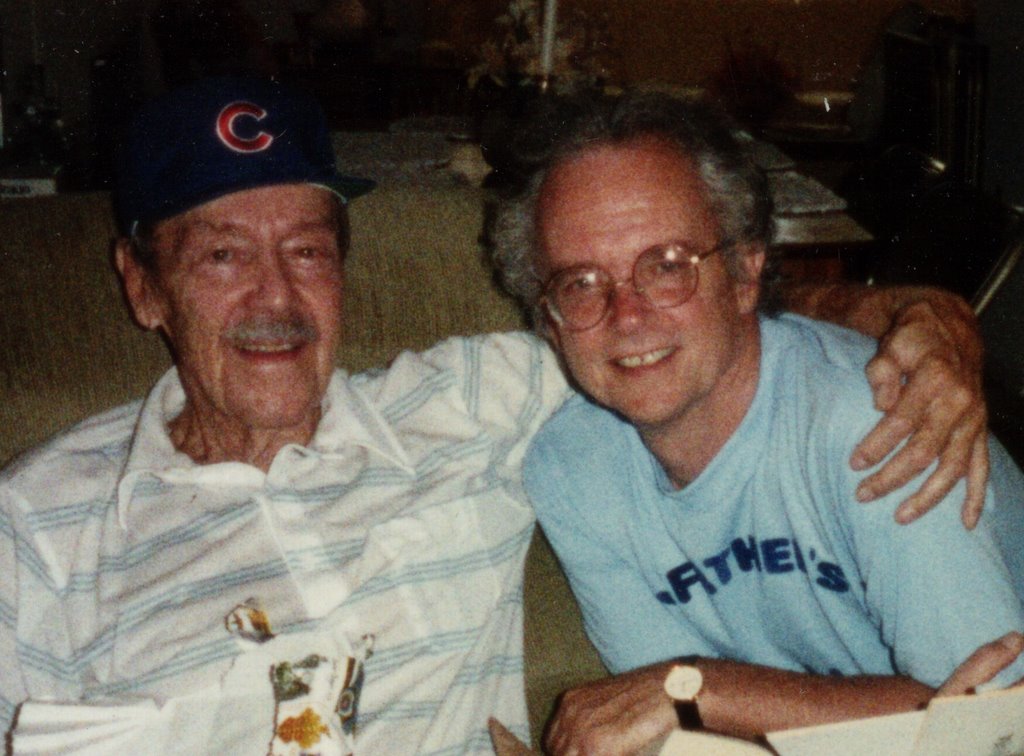
The last time I celebrated Father's Day with him was when this picture was taken in Bayonet Point, Florida, north of St. Petersburg, not long before he died thirteen years ago. Mom had made two tee shirts for us and you can almost read the one I'm wearing. Other than "Father's," I don't remember what it said. But it was a nice touch. Because he was following the Chicago Cubs baseball games on TV, I got him the hat. I had flown from California to visit him with my then wife and two youngest kids, Molly and Nicki. Various ailments, from congestive heart failure to emphysema, were beginning to take their toll.

Dad was a fraternal twin, and he and Ted lost their father to tuberculosis at the age of two. Neither got along with their step-father and he sent them off to military school in New Mexico at a young age. Uncle Ted and Dad were like two halves of a whole person. Ted was skinny and unhealthy, as well as artistic and charming. Dad was muscular and physical, the strong, silent type; one of his first jobs was as a lifeguard. Ted became an actor and appeared in small roles on Broadway. Dad was a traveling salesman for much of his working life. He sold glue to make plywood for furniture. And he married and raised two boys, while Ted was a homosexual whose long-term partner was an alcoholic.

At the age of six I developed asthma and was unable to take part in most sports. Because Dad was an enthusiastic sports fan all his life, I felt like I had failed him. I compensated by learning to read early, and taking up the clarinet. But after his death, my mother told me that Dad had worried deeply about my ill health, and when I played in a band for dances in junior high school he was often in the back of the hall, listening.

I was a rebellious teenager and we fought often. Or rather, I was the one who argued about his rules; he was a man of few words and little outward emotion. When I was 15 I peroxided my hair against his wishes. My mother's only response was a tense: "Wait till your father gets home." He came into my room with a pair of scissors and proceeded to cut off my newly blond (it was kind of reddish) hair. Neither of us spoke. The next morning he took me to the barber to have the rough edges smoothed out into a butch, his favored look anyway because it was "clean cut." I had the last laugh, though. When I let my hair grow out into a long "duck tail," it was half blond and half black. But Dad had made his point.

After high school, I didn't spend much more time at home. I was anxious to spread my wings, and I didn't think my father would appreciate my career choices. He forbid me from taking acting lessons because he thought my friend who had recommended the teacher was gay. My early career involved frequent job changes, of which he disapproved. Dad felt loyalty to an employer was important (an idea whose time has passed). He and my mother and brother returned to North Carolina from California, and I worked in New York, Pasadena, San Francisco and London. I married and we gave him a grandson, then another. Visits were few and phone calls irregular. I realize now that for many years I did not share myself openly with my Dad, fearing or imagining his disapproval.

In his later years, Dad mellowed considerably. He was a total wimp as a grandfather, letting his three grandsons and granddaughter, when they were small, do anything, from crawling all over him to eating up the refrigerator's supply of ice cream. He became pure love, and all his judgments melted away. I wished I'd known that man when I was small.

The father I remember growing up with was never sick. Even when it was obvious that he was ill, he would deny it and muscle through. Dad was the epitome of a macho man. But after two heart attacks, his attitude changed. During the last couple of years he was surrounded by pills. And he was a very good patient, doing everything the doctor prescribed. He loved the hardware store and the mall where he walked and talked with other men his age. Until he no longer had the strength.

After his death, my mother, brother and I presided over a memorial service in their home in Florida. The room was full of Dad's former golf and bridge partners and all of them had wonderful stories to tell about his friendliness, kindness and generosity. The next day we stood on a boat dock on Tampa Bay and I dropped his ashes into the waters where Dad had sailed as a boy.

On this day, when I wait for my distant children to phone, I am thinking about you Homer T and remembering what a wonderful father you were. I miss you.

Saturday, June 17, 2006

Lust & Death

When I was a young man, the thought of elderly people having sex filled me with repulsion. My grandparents! My parents, even! But that was long ago. The libido, I thought, would run out, like hair and smooth skin. But now that I have wrinkles, hemorrhoids, and even prostate cancer, my libido runs on like an Eveready Energizer bunny that just won’t give out.

The poet Dylan Thomas wrote:
Do not go gentle into that good night,
Old age should burn and rave at close of day;
Rage, rage against the dying of the light.
While I never intended to totter gently off this mortal coil, it never occurred to me that raging against death would take the form of relentless, unrequited lust. And a lust that was more intellectual than physical, a lingering mental erection inspired by the passing parade of beautiful women, young and old, large and small. As long as that spark of desire remains, I feel alive, I am not dead.

So it has been easy to identify with the aging wounded heroes of Philip Roth’s fiction, and in particular the men in his recent novels, the just released Everyman and Sabbath’s Theater, published in 1995. The mad arthritic lecher, Mickey Sabbath, and the slowly dying, unnamed, Everyman both desperately fan the embers of their libidos because, for Roth and for some of us seniors, impotency equals death. Unfortunately, in his novels there is no hope for transcendence of the body. It’s all down hill.

“Passion doesn’t change with age,” Roth told a Danish journalist last year, “but you change – you become older. The thirst for women becomes more poignant. And there is a power in the pathos of sex that it didn’t have before. The pathos of the female body becomes more insistent. The sexual passion is always deep, but it becomes deeper.”

Roth’s character, Mickey Sabbath, in his 60s like the author at the time that book was published, wants to believe that there is “still a chance for the old juicy way of life to make one big last thumping stand against the inescapable rectitude, not to mention the boredom, of death.” Everyman, in his 70s like Roth today, takes walks along the Jersey shore and notices that “nothing any longer kindled his curiosity or answered his needs… except the young women who jogged by him on the boardwalk in the morning. My God, he thought, the man I once was! The life that surrounded me! The force that was mine! No 'otherness' to be felt anywhere! Once upon a time I was a full human being.” Flirting with one young jogger, Everyman feels himself
growing hard in his pants, unbelievably, magically quickly, as though he were fifteen. And feeling, too, that sharp sense of individualization, of sublime singularity, that marks a fresh sexual encounter ot love affair and that is the opposite of the deadening depersonalization of serious illness.
Everyman takes its title from a 15th century morality play in which the main character is visited by death. “Oh death,” he responds, “thou comest when I had thee least in mind.” And the characters in Roth’s novels also seem chagrined, to say the least, to find their faculties failing and death a distinct possibility. In the medieval play, however, the theme is Christian salvation. Be good and go to heaven; be bad and, well, you know what happens. Roth, a secular Jew, will have no otherworldly consolation. “Religion was a lie that he had recognized early in life,” his mouthpiece Everyman thinks, “and he found all religions offensive,”
considered their superstitious folderol meaningless, childish, couldn’t stand the complete unadultness – the baby talk and the righteousness and the sheep, the avid believers. No hocus-pocus about death and God or obsolete fantasies of heaven for him. There was only our bodies, both to live and die on terms decided by the bodies that had lived and died before us.
Everyman is a retired advertising artist who calls his series of abstract paintings “The Life and Death of a Male Body,” an alternate title perhaps for Roth’s book.

Sabbath (the name is telling), describes himself as “whoremonger, seducer, sodomist, abuser of women, destroyer of morals, ensnarer of youth,” and he pursues sexual pleasure with an athletic single-mindedness.
The core of seduction is persistence. Persistence, the Jesuit ideal. Eighty percent of women will yield if the pressure is persistent. You must devote yourself to fucking the way a monk devotes himself to God. Most men have to fit fucking in around the edges of what they define as the more pressing concerns: the pursuit of money, power, politics, fashion. Christ knows what it might be – skiing. But Sabbath had simplified his life and fit the other concerns in around fucking.
Sabbath and Everyman, raging against the dying of the light by means of sexual excess, real or imagined, are both sad figures. The point in Roth’s fiction seems to be that death, and the manifold ways we humans invent to avoid the inevitable, is the central fact of our lives. He does not appear to advocate sexual license. A friend, whose kindness Sabbath has mocked cruelly, tells the aging lothario:
Isn’t it tiresome in 1994, this role of rebel-hero? What an odd time to be thinking of sex as rebellion. Are we back to Lawrence’s gamekeeper? At this late hour? To be out with that beard of yours, upholding the virtues of fetishism and voyeurism. To be out with that belly of yours, championing pornography and flying the flag of your prick. What a a pathetic, outmoded old crank you are, Mickey Sabbath.
Roth was similarly insulted, although not in such crude terms, by his ex-wife, the actress Claire Bloom, in her bitter memoir of their nearly 20 years together, Leaving a Doll’s House.

Novelist Nadine Gordimer, in her review of Everyman in the New York Times, wrote that for Roth, “the violent upsurge of sexual desire in the face of old age is the opposition of man to his own creation, death.” His theme is “the phenomenon presented as similar to that of adolescence – of late sexual desire. The last demanding exuberance in the slowly denuded body…[and] the doubt that comes about the unquestioned superiority of the rewards of the intellect.” The protagonist in Roth’s The Dying Animal “claims the phenomenon as the undeniable assertion of ‘erotic birthright’.”

I wonder if women also experience the phenomenon of late sexual desire? In my observation, gender differences (sex plus its social construction) make for two very different paths. Many women find their fulfillment in giving birth and nurturing life into adulthood. Men tend to make their mark in the world, finding their fulfillment through deeds. Aging is probably even harder on women then it is on men because of cultural standards of beauty. And finally, not a few older women I know live through their grandchildren. As Everyman puts it, the residents in his retirement home “were able not merely to construct whole conversations that revolved around their grandchildren but to find sufficient grounds for existence in the existence of their grandchildren.”

But old men, and I now count myself among them, are more content to sit on a bench and watch the joggers pass by, thanking the gods and goddesses for whoever invented the popular bare midriff look. Lust keeps the fires of life burning. Unlike Philip Roth, however, I do not equate health with potency. Sex also can be a spectator sport for those who find beauty a constant delight but have no desire for conquest.

Roth’s spiritless vision of anguished bodies in motion, permanently erased by death, holds no appeal for me. I suspect that even lust, in the form of passionate love for others, will not die but will transcend this limited time-space continuum to permeate the universe forever.

Sunday, June 11, 2006

Al Gore's Convenient Truth


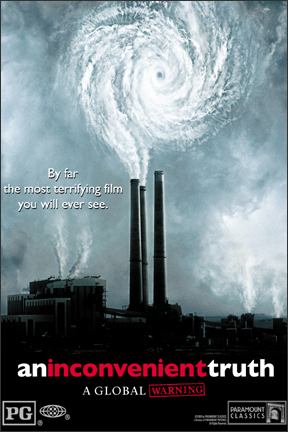
If Al Gore, the former "next president of the United States," has been so concerned about climate change since the 1960s -- as we're told in the new documentary "An Inconvenient Truth" -- then why was so little progress made in slowing or stopping global warning during the eight years he was in power as vice president during the Clinton administration?

That nagging thought made it difficult for me to appreciate director Davis Guggenheim's (director of episodes of Alias and 24) dramatic film version of the Power Point presentation that Gore has given thousands of times around the world since his defeat at the hands of the Supreme Court. That, and the adoring portrayal of Gore that makes him out to be a prophet, or rock star. While the clips of natural disasters and the rising roller coaster representations of statistics make an imressive and persuasive case for the devastating consequences of global warming, the documentary's primary focus is Al Gore and his future more than the environmental message he's bringing.

I suspect that Gore is positioning himself to compete with Hillary Clinton for the Democratic nomination for President in 2008. If that's so, then this adulatory video is convenient way for him to return to the political stage. But will it save the world from destruction at the hands of global corporate thugs? I doubt it. Certainly Gore offers no particular political strategy, and the suggestions, along with the film's closing credits, that individual choices will make a difference is insulting to intelligent environmentalists who know that only large corporations and courageous politicians can save us this time. Curbside recycling is a drop in the bucket; closing down large-scale polluters and finding a substitute for the use of oil might help.

In the first place, there is little information that is new in "An Inconvenient Truth." The rise of carbon dioxide in the atmosphere from the burning of fossil fuels has led to an overall rise in temperature which has resulted in the melting of polar ice and glaciers, the prediction of an eventual (perhaps catastrophic) rise in sea levels, and the production of more hurricanes and tornadoes (which are stronger and more fierce). Only the ideological right (which includes our current government) remains unconvinced by the scientific evidence, and they'll never see this film. Glenn Beck, host of CNN Radio's Headline News, accused Gore of mixing untruth with truth, just like the Nazis. The documentary will undoubtedly find a comfortable audience only among the already converted.

So will Al Gore as president save us? Here the evidence is not persuasive. Gore is the scion of an illustrious family of wealthy politicians. His father was also a senator from Tennessee. Progressive curmudgeon Gore Vidal is a distant cousin of Albert, and is not very fond of his kin. "I've always thought he was absolutely pointless as a politician. He's just another conservative Southerner," according to Vidal. For much of his political career, Gore has been pro-life and anti-abortion. He was also openly anti-gay, calling homosexuality "abnormal" and "wrong," and he was a strong supporter of the gun lobby. Vidal described his relative as "another border-state, southern lover of the Pentagon...there was never anything the Pentagon asked for that Cousin Albert wasn't down there giving it to them; he voted for the first war in the gulf," one of only ten Democrats to break with the party.

In 1988, Gore made an unsuccessful run for the presidency. In 1992 he published Earth in the Balance, which summed up his environmental ideas and made a strong case for protection of the environment. We learn in the documentary that Gore, as a Harvard undergraduate, had studied with Roger Revelle, one of the first scientists to predict that rising levels of human-produced emissions would lead to climate change. That same year he was nominated for the Democratic ticket with Bill Clinton and after their election many people expected him to be able to turn his ideas into action at the federal level.

But little changed, and why that is so is absent from "An Inconvenient Truth." Politics and corporate interests got in the way. In Al Gore: A User's Manual, written in 2000 by Alexander Cockburn and Jeffrey St. Clair, the authors skewer Gore for his hypocrisy and for his ties to moneyed interests.
Like a street mountebank fluttering a handkerchief to distract attention from his sleights of hand, Gore has always used his proficiency with the language of liberalism to mask an agenda utterly in concert with the Money Power.

Nowhere is this truer than in his supposed environmentalism, which nicely symbolizes the chasm that has always separated Gore's professions from his performance. He denounces the rape of nature, yet has connived at the strip-mining of Appalachia and, indeed, of terrain abutting one of Tennessee's most popular state parks.
Cockburn and St. Clair claim Gore denounces vouchers while sending his kids to private schools, argues against the nuclear arms race while supporting the MX missile, praises civil liberties while turning a blind eye to censorship, smoked dope when younger but later advocated harsh penalties for marijuana use. Others have argued that Gore is beholden to Occidental Petroleum and helped secure oil drilling rights for that firm in the Elk Hills National Petroleum Reserve near Bakersfield, the largest turnover of public lands to a private corporation in American history. Despite protests from native peoples, many archaeological sites were destroyed. In 2000, Gore defended Occidental's plan to drill for oil near the sacred grounds of the U'wa tribe in Colombia.

Johann Hari, columnist for the Independent in London, says that Gore's speeches on global warming "are terrifying, true -- and contain a hole bigger than the old Ozone hole he spent decades warning against."
When Bill Clinton and Al Gore were in the White House, their environmental record was abysmal. They pushed through NAFTA, a free trade area for the Americas, which defined environmental regulation as an illegal "market distortion" which must be struck down by the courts. They allowed dioxin dumping in the oceans. They were the main international drivers between the World Bank and IMF, which have systematically smothered tentative environmental regulations in the developing world. They oversaw the largest slashing of publicly owned timber in US history. I could go on. And on.
The problem, Hari says, is that the fossil fuel industry pays the bills for politicians in America, Democrats as well as Republicans. And without that money, you can't get elected. Twenty-eight gas and oil companies gave to Gore's failed election campaign. "These companies own the American political process," according to Hari, and if Gore wants to run for president again in 2008 "he will have to plunge back into the petrol tank to grab some campaign funds." The only solution to this impasse, according to Hari, "is for the American people to reclaim their political parties from corporations and start paying for their parties themselves, out of general taxation." But this idea is about as popular as one nationalizing the banks, or the oil companies.

"Other than his alleged environmental convictions," writes author Joshua Frank, "Gore was politically timid when push came to shove in Washington." During the 1992 campaign, he promised supporters in Ohio that Clinton's EPA would never approve a hazardous waste incinerator near an elementary school. Three months after Clinton took office the incinerator was approved; its owner was one of the top campaign contributors to the Clinton/Gore campaign. Under Clinton/Gore, the Interior Department approved a destructive deal with sugar corporations in Florida which doomed vast portions of the Everglades. Gore's successful efforts to secure an Endangered Species Act waiver for the Tellico Dam on the Little Tennessee River paved the way for the gutting of the act, according to the late David Brower. A "salvage rider" bill pushed by the timber industry directed the Forest Service to cut old-growth timber in the Pacific Northwest. The administration, under Gore's watch, eliminated a regulation that had prohibited cancer-causing pesticides to be put in our foods, and cut a deal for the use of Methyl Bromide despite its reported contribution to ozone depletion.

While vice president, Gore did little stop global warming. The administration made it easy for Bush and Cheney to back out of the Kyoto Protocol by undermining the agreement in the late 1990s. Gore championed a "pollution credits" system at the Kyoto conference in 1997. But he opposed the watered down version of the Protocol, despite loopholes that would allow corporations to continue business as usual, because he feared alienating labor organizations that worried new environmental standards would shift jobs to developing nations with weaker regulations. "So while Al Gore flies a polluting jet around the country and overseas to preach to the masses about the dangerous effects of global warming and its inherent threat to life on earth," writes Frank, "you may want to ask yourself whether the hypocritical Gores of the world are more a part of the problem than a solution to the dire climate that surrounds us all."

Even if a U.S. government with a backbone solved the global warming problem by restricting corporate abuses and developing new systems of energy, the environmental crisis would be far from over. Out-of-control climate change is only one issue, albeit a crucial one. There are many others. For example, since World War Two a proliferation of chemicals in the environment (over 75,000 new compounds, at one count) parallels a drastic rise in cancer and other environmentally caused diseases. On a graph the huge jump in chemicals and cancer is remarkably similar to the jump in carbon dioxide in the atmosphere and global temperatures. Wherever you look, humans are fouling their nest. Liberal optimists like Gore believe there is no conflict between the public welfare and corporate welfare. They see science as our savior and believe that technology can solve the very problems that it created in the first place.

But just as the United States seems unable to clean up the mess it made in Iraq, American science and industry may never be able to keep up with the unfortunate unintended consequences of technological innovation. This is nothing new. Goethe wrote about it in Faust and Walt Disney portrayed it in The Sorcerer's Apprentice.

Saturday, June 10, 2006

What's in a Name?

Communion Reflection on 2 Timothy 3:10-17 and Mark 12:35-37


What difference does it make what we call Jesus, or what title we give him?

In today’s Gospel from Mark, Jesus appears to question the title “son of David,” which is given to him in the very first verse of Matthew.

David, the most famous king of ancient Israel, was a poet who is believed to have authored or edited many of the Psalms. He prepared for the construction of the first temple in Jerusalem, which was eventually built by his son, Solomon. In the Davidic Covenant, told in the book of Second Samuel, God promised that David's royal dynasty would last forever, and that David's son would be God's Son.

The Jews in the time of Jesus, therefore, expected that the Messiah would come from the house of David. He would restore the lost glory of Israel and would rescue her people from oppression. The son of David, the anointed one of God, would be a king, a political savior. Even today Jews continue to pray for the coming of the Messiah, the son of David, who would build the third temple in Jerusalem.

Genealogies in Matthew and Luke identify Jesus as a descendant of David, by adoption through Joseph and by blood through Mary. When the angel of God appears to Joseph in a dream, telling him to take Mary as his wife, he is addressed as “son of David.” King David was born in Bethlehem, and so the Gospel writers identify this city as the birthplace of Jesus.

The Gospels record that Jesus was called by many names during his earthly life: rabbi, prophet, teacher, and also: the good shepherd, the true vine, the bread of life. Followers impressed by his authority would call him “my Lord,” a title often given to rabbis. The title “son of David” is not that common in the New Testament. In Mark and Luke, the phrase seems to refer not to royal power, but rather to the magical/ healing power for which Solomon was famous. Only Matthew uses this more often and more clearly as a messianic title with royal connotations.

There is some tension in the Gospels between the messiah as the “son of David,” a political or royal figure, and the messiah as the “son of Man (or Adam),” a heavenly figure. Some expected that Jesus would become King of the Jews, and they were disappointed.

In the reading for today, Jesus suggests, by quoting Psalm 110, that the Messiah actually pre-exists David and is superior to him, and therefore cannot be his son. In this way, he renounces the claim of a kingly messiah.

What's in a name, anyway?

According to Shakespeare, “That which we call a rose, by any other word would smell as sweet."

We can call Jesus “the Messiah, the son of the living God,” as Peter did. Or we can call him brother, for he told us that “whoever does the will of my Father in heaven is my brother, and sister, and mother."

Best of all, we can call him friend, for Jesus tells us in John’s Gospel: “I no longer speak of you as slaves, for a slave does not know what his master is about. Instead, I call you friends.”

On the question of the relevance of names, I can’t resist quoting here the lyrics of a song by that famous convert from Judaism to Christianity, Bob Dylan, In “Gotta Serve Somebody,” he sings:
You may call me Terry, you may call me Timmy,
You may call me Bobby, you may call me Zimmy,
You may call me R.J., you may call me Ray,
You may call me anything but no matter what you say,

You're gonna have to serve somebody, yes indeed,
You're gonna have to serve somebody.
Well, it may be the devil or it may be the Lord
But you're gonna have to serve somebody.
And this service, I might add, is terminal…unto death. In the first reading from Second Timothy today we heard that “all who want to live religiously in Christ Jesus will be persecuted.”

After allowing us to think of ourselves as his friend, Jesus tells us: “There is no greater love than this, to lay down one’s life for one’s friends.” We can easily come up with a long list of names of those who gave their life for the Gospel, from the early martyrs of the Church to Bishop Oscar Romero and Martin Luther King in our time.

It doesn’t matter what name or title we’re called. It’s what we do that counts.

* * *

After spending at least a week in preparing the above reflection, I awoke this morning to discover that I had based it on the readings for yesterday, not today's. I suddenly felt like the man in the garden of Gethsemane, who, when Jesus was arrested, ran away naked. In Paul's letter to Timothy, in the readings today, he says "proclaim the word; be persistent whether it is convenient or inconvenient." Without my well-crafted words to read, presiding at communion today would certainly be inconvenient!

Providentially, the "real" Gospel for June 10 is the Widow's Mite. The scribes "have all contributed from their surplus wealth, but she, from her poverty, has contributed all she had, her whole livelihood." As a perfectionist with words, terrified at the thought of speaking extemporaneously (despite my debate training long ago), I can certainly identify with the scribes who thrive on admiration and respect, and who "recite lengthy prayers."

So I stood at the ambo and tore up my speech. I recalled that Fr. Cyprian, who led the retreat I attended last week at Mission San Antonio, is found of saying, with St. Paul, that "the love of God has been poured into our hearts." Certainly in the week after Pentecost, that gift of the Holy Spirit is on our minds. What a revelation: We have God within us! The Indian sages are fond of speaking of the "cave of the heart." The Spirit dwells in that cave, speaking in a still small voice. What stands between us and the experience of God within is, precisely, us, the selfishness and self-preoccupations and obsessions about the world that make us deaf to that voice. In contemplative prayer we sit silently before the cave, while the constant chatter of our egos, our selves with a little "s," rattles on endlessly. If that background noise of the self were to stop, we would be face to face with God.

The widow's utter poverty enables her to hear God speak. She is an example to all us scribes who feel naked without our fine speeches and fancy prayers. May we all be naked!

Friday, June 09, 2006

Madison, WI: Cows, Cheese Curds & Brats


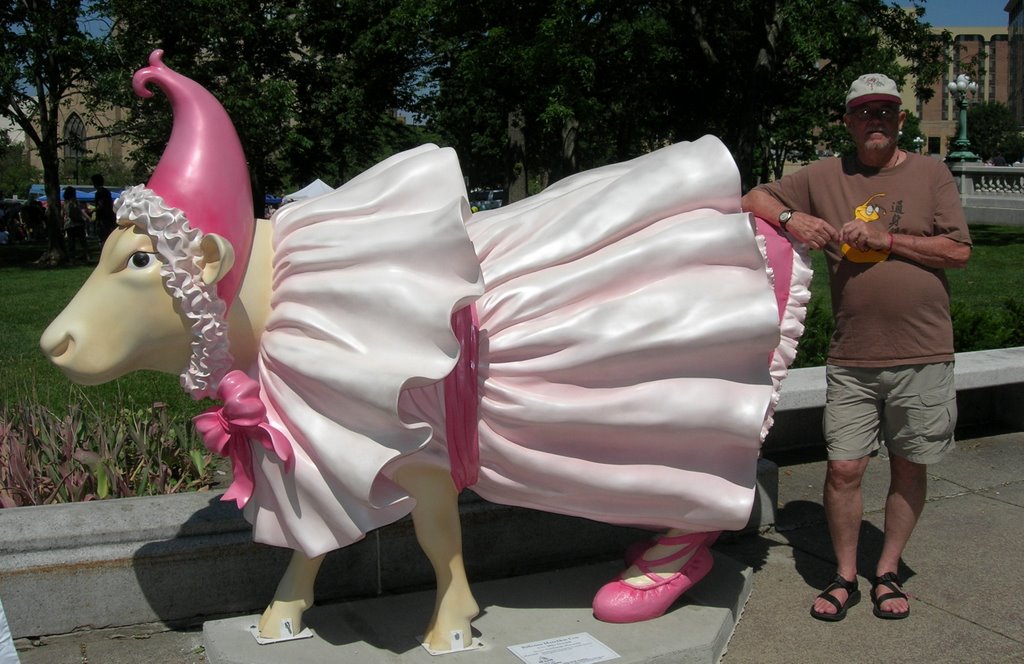
June is Dairy Month in Wisconsin and during my first visit to Madison last weekend the cows were on display. It was the 27th annual Cows on the Concourse around Capitol Square and there were 101 of them in the "CowParade" in artsy disguises like the one above.

I knew little about Madison before my visit last weekend, except that it was an exceptional college town, on a par with Berkeley, Ann Arbor and Cambridge. And I knew Wisconsin weather was something to be feared. After it had hailed several times here last winter, the local paper headlined: “Wisconsin Weather Comes to Santa Cruz.” But June is different. Madison was sunny and warm and delightful.

I got a fine view of the Capitol flying into the airport. The stately white building is surrounded by the downtown business district on a narrow isthmus between two beautiful lakes, Mendota and Menona. On the ground, Madison is straight streets, green trees, two-storey brick houses and the University of Wisconsin with its 40,000 students and the unending construction of new buildings.

Kay, my hostess with the mostess, wisked me off to the University’s Memorial Union Terrace on Lake Mendota where a large crowd was listening to Ben Sidran’s group on the opening evening of the free Isthmus Jazz Festival. Dinner for me was a glass of the local beer and an infamous Wisconsin brat which looked suspiciously like a fat hot dog with a German accent. Pleasure boats lined the waterfront within listening distance.

On Friday, after hiking through Parfrey’s Glen (we took the wrong trail and missed the scenic spot), relaxing on the grass by Devil’s Lake (alongside overweight, bikini-clad teenagers, until a rain shower sent us packing) and climbing to the top of Gibralter Rock with its incredible views of the pastoral countryside, we stopped for the traditional Friday fish fry at a local country club. I’m sorry to report that the fish was not local and had seen better days. Wisconsin is farming country and I saw cows, sheep and pigs, and fields planted with young corn plants. I also saw indoor and outdoor silos filled with corn for animals, and learned that the fumes from silos can be lethal.

On Saturday we strolled through the Dane County Farmer’s Market on Capitol Square and I was introduced to cheese curds. Where have they been all my life? The best curds, I was told, squeak when eaten. But they must be at room temperature. I took a pack of them with me, and, now that the airlines no longer provide meals, they kept my strength up on the long flight home. Lunch at the Market was a grilled cheese sandwich from a booth where they were fried by the hundreds, for $1 each.

The streets around the fair were lined with food stalls and one of them, “Loose Juice,” which serves organic juices, is owned by Karl Armstrong. He was one of the radicals protesting the Vietnam War who were responsible for the 1970 bombing of Sterling Hall, which housed the Army Mathematics Research Center. A young scientist was killed. After two years on the run, Armstrong was caught and served seven years in prison. Now he’s an entrepreneur.

Not far from the Capitol is the burnt out shell of St. Raphael Cathedral. The fire last year was started by a homeless man with a history of mental problems who broke into the church, stole a bottle of communion wine, and then apparently lit some matches. Madison’s bishop, Robert Morlino, is on the board of the School of the Americas, a training ground for government terrorists. Bad karma, I think.

Also a stone’s throw from the Capitola is the Monona Terrace Convention Center which was originally designed in 1937 by Frank Lloyd Wright for the city and county offices, but eventually completed in 1997 by a student of Wright’s. Wright was born in Wisconsin and studied at the University in Madison. We stood on the outdoor rooftop of the Center and watched the boats and water skiers on Lake Menona.

On my first night in town we passed up ice cream in the Union because the line was too long, but the next night, driven by desire, we waited in an even longer line. I got “blue moon,” a delectable flavor. The ice cream is made at the University, and on Monday we visited the Dairy Store in Babcock Hall where I got the “sundae of the day” which featured “lumberjack” ice cream , caramel syrup and nuts. Yum.

The long weekend was filled with fun: riding bikes through the University, past the Indian mound, and along the waterfront (next time I’ll wear padded underpants), watching the bears and the sad-looking buffalo (which once roamed free in the Midwest) at the Henry Vilas Zoo, kayaking on Lake Wingra, eating a Bob’s Bad Breath Burger at the Weary Traveler Free House, attending Josh’s graduation party in his parents’ house on a hill near the Swiss village of New Glarus, and going to mass at St. Mary of Lourdes in the rural community of Belleville where the recipients of intercessory prayers included “family farmers.” The church is presided over by the affable Fr. Ken Klink who specializes in short, pithy homilies about social justice that would make Jesus proud.

My hostess was anxious to show me Wisconsin wildlife and mentioned a Great Blue Heron she had frequently encountered on the road to Belleville. It was there in a farmer’s pond when we passed by, so we stopped to talk with the landowner. He informed us that the heron was plastic and that he had put it there to keep real herons from eating his fish. Aside from various road kill, including two dead deer, the only wildlife I saw outside of the zoo were birds – red-winged blackbirds and a variety of raptors and gulls – and the chipmunk and mice (or moles) in Kay's basement.

I’ve learned that Madison was named after President James Madison who died in 1836, the year the town was founded. It’s the home of Sen. Russ Feingold, one of the few remaining liberals in Washington, and everywhere I saw bumper stickers and signs on lawns that made abundantly clear the citizens’ dim views of Bush and his misguided war in Iraq. Kay’s neighbor advertised his liberal sentiments in stickers covering his car. But I particularly liked his front lawn which included a number of golf clubs upside down among the flowers. I feel the same way about that so-called sport.

If I didn't live in the greatest town around, I might consider moving to Madison, which I will ever hereafter think of as the "Santa Cruz of the Midwest." We'll give her our strawberries and she can send us her cheese curds.

Monday, May 29, 2006

Memorial Day: Dying in Vain


Where have all the soldiers gone?
Long time passing
Where have all the soldiers gone?
Long time ago
Where have all the soldiers gone?
Gone to graveyards every one
When will they ever learn?

On this Memorial Day, let us celebrate the fallen warriors, the soldiers that marched off to fight in the politicians' wars under the illusion that they were defending our freedom, the young men, and now young women, who died in vain.

At the beginning of this weekend, about a hundred of us gathered under sunny skies in Santa Cruz Mission Plaza for a Peace Walk organized by a local chapter of the Buddhist Peace Fellowship. There was an altar on the grass flanked by two large exhibits containing the photographs and names of several hundred American servicemen and women killed in Iraq, thus personalizing our remembrance of the fallen. Holding flowers and Buddhist prayer flags, we marched silently down into town, along the river, and up Pacific Avenue past the shops and the tourists. On our return, we unrolled a huge scroll containing, symbolically, the names of 28,000 Iraqi soldiers and civilians killed since the invasion three years ago (a low estimate, I suspect). The event ended with a metta meditation, sending compassion out from Santa Cruz to our poor, war-torn world.

President Bush laid a wreath at the Tomb of the Unknowns in Arlington National Cemetery this morning. "I am in awe of the men and women who sacrifice for the freedom of the United States of America," he reportedly said. And just how, pray tell, did their deaths in Iraq or Afghanistan do anything for our freedom or liberty here in the United States? It is well known by now that Saddam Hussein did not have weapons of mass destructions, did not consort with Al-Qaeda, and posed no threat to this country. He was a tyrant, like many of the foreign leaders our presidents have supported in the past. But how does toppling him, in defiance of international law, make us secure? The logic of patriotic ideology is absurd. I sympathize with the hard life of a soldier. But I see no reason, as the bumper sticker has it, to "Thank a Soldier for your Freedom."

My ex-wife's brother died in Quang Tri Province, Vietnam, in June of 1967, two month's shy of his 21st birthday. We found his name on the Vietnam Memorial in Washington, surrounded by 50,000 others. He died for a lie, the Tonkin Gulf incident. His death left a hole in the family and his father never recovered. How many times has that story been repeated? Now soldiers are marching off to Iraq and Afghanistan, not to defend democracy and freedom but to build an empire and protect our access to oil. More lies. How many deaths, how many mutilations and maimings does it take, before the soldiers stop marching off to war? How many revelations and shameful exposes will it take before our politicians stop putting our finest in harm's way?

Who do we blame for the prevalence of war, the politician or the solider? Pete Seeger's "Where Have All the Flowers Gone?" laments the ubiquity of war. Buffy Saint-Marie's anthem from the 1960's, "Universal Soldier," picks on the soldier:

He's five feet two and he's six feet four
He fights with missiles and with spears
He's all of 31 and he's only 17
He's been a soldier for a thousand years

He's a Catholic, a Hindu, an atheist, a Jain,
a Buddhist and a Baptist and a Jew
and he knows he shouldn't kill
and he knows he always will
kill you for me my friend and me for you

And he's fighting for Canada,
he's fighting for France,
he's fighting for the USA,
and he's fighting for the Russians
and he's fighting for Japan,
and he thinks we'll put an end to war this way

And he's fighting for Democracy
and fighting for the Reds
He says it's for the peace of all
He's the one who must decide
who's to live and who's to die
and he never sees the writing on the walls

But without him how would Hitler have
condemned him at Dachau
Without him Caesar would have stood alone
He's the one who gives his body
as a weapon to a war
and without him all this killing can't go on

He's the universal soldier and he
really is to blame
His orders come from far away no more
They come from him, and you, and me
and brothers can't you see
this is not the way we put an end to war.


She gets it right in the end. The orders to fight "come from him, and you, and me," all of us who subscribe to the idea war can be a path to peace. Our freedoms must be defended. The Homeland is in peril! Democracy requires the blood of martyrs. I prefer not to blame the victim, however. Soldiers are recruited, not only by ideological slogans but also by conditions. Poverty and lack of employment possibilities impell healthy young people into the military. Our celebrated "all-volunteer" Army is populated with people of color who can't get a job, along with middle-class white kids who who couldn't afford to go to college. Some just wanted to "see the world," but not necessarily to visit exotic places and kill the natives.

The villains most responsible for war, and for the deaths in vain of hundreds of thousands of someone's sons and daughters, are the corporate profiteers and the corrupt politicians who scare us with lies about "Communists!" and "terrorists!" to hide their hidden agendas. They twisted the tragedy of September 11th for the own purposes, and have now embroiled the United States in an endless war in the Middle East, a new crusade that generates new "terrorists" as fast as it kills them. When will it ever end?

On this Memorial Day, 2006, let us remember the the fallen warriors, our children, who marched off to foreign lands for a fake cause where they died in vain. Let us also remember the ones who sent them there.

Saturday, May 27, 2006

Bread and Circuses


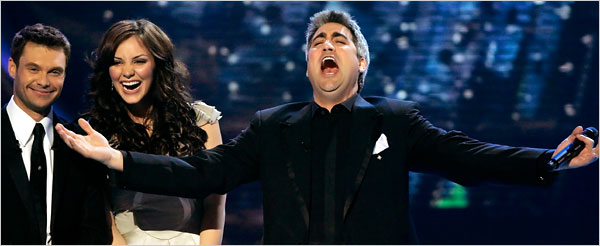
I have never watched "American Idol" so I consequently missed the finale Wednesday when a white "soul singer" named Taylor Hicks (have they redfined soul while I've been unplugged from the TV cable?) was declared the winner. What caught my attention in the news of this event spread over the front page of all the newspapers was that over 63 million votes were cast for the new idol, more votes than President Bush received in the last election. At least half that number watch this show every week. What are these people thinking?

When I was growing up, Ted Mack's "Amateur Hour," esstentially the same kind of talent show, was popular. Raw talent from the hinterlands competed for prizes and recognition, the 15 minutes of fame Andy Warhol hoped we would all have. Americans love to root for the underdog. That helps to explain the popularity of the Rocky movies. We are an incredibly generous people. We open our pockets to the victims of global natural disasters, like the tsunami in southeast Asia.

We also are a murderous bunch who slaughter the innocent in our quest for power and world domination. Just now we are uncovering an Iraqi "My Lai" where angry U.S. Marines indiscriminatly killed men, women and children (click here for story). Our young people respond to the unspoken recruitment slogan: "Join the Army. Travel to exotic distant lands; meet exciting, unusual people and kill them." The son of a friend is currently in Iraq, flexing his young machismo, and he told his parents than when his tour of duty is over he will return as an employee of one of the private security firms (in other words, a mercenary soldier).

President Bush has told the country that we are engaged in a global war on terror, one that will last for a very long time. But unlike in previous wars, we have not been called upon to sacrifice anything. Sure, gas has gotten a little expensive. But there is little evidence in this country that we are a nation at war. There is no draft. The body bags are hidden. In fact, the President told us that the best thing we could do, to keep the economy afloat, was to shop . If it's good for business, it's good for America. And he also suggested the we visit Disneyland, if we can afford the gas.

Bread and circuses. It's a phrase used by the Roman poet Juvenal to lament the falling heroism of Romans after the decline of the Roman empire. “Two things only the people anxiously desire—bread and circuses,” he wrote. The government kept the people happy by distributing free food and staging huge spectacles in the Coliseum. When I visited the Coliseum in Rome last summer they were getting ready for a free concert by Elton John. We are an easy people to please. We're satisfied with watching desperate housewives, amateur survivalists competing for money in remote locations, and entertainers hoping to be the next "idol." Our government doesn't even have to pass out free food to keep us happy, content, and silent.

Am I the only one who thinks he's living in a nightmare? We should know better. We've read about the passive German people during the rise of Hitler's regime. I've been studying the history of Argentina in preparation for a month in Buenos Aires this summer when I'll study Spanish. The Argentinians suffered under a murderous military dictatorship in the 1970s. Suspected revolutionaries and terrorists, many in their teens, were arrested by the police and "disappeared." Over 30,000 cannot be found. It was later revealed that some were dropped alive out of airplanes over the bay. Pregnant women were imprisoned, the babies were adopted by families in favor with the regime and the mothers killed. Can horrors like this happen here?

Bread and circuses. Keep watching your TV. "Dont worry, be happy."

Wednesday, May 24, 2006

The Coarsening of Society

Recently, my pal Jim introduced me to an intriguing new phrase, "the coarsening of society." He's a cantankerous old fart like me and was amazed that I'd never heard it before. It's all over the internet, he said. My first reaction was that "coarsening of society" was a new verbal weapon, like "political correctness," invented by the socially conservative right wing with which to beat liberals over the head in the Culture Wars. And when I looked for the first occasion of its use, I found a speech from 1984 by Ronald Reagan that included the following:
Without God there is no virtue because there is no prompting of the conscience... Without God there is a coarsening of society. And without God, democracy will not and cannot long endure. If we ever forget that we're one nation under God, then we will be a nation gone under.
But I also found uses of the phrase by liberals. In an article on "Television and the Hive Mind," Mack White criticizes talk shows like Jerry Springer's and the fad for reality television, and argues that these programs
contribute to the general coarsening of society we see all around us -- the decline in manners and common human decency and the acceptance of cruelty for its own sake as a legitimate form of entertainment. Ultimately, this has the effect of debasing human beings into savages, brutes -- the better to herd them into global slavery.
Clearly the "coarsening of society" is an equal opportunity epithet. John P. Hubert, Jr., writes that the coarseness of social injustice is spreading just as fast as sexual immorality.
In the United States there is a worrisome trend underway in which the differential between the income of the lowest wage earner and the corporate CEO is beginning to approach the truly immoral and unconscionable. At present it exceeds the ratio of most industrialized nations. These unjust and immoral notions are also exported to other nations just as our pornographic content is. Combined they contribute to an overall coarsening of society in which there is less and less concern for the least among us.
So what does "the coarsening of society" really mean? Jim looks at the world through the eyes of his elderly mother and is shocked by what she sees: public profanity, clothing that leaves little to the imagination, rudeness, vulgarity, a complete absence of manners and civility. What happened to our world? It was not always like this.

"The coarsening of society" assumes a fall from grace, from an Eden of innocence when life was simpler, quieter, less complex, and people were more polite and formal. We bowed to convention, in dress and behavior. It might have been the 1920's, or perhaps the 1950's; it could have been in a small town, perhaps in the Midwest. When I was 10, I lived in a town of 7,000 in western North Carolina. Everybody knew everybody else. People were friendly, neighborly. Of course if you were colored there was a different set of rules, and that past is not so romantically remembered.

Life has changed. That's one of the benefits of being old. You remember what it used to be like. But there are others ways of looking at it rather than through the lens of a fall. What about progress? Women no longer die from illegal back street abortions. Medical technology keeps people alive longer. The accumulated knowledge of the world is available online. The world no longer takes 80 days to circumnavigate. Is your glass half full or half empty?

Recent books by Jim Wallis and Michael Lerner point out that the right has a stranglehold on issues concerning moral values. If you worry about perceived threats to the family, such as abortion on demand, gay marriage and obscenity over the airwaves and in public places, then most likely you have voted Republican. But Wallis, founder of Sojourners, said, in a recent interview posted online, that "there is a difference between the leaders and the constituency. Jerry Falwell, Pat Robertson and James Dobson are genuine theocrats, and they do not want to see democracy take place. But a lot of their followers are just concerned about what they see as the coarsening of society." Wallis believes that this is
actually a genuine issue, but it shouldn’t be just a left or right issue. Being pro-family should mean you support aid for the poor, or family leave policies like they have in European countries, but when has the right ever done that?
Wallis and Lerner see a movement growing on the religious left that can reclaim the moral high ground currently dominated by the Falwells and the Robertsons. It must convince people concerned about their families that pre-emptive global war is a threat to them, chemical poisoning of the environment and global warming is a serious threat, poverty and the absence of universal health care are shameful, and the police state constructed by the Bush regime is no protection.

But what do we do about the pierced and tattooed youth with spiked and brilliantly dyed hair who swagger through our streets, blatantly exposing their midriffs and underwear?

Nothing. They may be our only salvation.

Sunday, May 21, 2006

Decoding Christianity


"The Da Vinci Code" opened yesterday around the world and I joined a sold-out audience at a theater in Santa Cruz to see it. I enjoyed the book, a real page-turner, when I read it a couple of years ago, and I liked the movie. My name is Will, and I'm a card-carrying Catholic.

So what's the fuss all about? The book and now Ron Howard's film of it have both been panned by all the respectable critics. The guardians of religious orthodoxy have condemned it. It was declared "morally offensive" last week by the U.S. Conference of Catholic Bishops. And yet some 60 million copies of the book have been sold and probably that many people around the globe will watch the movie on its opening weekend. All the while, the media and Hollywood's PR machine have been relentlessly stoking the fires of controversy in search of readership and ticket sales. Is this all just a tempest in a teapot (or an espresso machine)?

I believe the book and the movie version have awakened a sleeping giant. Their wide-spread popularity and the fascinating flap over the film is a indication of deep spiritual hunger and a discontent with reigning interpretations of Christianity. People are drawn to Dan Brown's story because it portrays the humanity of Jesus and the possibility that communion with the divine might be possible in this life.

When I first read The Da Vinci Code, the novel's thesis, that Jesus fathered a child with Mary Magdalene, was familiar. It was reported as truth in Holy Bood, Holy Grail, a book published in 1982 by Michael Baigent, Richard Leigh and Henry Lincoln. And the suggestion that Jesus and Mary were lovers was portrayed in The Last Temptation of Christ, a book and subsequent film written by the Greek Marxist Nikos Kazantzakis. In his story, however, Jesus experiences the temptation of living a normal family life with Mary while on the cross but ultimately choses to die. When the film was released in 1988 there were boycotts by Christian groups and picket lines outside theaters, even in Santa Cruz. I was moved and inspired both by Kazantzakis' novel and the film which was directed by Martin Scorsese. In all of these cases I was able to find something that affirmed my faith rather than attacked it.

My Catholic Church has been identified, in the proceedings of Vatican II, with the "people of God" rather than the historical institution. Institutions, as is their nature, are threatened by attacks on their authority, and the U.S. Bishops have a website, "Jesus Decoded," that calls the book and film anti-Catholic and anti-Christian. My guide for understanding the institution has always been "The Grand Inquisitor" chapter of Fyodor Doestoevsky's magnificent novel, The Brothers Karamazov. In this tale told by the atheist Ivan to his brother Alyosha, a monk, Christ comes back to earth at the time of the Inquisition in Spain and is arrested after performing several miracles. The Grand Inquistor visits Jesus in his cell and tells him the Savior is no longer needed by the Church. Jesus brought freedom but the people cannot handle it. The Church's role, according to the Inquisitor, is to protect its followers from suffering the uncertainties of freedom to choose by surrounding them with comforting dogmas and rituals. Jesus responds to this perversion of his Gospel message by kissing the Inquisitor rather than answering him.

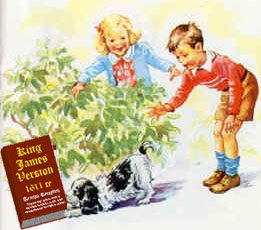
Most Christians are comforted by what I friend of mine once called "Dick and Jane religion." See them go to church on Sunday (perhaps only on Easter and Christmas), see them identifying
religious faith with propositional statements, see them proclaiming the literal truth of the (English) Bible, see them denouncing as heretics any religious seeker struggling with doubts and uncertainties, etc., etc., etc. It is these folk whose faith is threatened by escapist novels and Hollywood's art. They were embolded by Mel Gibson's bloody and orthodox film "The Passion of Christ" to demand that every representation of the Christian story toe the company line.

Brown's "Da Vinci Code" is a unique phenomenon because it opens up a discussion about the nature of humanity and divinity, the quest for the Holy Grail, the place of women as followers of Jesus and in the churches today, and authorities who hide the truth to save their own agendas (this goes for politicians as well as religion). For those whose minds are open, the book and film have the great potential for encouraging dialogue between believers and skeptics.

If the conversation ever happens, what we might talk about is sex. What is so threatening about the possibility that Jesus might have had sex? I fail to understand why God is said to value celibacy so much. Not only did Mary not have sex with Joseph, we are taught by the Catholic Church that Joseph gave up sex for Mary (Jesus had no brothers or sisters in our tradition). Sex has always been a problem for the Church (even before the current rash of sex abuse scandals). There are very few non-virginal saints and even the married couples canonized were reported to have given up sex. Despite much talk about the empowerment of lay people, the celibate religious life is valued more highly than married life.

Most of the criticism of "The Da Vinci Code" has been focused on errors of fact. Brown, it is said, gets his facts wrong about Constantine, the Council of Nicea in 325, the Pirory of Sion, Opus Dei, as well as Jesus and Mary Magdalene. Christians might believe Brown's false facts and stray from the faith. This assumes that religious faith is a matter of fact, like the boiling point of water or the French Revolution. But faith is a way of seeing that leads to a way of being in the world; it is not a rational conclusion about truth based on evidence. Despite claims to the contrary, Christianity is not historical. Biblical texts do not prove anything. The Gospels are a collection of poetry and allegory written by God-intoxicated scribes whose hearts were burning within them, like the followers of Jesus on the road to Emmaus. Reading the Gospel message today can awaken the spirit of God within us and lead us to the love of others, even to the point of death, that is the hallmark of the kingdom Jesus preached.

At the end of the film, Tom Hanks, playing the Harvard "symbologist," wonders about the nature of Jesus, and asks: "Why does it have to be human or divine?" And his answer is that "maybe human is divine." Saint Athanasius of Alexander declared that "God became human that we might become God." Doctors of the Church and mystics have taught that divination is our birthright. Rather than see a rigid separation between the human and the divine, as the early Gnostics did, contemporary literary and cinematic explorations into the human and the divine have emphasized the human possibilities, and what a divinized human nature might look like. We should not feel threatened by any genuine attempts to see the divine in the human, or the human aspects of the divine.

Sunday, May 14, 2006

Mom, This is For You

My mother died three years ago. For her 90th birthday, I flew to Florida to celebrate with her. We had lunch at the seafood restaurant she liked near her home in Bayonet Point north of
St. Petersburg where she had survived my father's death by ten years. We both had the shrimp.

Less than a month later she fell and broke her hip. While she was recovering after an operation to give her a new hip, one of her doctors noticed an irregular heart beat and suggested a pace maker. "But my heart has always been like that, dear," she told me on the phone. My brother was convinced by the physician, and gave his permission. She never recovered from the second operation, and after she was moved to a hospice, a nurse told me that her heart continued to beat irregularly. Until it stopped.

I don't know much about mothers, having had only one. She was named Alyce Anita by her parents but changed it to Peggy because she liked it better. And she thought it suited her red hair, which in later years she assiduously dyed. For most of my life, we were not close, either emotionally or geographically. She loved to gossip, read only Readers Digest condensed books, and knew nothing of music, art or literature. She was born in Winnipeg, Canada, but had absorbed all the prejudices of the South from six years of living in North Carolina and Georgia.

I went to high school in California, and we lived in a lily white suburb of Los Angeles. One day a friend I'd met in the high school band came to my house to visit. He was black. My mother, after slamming in the door in his face, went into the bedroom, shut the door loudly, and shouted: "I'm not leaving until he goes away." I was mortified.

My father was tall and silent, my mother was short and fussy. They hardly ever argued, but when they did it was usually my mother who would scream hysterical accusations at my father from the sanctuary of her bedroom.

When I brought my first wife home to meet her, my mother stood outside the guest bedroom at 6 in the morning and loudly complained about the sin of oversleeping. She herself would rise at dawn and scrub the kitchen floor.

After we settled on separate coasts, I would call my parents regularly and dutifully. They, on the other hand, rarely called me. I excused this, thinking it was from a concern not to meddle in our affairs. But my mother was an experienced and accomplished meddler, so it must have been my father's calming influence.

My father died slowly, of emphysema and congestive heart failure, and she was a loving and devoted nurse. After he was gone, she seemed to flourish in her new-found singularity. She took more of an interest in my families and pride in my accomplishments. After my second marriage ended, I began visiting her more often. We enjoyed shopping together, reading the National Inquirer and laughing at the stories, and we watched her favorite TV shows. She had an impressive grasp of the lives of celebrities.

As her body aged and shrunk, I noticed the courage with which she approached every new challenge. Giving up her driver's license after an accident that was her fault, she talked about the wonderful door-to-door bus service for seniors in her town. She was always cheerful, even while sending me to the store on an emergency errand to buy adult diapers. Optimism for Mom was a way of life and I came to respect the person she had become.

"My mother didn't know how to be a mother," she once confessed to me. Her mother had been cold and distant, and she was sent to a convent boarding school in Toronto at an early age. Hearing this, I began to see why my mother seemed flighty and superficial rather than warmly affectionate and loving. She had never learned how. And I, too, have struggled with being real, honest and loving.

Wherever we lived while I was growing up, she would attend the most socially acceptable Protestant church, accompanied by me and my brother. My father claimed to worship God on the golf course. After his death, I bought her a rosary and on my visits to Florida we would go to mass at the nearby Catholic church. She took great pleasure in receiving the Eucharist. I give her credit now for starting me on the spiritual path.

Slowly I let go of my judgements about her. I remembered how she had cared for me when I developed asthma at the age of six. She was there, patting my back, when I stood bent over, struggling for each breath. And when I broke my femur in a car accident after high school graduation and was forced to lie in bed for two months in a body cast, she changed my bed pan. After my second divorce, she defended me so vehemently against the woman who had rejected me that I had to take my ex-wife's side and urge a little compassion.

I am glad that I got to know you, Mom, before you died. And on this Mother's Day, I remember you with all the warmth, love and affection that you deserve.

Saturday, May 13, 2006

I am he as you are he as you are me and we are all together

Feast Day of Our Lady of Fatima

Communion Reflection on John 14:7-14

I can identify with Philip in this reading. “Master, show us the Father.” Just let us see God, and that will be enough. For years that has been my secret prayer. If I could only see God then this troublesome uncertainty would go away. I would know God and that would set me free.

It’s my secret prayer because we’re not supposed to see God. Moses heard the voice of God coming from the burning bush, but he did not see him. “My face you cannot see, for no man sees me and still lives,” he was told. In First Timothy we read that “no human being has ever seen or can see” God.

But that doesn’t stop me. I still want to see God. Mystics in the past have reported encounters with God. Even poor Job got to behold His majesty. I’d settle for a pillar of fire, a burning bush, even a still small voice.

Philip, like the stubborn Peter who gets it wrong so many times, does not hear Jesus. The disciples are gathered around their teacher for the Passover meal. In John’s Gospel they wash each other’s feet. Although they do not know it yet, this is the last time they will be with Jesus and he has some important things to tell them.

One of them is: if you want to see God, look at me.

The Evangelist did not record Philip’s reply. The disciples must have been puzzled. How could a man be God? Perhaps they had forgotten that he earlier said: “The Father and I are one.”

It’s two thousand years later and now we think we know, unlike the poor disciples, what Jesus meant by these words. Theologians have explained to us the mystery of the Trinity, which is hinted at in the Gospel of John, and many of us believe, with little doubt, that Jesus is God. They are one and the same.

But rather than bringing God closer to me, the idea that Jesus IS God takes Him father away. I am still left with the absence of God and my secret prayer to see him face to face.

I think if we read the passage from John over carefully we will see that Jesus does NOT say he is God, but rather “I am in the Father and the Father is in me.” He says it twice for emphasis. What does this mean? It signifies a very close intimacy, but not identity. This intimacy will expand with the coming of the Holy Spirit, the Paraclete. And – what is most amazing – this intimacy that we call the Trinity will include us.

At the close of his last discourse, Jesus prays “that all may be one as you, Father, are in me, and I in you…that they may be one in us.” In this cosmic communitarian view, we are all one in one another, in Jesus and in God.

Because we are all one, mutually indwelling, the entire universe is connected with a thread of the divine. The late great preacher Martin Luther King wrote that: “We are all caught up in an inescapable network of mutuality.” This is not unlike the ecological insight that everything in nature is interdependent and interrelated. For John Muir, the prophet of ecology: “When we try to pick out anything by itself, we find it hitched to everything else in the universe. “The Vietnamese Buddhist monk, Thich Nhat Hanh, said that “through mindfulness (or meditation) we experience interbeing, which means everything is in everything else.” And finally, the Beatles sang: “I am he as you are he as you are me and we are all together.”

The risen Christ has made it possible for us to see God everywhere.

One day in 1958, Thomas Merton, the Trappist monk, was standing on a crowded street corner in downtown Louisville, Kentucky, when, he writes, he “was suddenly overwhelmed with the realization that I loved all these people, that they were mine and I was theirs, that we could not be alien to one another even though we were total strangers. “ He continues: “I have the immense joy of being human, a member of the race in which God himself became incarnate. The sorrows and stupidities of the human condition can no longer overwhelm me, now that I realize what we all are. If only everybody could realize this! But it cannot be explained. There is no way of telling people that they are all walking around shining like the sun.”

I’ve spent some time in Asia, and there – in Buddhist and Hindu countries alike – people greet each other with the palms touching in front of the heart. “Namaste,” they say in India, and I’ve been told that it means “the divine in me acknowledges the divine in you.” It’s a good gesture, and I suggest we do that with each other: “The Trinitarian God in me acknowledges the Trinitarian God in you. May we be all one in one another, in Jesus and in God.

We Are What We Eat (and how)

I've never cared much for food. Eating has always seemed to me to be a necessary evil. That might have something to do with the way I was raised. My mother protected her domain -- the kitchen -- like a mother hen and forbid entrance to the men in the house. So I never learned to cook. And the deciding moment for her in the 1950s was the introduction of TV dinners. Consequently, we rarely ate together at the dining room table, unless it was a holiday or there were guests, and my culinary memories are of eating tasteless food on TV trays in front of the small black-and-white screen, watching Ed Sullivan. Now, my gourmet experiences involve heating frozen packages from Trader Joes in the microwave.

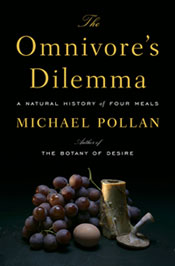
These thoughts about food and eating practices were prompted by a wonderful interview with Michael Pollan in The Sun this month, "Lost in the Supermarket," which you can read here. Pollan is the author of The Omnivore's Dilemma, which, he explains, is "the existential predicament we're in regarding food...deciding what to eat out of all the potential foods available is a complicated process." Pollan says that how we answer the question of what we eat defines our relationship with the natural world.

While I resent taking time to think about what I should eat, I am concerned about the natural world, the politics of industrial agriculture (California's dubious claim to fame) and the relationship of oil to cheap, globalized food. Pollan shows how all these factors are connected, and the resulting picture is not pretty

In "The Communist Manifesto," Karl Marx wrote that capitalism was distinguished by "constant revolutionizing of production, uninterrupted disturbance of all social conditions, everlasting uncertainty and agitation." The result was an overturning of all that had been sacred in previous ages. "All fixed, fast frozen relations, with their train of ancient and venerable prejudices and opinions, are swept away, all new-formed ones become antiquated before they can ossify. All that is solid melts into air, all that is holy is profaned." Michael Pollan argues that this capitalist revolution includes the destruction of ancient cultural practices of eating which helped us choose between healthy food and poison, a knowledge obtained through long trial and error.

"The family dinner, and more generally a cultural consensus on the subject of eating, appears to be the latest such casualty of capitalism. These rules and rituals stood in the way of the food industry's need to sell a well-fed population more food, through ingenious new ways of processing, packaging, and marketing it...So we find ourselves as a species almost back where we started: anxious omnivores struggling once again to figure out what it's wise to eat. Instead of relying on the accumulated wisdom of a cuisine, or even on the wisdom of our senses, we rely on expert opinion, advertising, government food pyramids, and diet books, and we place our faith in science to sort out for us what culture once did with rather more success."

But this means that we are relying on corporations and institutions who are intent more on extracting a profit from us eaters and feeders rather than nourishing our health. "McDonald's pushes our evolutionary buttons," Pollan says, "by making things very sweet, salty, and fatty." In his book he follows the food chain of a bushel of corn, 56 pounds of kernels which sell for $1.50. "The challenge is to turn that cheap corn into something expensive," he writes, and he discovered that at McDonalds 15 percent of the bun comes from corn and 100 percent of the soda. Corn can be made into sweeteners, gasoline (ethanol) and feed for animals. In addition, you need vast quantities of fossil fuel (the food industry uses 20 percent of imported oil). That bushel of corn, or a half-pound of beef, each requires a half gallon of oil to grow, and more to transport them to market. "So to eat that McDonald's meal," Pollan says, "we need to keep the oil flowing. that's one reason we're in Iraq."

The industrialized, processed food that we eat is bad and it's cheap. Americans spend less of their income on food -- around 11 or 12 percent -- than any other people in history, according to Pollan. Europeans spend 20 percent, and for most of history people spent 50 percent of their income on feeding themselves. And one consequence of cheap, nutritionally empty food is the current obesity epidemic in America.

Eating, then, is a political act. My dilemma is that I never developed the skills to feed myself easily, and food in general (as opposed to celebratory meals with friends) is about as interesting to me as stamp collecting. I love the smells and colors of the weekly Farmer's Market but often feel like an alien among the roots and berries. Pollan's survey and analysis of the changing ways we eat, however, is a healthy kick in the ass. Buy organic. Buy local.

Thursday, May 11, 2006

Letter from Iran

The Western press, in lock-step with Condi Rice, has already dismissed it as irrelevant and insubstantial, but I found the letter from the president of Iran to President Bush fascinating.

You can read it in full here.

Addressing Bush as "a follower of Jesus Christ (PBUH), the great Messenger of God," Mahmoud Ahmadinejad asks him "how one can justify the undeniable contradictions that exist" between the values one professes and the deeds one does. In a polite and somewhat abstract way, Ahmadinejad is asking the American president to explain his apparent hypocrisy. How is it possible that a Christian (and there is much about Jesus the prophet in the Qur'an) can wage preventative war under false pretenses? How can a Christian trample human rights in Guantanamao Bay and in the secret prisons of Europe? How can a Christian support the oppression of Palestinians by Israel?

"If prophet Abraham, Isaac, Jacob, Ishmael, Joseph or Jesus Christ (PBUH) were with us today," the Iranian leader asks, "how would they have judged such behavior?"

History will judge us, he tells Bush. "Did we manage to bring peace, security and prosperity for the people or insecurity and unemployment?" He notes that in the U.S. many people are living in poverty, thousands are homeless and unemployment is a "huge problem." The enormous cost of the Iraq misadventure is singled out: "What has the hundreds of billions of dollars, spent every year to pay for the Iraqi campaign, produced for the citizens." And Ahmadinejad notes that Saddam, "a murderous dictator," had long been supported by the West.

As for the current campaign to deny Iran the use of nuclear energy, Ahmadinejad askes why it is "that any technological and scientific achievement reached in the Middle East regions is translated into and portrayed as a threat to the Zionist regime?" America's obsequiousness to the pro-Israel lobby is the blind spot that prevents any solution to the Middle East quagmire. The Iranian argues that "scientific R&D is one of the basic rights of nations." The fact that Israel has long had nuclear weapons pointed at Iran is not mentioned.

Ahmadinejad calls 9/11 "a horrendous incident," and says the "killing of innocents is deplorable and appalling in any part of the world." But he hints at a possible conspiracy on the part of intelligence and security services and wonders why no one has been arrested, tried and convicted for failing to protect the United States from terrorists.

"Are you pleased with the current condition of the world?" he taunts Bush. "Do you think present policies can continue?" The situation has resulted in "an ever increasing global hatred of the American government?"

At the end of the letter, Ahmadinejad asks Bush, as a fellow believer in God, to join him in overcoming the present problems of the world "that are the result of disobedience to the Almighty and the teachings of the prophets...Will you not accept this invitation?"

I find this letter eminently sensible. But I also thought that Osama Bin Laden made some excellent points in his recent message to the world. When will we learn to listen to our opponents, our foes, our enemies? Jon Stewart had it right when he asked immediately after 9/11: "Why do they hate us so much?" There are reasons, and they have a long history. But in a black-and-white world where we demonize those who think differently, this history is not heard.

Monday, May 08, 2006

In Praise of Hairy Palms

Walking down Pacific Avenue yesterday, I did a double take in front of Camouflage, the lingerie (and more!) store. A sign in the window read: “May is Masturbation Month. Are you doing your part?” A little research on Google uncovered the facts. Early in 1995, Surgeon General Jocelyn Elders was fired by President Bill Clinton after suggesting that masturbation was a natural part of human sexuality and should be discussed in a comprehensive sexual health curriculum. In response to the firing, Good Vibrations, a supermarket for sex toys and books in San Francisco, declared May to be National Masturbation Month, and the unofficial holiday has been celebrated for over a decade. You can read all about it here.

I still vividly recall my embarrassment when an 8th grade science teacher solemnly told his class that “excessive masturbation makes hair grow on your palms” – and I looked. Has anyone managed to avoid this rite of passage? According to wisdom of Lily Tomlin: “We have reason to believe that man first walked upright to free his hands for masturbation.” And another wit has argued: “if God didn’t want us to masturbate, He would have given us shorter arms.” Certainly in the catalogue of human sexuality, masturbation is something to be laughed at, and enjoyed, rather than to be feared.

But my Catholic Church does indeed continue to believe that masturbation is a sin. According to the official catechism, masturbation is an offense against chastity because it is “an intrinsically and gravely disordered action.” Pope Paul VI, in “Persona Humana,” declared that the main reason for this condemnation is because “whatever the motive for acting this way, the deliberate use of the sexual faculty outside normal conjugal relations essentially contradicts the finality of the faculty.” In other words, the “faculty” was created by God solely for the purpose of procreation within (heterosexual) marriage, and not for pleasure, with someone else or alone.

Is masturbation a trivial sin, something to be eventually overturned, like eating fish on Fridays or the necessity for women to cover their heads in church, or is it rather symptomatic of all that the Church has gotten wrong about human sexuality? While the Magisterium in Rome claims that tradition is one of the pillars of the Church, it has been clear to scholars for years that culture and politics play important roles in shaping that tradition. While not willing to rehash history now, let me argue here that the Church’s attitude toward sex and the body is a holdover from Gnosticism which saw the universe in black and white terms (not unlike the Manicheanism that St. Augustine believed but later rejected). In this tradition, the body is either evil or an illusion, or both, and something to be transcended rather than enjoyed. This tradition contradicts another which takes the creation story in Genesis for its source. God declared that what he had created was “good,” all of it, and this includes bodies. Matthew Fox took this idea as the beginning for his theology of creation spirituality.

Jesus did not discuss sexuality in the Gospels. And although there is an otherworldly character to many of his reported sayings (particularly in John which shows Gnostic influences), the message to any sincere reader today is decidedly thisworldly. The way to the Kingdom (now, in this lifetime) is by loving God and neighbor, and we do that by taking care of others, feeding the hungry, healing the sick, sheltering the homeless (Matthew, chapter 25).

The sexual abuse scandal has knocked the Church to its knees, but without the kind of repentance that would indicate a change of heart. It continues to maintain misguided and downright wrong ideas about sexuality. Because sex outside procreation is sinful, it must be repressed. And any first-year student of Freud knows that the repressed always returns with a vengeance. For generations, young candidates for the religious life have embarked on a life of celibacy with few tools other than repression. And we see the results today in countless stories of sexual aberrations by priests and nuns. Homosexuals and lesbians, drawn to a life of service to God and neighbor, are doubly condemned. Parents and sexually active young people, faced with unwanted pregnancies, have ignored the “pro life” teachings of the Church in numbers comparable to the un-churched. Once the respect for Church tradition has been compromised, can the edifice survive?

And finally, the Church’s historic misunderstanding of sexuality has led it into comparable problems involving gender. It should be obvious today that to conceive of God as father is culturally and linguistically based. Likewise, Jesus set no rules in the Gospels for which gender might perform the role of priests in the Church (which he did not clearly originate). Despite the customs of the time, women were involved at all levels of the early Church, and Mary Magdalene can be reasonably called the first apostle because of her presence at the empty tomb. Only many years later did men take control of the Church. Continuing attempts to justify an all-male priesthood are embarrassing, to say the least.

Why stay in such a fallible Church? Because I enjoy the companionship of good people who are seeking the mystery of God, and because the liturgy and the sacraments feed me on my journey. This morning as the congregation held hands and prayed the Our Father, I laughed to myself and imagined us as the community of the hairy palms, all of us struggling to live full-bodied lives, illuminated by the light of the Holy Spirit.

Sunday, May 07, 2006

Body Image

No, I am not this Bill Yaryan. I know he has my name, and I'm aware that this picture of him, with that award-winning prodigious protuberance, is all over the web. But it's not me.

I suppose I shouldn't care. What if I were named John Smith and the world were full of other John Smiths? Or I could be named Jose Gonzalez, or even Mohammed, with all the name confusion and competition THAT would involve.

Let me be honest. The fact that he is named Bill Yaryan does not bother me so much as that he's large, excessively large. And seemingly proud of it. In days long gone by, when I was string-bean thin, I would have laughed at the difference. I'm obviously not him! (pointing to my wimpy stomach). But those days have passed, and as I move through my seventh decade on this planet, my stomach has grown accordingly. I, too, have a protuberance, though not (yet) an award-winning one. I gaze at my rotund reflection in store windows as I stroll the street, and I mourn my transformation from a boney, gawkey kid into this amply-endowed elderly gentleman.

I am troubled by my body image, by the self conveyed through appearance, and I share this malaise with countless people on the planet, particularly those in First World, enlightened countries where youth and health are emblems of worship. I can identify especially with women who are forced into the false facades of fashion, spread by seductive advertising and the media's focus on celebrity. The cosmetics industry would collapse if women would only recognize that true beauty and worth come from within, not from a bottle or tube or lipsuction. But we don't teach that in schools. And even men are getting facelifts.

I am also troubled by the widespread idea that our bodies are infinitely malleable, and that we can sculpt them as we please, with enough effort and the correct diet or supplements. The gyms, pools and bike paths and full of part-time athletes anxious to win the gold, or at least live forever. There is nothing wrong with seeking and staying healthy, but I detect in many of my friends a compulsiveness to fend off wrinkles and double chins, a desire to recapture the vigor and sheen of their youth.

Most people are satisfied to tell others that they've been "working out" alot. Twenty some years ago I participated in the fad for running and I reveled in the thought that I was an athlete, at least temporarily. There is no question that I felt good, in body and mind, from the exercise. But I don't run any more, and I am aware of the others around me who have failed to get in shape, their bodies capitulating to gravity and cellulite. If you're wealthy, though, like my 63-year-old friend in Spain, you can defy fate by getting a face lift and a boob job.

What I resent (and here comes the rant) in all this obsession with the body is that it turns the victims of genetics and the choosers of alternative priorities into failures. We pity the mishapen and the prematurely aged. If only they'd exercised more and kept in shape! It's not unlike blaming the cancer victim for causing their condition by not eating the right foods, exercising, etc. Yes, there is an obesity epidemic in the modern west, but it's the fault of a greedy (i.e. capitalist) food industry eager to profit from the poor, and NOT the fault of the eaters. Yes, exercise is good for you, but why is cheaply produced corn syrup in pratically everything we buy?

There is so much more to worry about and work on in this world that is more important than our body image. And even if I might be happier looking like Tom Cruise (or, for me, Sean Connery), I'm too busy campaigning for world peace and an end to hunger than to pump iron and huff and puff on a tredmill.