Saturday, June 28, 2014

We're Not in Kansas Anymore


St. Thomas Aquinas: "Everything I have written seems like straw by comparison with what I have seen and what has been revealed to me."

Every few days the world turns, the poles shift, and I realize with a jolt that the certainties that formed the basis for my opinions were as worthless as straw.  Unfortunately, unlike the good doctor at the end of his life, nothing new has been revealed to me. The quest for wisdom has been a bust!

"The Wizard of Oz" was released a month after I was born and I've seen it many times; "Over the Rainbow" is in the soundtrack of my life.  I bought a copy of the film here with Thai subtitles for my wife's cousin Edward but he showed little interest in watching it during his last visit to Bangkok. It was the series of Spiderman movies that captured his attention.  The original Wizard book was written by a relative of a junior high school friend who has managed to turn Oz into an industry.  The ultimate message of the film -- "There's no place like home" -- is of not much use to someone whose home is a moveable feast.

This is the rainy season in Bangkok.  I can see the black clouds move across the sky from my 9th floor apartment.  Most days the sky darkens, thunder cracks, and a brief monsoon downpour sends pedestrians and sidewalk vendors scurrying for shelter. Most tourists avoid the rains by visiting Thailand in the dry season from November through March, unless there is political unrest which tends to scare them away.  I've learned to love this time of year.  Storms for some strange reason soothe my soul.  I am mad for thunder, lightning and the frenzy of rain drops.

Kansas is far away.  I crossed through it once on miles of interstate threading between corn fields probably filled with genetically modified crops.  Now the state is probably dotted by wells for hydraulic fracking.  Only a native like Dorothy could love that place.  Most of America seems just as strange to me now.  The sorry stories about surveillance, gun nuts and serial shooters, Tea Party craziness and another war in Iraq parade across my laptop screen and my eyesight grows dim.  I did not vote for Obama and I no longer care if he's beholden to the banks or a beacon of hope for the downtrodden masses still yearning to be free.  The news from the land of my birth is not good.  I blame the chemicals.

Now I'm living under a military dictatorship.  The civil war many feared after yet another coup d'etat in this once almost democratic country did not materialize.  After a month in power, General Prayut and his subordinates are now firmly in control.  There is little outward evidence that the new government is unelected, other than an occasional armed soldier or two, like the pair I saw yesterday on Phra Arthit near Khao San Road protecting the media offices of Sondhi Limthongkul, the yellow shirt editor. The malls are full of shoppers, the BTS and MRT trains are packed with commuters and the roads jammed as usual.  Stories in the news tell of those "invited" to "reconciliation" centers with the authorities to discuss their "attitude."  They invariably leave smiling, declaring their happiness and promising to refrain from political activity in the future.  Arrest warrants are issued for those refusing the invitation and not a few dissidents have gone into exile where they're trying to organize.

As mentioned in an earlier blog post, I'd expected something entirely different.  I've seen the movies and read the books about resistance and revolution.  In the first heated days after the coup, protesters, many of them students, employed symbolic signs of non-cooperation: banners in English, the three-fingered salute from "Hunger Games," passively reading Orwell's "1984" in public, and the final disruptive act, eating sandwiches while thinking about protest.  All of these acts were subject to arrest. After a week or so, even these protests disappeared.  Of course I have no idea what people out in the provinces are thinking and planning, but consulting the green tea leaves in Bangkok leads me to the conclusion that the overthrow of the last government has been largely accepted by the citizens as a good thing.  It will probably last a long time.

Since it's against the law to criticize the coup, my words are necessarily temperate.  But I must say that the widespread acceptance of military rule is depressing.  Criticism from outside the borders of Thailand has universal condemned the end of democracy (until the next election, now promised in October next year).  The response by some Thais has been to threaten a boycott of American and EU products and turn to China for support.  It's assumed that only a Thai can understand Thai history and politics.  This calls into whole question the social construction of "Thainess" and even the name of the country which was changed from Siam in the 1930s to appeal to western interests.

But I digress.  Thailand is not Kansas and I'm not Judy Garland.  Most of my students are from elsewhere: Bangladesh, Myanmar, Nepal, Cambodia, Vietnam, Laos.  I put together a handout on the coup for our first class this term and many of them found it mystifying.  Not that the governments where they come from are more democratic and less militaristic.  There are no Switzerlands in Asia!

This term I'm teaching two days a week.  In addition to my advanced listening and speaking class for senior English majors, I'm now giving a course in how to teach English to first-year students in a weekend English MA course.  As a self-taught teacher who invented his lessons from scratch, I approach this challenge with some humility.  How much do I know about the subject after only seven years of experience here?  I'm still uncertain how much I help my students to improve their facility with the language I absorbed easily from birth.  Only a few of them have progressed to thinking in English which allows them to appear fluent; most are struck dumb when asked to speak a meaningful sentence or two.

When I began teaching English, I borrowed themes and material from the Headway series of textbooks published by Oxford, including the one I'm currently using, American Headway.  For the MA course, I visited the wonderful DK Books and its many shelves stocked with English instruction books, and chose Penny Ur's A Course in English Language Teaching.  Published two years ago by Cambridge, it provides a guide which I hope to adapt for my class of 45 students from mostly other Southeast Asian countries.  In the first three weeks of the term, however, our classes have been cancelled twice for ceremonial events (Thai schools seem to favor ritual over education).  At our only meeting I learned that the students had been split into two groups and my three-hour lecture had been cut into two hour-and-a-half sections.  Less work for me, but also less teaching for the students.

In the teaching textbook, Ur, a British OBE who taught ESL class in Israel, makes some points I first heard when I prepared a lecture several years ago on the 10-country ASEAN group which is using English as it's working language.  English today is no longer a foreign language.  It's an international language and for the majority of those using it, English is a second language, "globish" according to one article I reprinted for my students. The primary method of instruction these days is based on the "communicative approach," in which understanding is more important than grammatical correctness.  Grammar now takes a back seat to vocabulary.  What this means is that the native speaker is no longer king of the hill. A non-native teacher of English is a better model for students because they've gone through the process of learning English.  If nothing else, however, native speakers like me are seen as models for pronunciation.  But our days may be numbered.

Despite the military dictatorship, despite the uncertainty I feel over ever being able to teach my students anything worthwhile, I continue to see Thailand as "over the rainbow."  Strange that I never dreamed it.  And it's not bluebirds but the dove that comes to sit on my windowsill that makes me feel at home. California was my Kansas but I doubt that I would have been as happy rounding out my days there sipping cappuccino near the sound of the Pacific surf.  Familiarity was never my thing. Thailand is exotic and strange and not a day goes by without a puzzle I cannot solve.  Some expats deal with these mysteries by complaining about them.  But from my first day here I found the uncertainty exhilarating.  The novelty of living here has pretty much gone but the delight I take in the sounds and smell and blooming buzzing confusion of Bangkok street life has not faded.  Thank the goddess I'm not in Kansas anymore!


Thursday, June 19, 2014

Death Comes Calling


Dead men naked they shall be one
With the man in the wind and the west moon;
When their bones are picked clean and the clean bones gone,
They shall have stars at elbow and foot
Dylan Thomas, "And Death shall Have No Dominion"

I met Michael three years ago on Facebook.  It was a meeting of minds over the political issues of the day.  He was an Australian, not that much my junior, with a long career in the theatre back home.  In Thailand he was a teacher, a connoisseur of art, and a lover of elephants.  Even before we met I was captivated by his way with words, the comments he made, the exchange of messages with me.  Here was someone for whom life was no guilty pleasure but an adventure to be savoured.

We finally met at an art exhibit in a school near the flower market. He was one of the organizers and had little time to talk between posing for photos with some of Thailand's notable artists, all of them his friends.  But he introduced me to his longtime friend Susan, the guru of laughter yoga in Bangkok, and we too became Facebook friends and co-admirers of the marvelous Michael.  Over the next few years, Mikhun (as his Thai friends called him) and I continued to commune on Facebook and occasionally to meet for a meal or coffee. A big man, he used his body to punctuate his many stories, particular his eyes which sparkled with enthusiasm and joy.  Not long into our friendship, he moved to Chiang Mai to help with elephants who had been found to animate children with autism.  Elephants were one of his many passions and kids another.  After that, he moved on to Yangoon to be a school administrator and then a teacher. When his internet was working, we stayed in touch on Facebook.

With Susan and Banlu
Michael would return to Bangkok on visa runs and medical checkups and his cheap guest house of choice was in a backpacker alley not far from the river (during the flood of 2011 he messaged me frequently to hear about the rising waters). Earlier this year he left Burma for good and was recuperating following treatment for swollen ankles.  We kept in touch during Songkran when he was unable to go outside because of the water play.  At the end of the holiday I took him some books to read and we drank beer in the guest house restaurant close by a fan which blew the smoke away from his ever-present cigarette.

With Susan at our last dinner
Michael was obviously very seriously ill; the sparkle in his eyes dimmed. Where are all you friends, I asked?  Most of them are yellow shirts, he said, and don't like my politics now.  He tried to explain his departure from the school in Yangoon but it seemed a bit mystifying.  Now, he told me, he wanted to heal first and then return to Australia where he would have to live for two years to qualify for retirement before he could return to Southeast Asia.  Susan and I took him away from the guest house for a sidewalk dinner around the corner.  It was painful to see him walk so slowly with his cane.

Not long ago, Michael tripped and fell, and he lay two days in his guest house bed before the ambulance was called.  At Phramongkutklao Hospital the doctors examined a painful lump in his leg (that he'd been complaining about for weeks) and discovered a mass in his lung.  They diagnosed him with pneumonia and perhaps TB, maybe cancer.  I visited him in the 17th floor intensive care unit and saw the bruise on his head from the fall. His long-time partner Unn was with him when his heart stopped for several minutes.  And his sister in Australia was contacted and came to supervise treatment.  A feeding tube prohibited conversation and the last contact Michael had was through his eyes which could be quite expressive.  He died with a friend by his side who was playing recorded music for him. Before the day was out, his account on Facebook was filled to the brim with messages of sadness and love from his many friends in Thailand, Australia and Burma.

I didn't know Michael for long or very well and I regret that now very much.  It's not often you find a conversation partner so sympatico, even on Facebook.  No one has yet written his obituary (better yet, eulogy) so there is much that I do not know about his life. The many messages on Facebook speak of adventures going back years, of his love for food and drink, and, as I noticed so soon after we encountered one another, his passion for life.  He didn't speak all that much about his illness and I suspect was unaware of the prognosis.  In other words, he was the opposite of a hypochondriac. Our last conversations were about books.  Confined to the guest house by his swollen legs, he worried most about running out of something to read.

With Susan and his partner Unn
When Susan mentioned Unn to me I didn't recognize the name and thought it a friend from Yangoon.  When I brought Michael a couple of cartons of juice that he requested to the hospital, I asked who Unn was.  He turned to me, his face lit up with the biggest smile I'd seen from him in months, and said: "He's my partner!" When I was unable to help, Unn spent a day renewing Michael's visa with a letter from the doctors.  He was there when his friend's heart stopped.  Tonight is the third and last night of chanting at Wat Apai Tharam (Wat Makok), the temple behind the hospital where Michael died, and the cremation will be there on Saturday afternoon.

The death of a friend is always unsettling because it reminds us of our own mortality.  Next month I will celebrate my 75th birthday and am thankful for every day I've outrun the Grim Reaper.  My parents are gone, my son Luke, and Peter, my oldest friend, long dead from the same cancer I've now survived for a dozen years. I think about my young wife and worry that she will grieve for too long after I go.  But present worry about an uncertain future situation does little besides stir up unpleasant juices.  The present joy I take in living each day is no doubt related to its tenuousness.  Dr. Holly's death in Bangkok a few years ago helped me to sense that exquisite connection between life and death.  Without death, life would lose its ecstatic edge.  Death, even from those heartbreaking tragedies that so absorbed Dostoevsky's sleep, is not only the great equalizer but the finalizing event that animates life.  


Saturday, May 31, 2014

Living in the Time of a Coup

Soldier in front of Democracy Monument
On May 22 the feeble remains of the elected government in Thailand were replaced by a military coup d'état. While this had been a possibility since the anti-government street protests began seven months ago, it wasn't quite what I expected.  Where were the tanks, like in 2006?

It was a sneaky coup.  Two days earlier, Gen. Prayuth Chan-ocha, commander of the Royal Thai Army, had declared martial law.  Large groups of opposing protesters -- Suthep's anti-government mob in the vicinity of Government House, and the pro-government Red Shirts south of the city -- were surrounded by troops.  Radio and TV stations were seized.  Two weeks before, Prime Minister Yingluck Shinawatra and several other ministers had been removed by a ruling of the Constitutional Court, and the fragments of a caretaker government were told to report to Prayuth. The general then ordered representatives of the warring factions to hold talks to settle their differences.  At the second meeting, after the Pheu Thai government refused to resign, Prayuth reportedly said: "Sorry, I must seize power."

This post will neither be a full journalistic report of the coup, the 18th in Thailand's modern history since 1932, nor will it be a critique: criticism of the military junta's actions is against their law and offenders are warned of severe consequences.  I write "their law" because it is not exactly clear what laws currently govern Thailand.  The 2007 constitution, written by the military junta that took control in a 2006 coup, was overturned by Prayuth's seizure of power.  Nevertheless, anyone with a gun is in charge now.

My first reaction, when I turned on my computer at dawn on the 20th to learn that martial law had been declared several hours earlier, was exhilaration.  Since I'd moved to Thailand in 2007, there had been two events on the horizon that promised excitement and adventure for an expat from a country where political passion had long since been tamed.  Discussion of the first event is strictly verboten.  The second event had been too long delayed.  Earlier in the year I wrote about endless street demonstrations, always expecting that a climax ("Armageddon") was near.  Suthep's mob tried to shut down Bangkok and had ultimately failed, although the carnivalesque closures of major intersections brought upset as well as entertainment.  Trying to mollify their demands, PM Yingluck resigned Parliament and called for new elections.  But Suthep's mob, seemingly protected by security forces, the courts and independent agencies like the Election Commission, blocked much voting and the results were nullified by a court ruling.

Protester at Victory Monument
At first it was amusing.  TV programs were replaced by the juntas slides,  indicating that soap operas, game shows, and the news had been put on hold because of the coup.  The soundtrack for the slides of ancient Thai patriotic music was almost hilarious.  The lack of news was unimportant since Facebook and Twitter went into overdrive. There was little immediate resistance.  Once the coup was announced, people in small numbers carrying signs mostly written in English ("NO COUP" and "FUCK THE COUP" were popular), gathered outside a McDonald's outlet in the shopping center of Bangkok, a cinema in the north end of the city, and around Victory Monument, a landmark erected in 1941 to commemorate the brief Thai victory in the Franco-Thai War the year before (gains were soon erased by war's end).  Strangely enough, supporters of the military gathered at Democracy Monument, a few miles west, which commemorates the coup of 1932 which established Thailand as a constitutional monarchy. Soldiers seemed careful not to overreact as they had in 2010 when over 90 people were killed and 1,000 injured, most of them red shirts, as a two-month demonstration was crushed by the military at the orders of then PM Abhisit and his 2nd in command, Suthep.

Certainly many people in Bangkok were happy that the military had intervened after months of irreconcilable disagreement. While the violence during that time had been small compared to 2010, committed mostly by unknown forces, there was the ever-present threat of civil war if the elected government was overthrown.  No one, inside or outside of Thailand, could see any possibility of resolution.  The reds wanted the results of elections to be honored by the losers (since their candidates had won every election for over a dozen years) while the yellows (Suthep and all who since 2005 had opposed the Thaksin Shinawatra "regime") felt that elections in Thailand were flawed and resulted in a majoritarianism that trampled on the rights of the elite minority that hated him.  My heart had been with the majority through I felt sad for the whistle-blowing demonstrator who seemed clueless about the consequences of toppling Yingluck.

The protesters at Suthep's gatherings and those against the coup at McDonald's and Victory Monument look much the same.  It does seem as if women are dominant at both.  Both groups claim to love the King who apparently signed off on Prayuth's coup (though HM was not pictured).  Both sides could also be called nationalists.  In many respects it's a continuation of the long struggle of people in the hinterland against domination by elites in the capital, a 100-year-history told in Charles Keyes' excellent new book Finding Their Voice: Northeastern Villagers and the Thai State.  While there was some agreement on decentralization, which could result in the election rather than appointment of provincial governors, this is all moot now after the coup.

After a week, the coup has taken its toll.  While not as dramatic as tanks rolling down the main boulevards, the resolve of the general is firm.  The first curfew from 10 pm to 5 am has been modified to midnight until 4 in the morning.  Each night Nan had to rush after leaving work early to get the last transportation home. Hundreds of politicians, academics and journalists have been detained and those already released say nothing.  Pressure against resistance has been even stronger, and less publicized, in the provinces.  The junta threatened to curtail social media and Facebook was down for an hour the other day.  I've lowered my profile on both Twitter and Facebook, trying to "hold my tongue," not always with success.  I've stopped following and even de-friended some of the most vocal opponents of the coup, many of whom live outside the Kingdom, out of fear that I might find myself in the junta's sights.

Last night the general spoke to the nation on TV.  He only wanted a return of happiness, he said. Though democracy was always the goal (under the King as the head of state as it says in all constitutions), it was necessary to undertake reforms before elections could return.  This sounded remarkably like Suthep's goal which he announced nightly during his half-year campaign to eradicate the Thaksin regime from Thailand.  Anyone connected to or having publicly favored Thaksin is now undergoing treatment at a series of "reconciliation" camps designed to change their attitude.  Signs at red shirt villages in Isan, erected after the massacres of 2010,  have been taken down.  School administrators have been told to keep an eye on their teachers and students for any pro-Thaksin, anti-coup sentiments.  Those arrested will be jailed and judged by military courts.

My fears may be groundless but it's prudent to be careful. Outside on the streets in my neighborhood nothing is changed. In Siam at the shopping malls all goes on as usual.  Tourists at Thailand's many beaches notice nothing different.  This is a "bloodless" and peaceful coup.  Six months of protests followed by a military takeover have taken their toll, however, and financial prophets predicted a rocky road for Thailand's economic future.  Over 50 governments have posted warnings to travellers about visiting one of the world's most popular vacation destinations.  For many, their travel insurance is invalid where there has been a coup d'état.  But now the military is in firm control and the streets are quiet.  There is no civil war but there is also no democracy, not without elections and an agreement by all that the results will be accepted.  That has rarely occurred in Thailand since that first coup in 1932.  Friends ask if I'm worried or scared.  The answer is no. The military was in charge when I arrived here in August of 2007 and I barely noticed (except when a friend voted in the referendum on the junta's constitution).  It's hard to believe that the government's supporters and the large network of red shirts have given up.  But for now, there's an uneasy peace.

This soldier's tears were seen widely on social media after he was shouted at by angry anti-coup demonstrators at McDonald's.  Many soldiers come from poor villages in the north and northeast and now find themselves on the other side from their rural neighbors and kinsmen.

Sunday, April 27, 2014

Cooling it in Kyoto


Confession: I'm an unreconstructed tourist. I search out popular and significant sights and sites in foreign lands and take photos of them along with numerous selfies and pictures of what I eat. All goes into an album of memories, most likely these days on Facebook. This makes me not unlike a collector of stamps or the Boy Scout accumulating merit badges.  On my TripAdvisor page I'm up to 216 cities in 30 countries. Wow.

Seasoned travellers look down their noses at this.  I once traveled with a lady in Sri Lanka who sneered at my predilection for modern hotels with sumptuous breakfast buffets.  She thought a measure of discomfort was a mark of the exotic.  We parted in an ancient hotel on the beach at Negombo where fish were drying on the sand. For me, the exotic can often be found in the familar. Even the lowly McDonald's outlet can provide surprises in a menu adapted for Thai or Japanese tastes.

I live now in a foreign land far from where I was born and every day is a tourist excursion. As a resident in Asia, my goal has been to explore the neighborhood, and in the recent past I've taken selfies and eaten strange food in Seoul, Hong Kong and Singapore.  This year the destination was Japan, home of the Karate Kid, where Marlon Brandon said "Sayonara" and John Wayne was the barbarian who courted a geisha, birthplace of the Ninja Turtles and the place where Bill Murray became Lost in Translation.

We see what we are prepared for.  In my case, besides the movies already mentioned, my anticipation was conditioned long ago by reading James Clavell's novel Shogun which was made into a popular TV miniseries in the 1980s with Richard Chamberlain as an English ship pilot in the early 17th century.  In addition to films, I also have a fondness for the art of Hokusai and the haiku poetry of Basho, but both are associated with Eido which grew into Tokyo, now the world's largest city.  Tokyo, however, held little attraction since I already live in a large Asia city. It was Kyoto, imperial capital of Japan for a thousand years and home of the shogunate, that appealed most to me.

In the run up to departure, I read Pico Iyer's The Lady and the Monk, the story of how he fell in love with the city and the woman who became his wife, and I poured over maps and guide books and looked at pictures of many of the 1,600 Buddhist temples and 400 Shinto shrines, 17 of which have been declared World Heritage Sites by UNESCO.  From a YouTube video I learned that pickles and tofu were specialities of Kyoto cuisine. Friends said that our departure in the second half of April was too late for the blooming of the cherry blossoms, an almost religious event in Japan, but it also meant smaller crowds of tourists. I bought Nan a Kyoto guide in Thai and for me the just published Kansai Cool: A Journey Into the Cultural Heartland of Japan by Christal Whelan which takes a regional view to include nearby Osaka and Kobe.

Reality can be unexpected, since it's mostly of our own construction.  For reasons of price and location in the temple-saturated Higashiyama neighborhood of Kyoto, I picked a ryokan, or traditional Japanese inn, thinking it would add to our immersion in historical Japan.  It wasn't sleeping on a futon over tatami mats in a tiny room, or the postage-stamp bathroom, that was difficult so much as the 4th floor walkup in a building without an elevator.  Everything else about the Kyoto Traveller's Inn was superb, from its location opposite the zoo and art museums near the Heian-Jingu Shinto shrine, to the food and the friendliness of the staff, and not least the onsen hot bath in the basement (probably more correctly called a sento since the water wasn't from hot springs) that was strangely always empty.  The hot waters helped to soothe aches and pains brought on by extensive walking.

The burning summer weather had just begun in Thailand as we set off for Kyoto where long sleeves and coats were necessary and the shorts I brought useless.  Despite warnings that Sakura, the Japanese blossom time, was past its peak, there were blooms everywhere and tourists and locals who were taking their photo.  We cut notches on our tourist samurai sword by visiting Nanzen-Ji, Ginkaku-Ji and Kiyomizu-dera on the east side and Tenryu-Ji in the west. We walked the grounds of the Imperial Palace and Nijo-Jo Palace where the shoguns lived but failed to see much without the necessary reservations.  We sniffed the smells and eye-balled strange food in Nishiki Market and climbed to the top of the ultramodern Kyoto Station in the shadow of Kyoto Tower.  We walked the blossom-lined Path of Philosophy and the through the giant bamboo grove at Arashiyama.  In the evenings we ate yakiniku, okonomiyaki, sushi and sashimi, and sipped incredibly tasty noodle soups. So what if we missed Fuji and the short trip I'd hope to make to Nara?

In my imagination, Kyoto was forever lost in the shogunate period from the 11th to the 19th century.  And the authorities have certified that the tourists sites are historically authentic.  But Kyoto today is a cosmopolitan city of one and a half million with a modern bus and subway system that we quickly learned to navigate.  Ginkaku and Kiyomizu are surrounded by a veritable Disneyland of shops selling a hodgepodge of souvenirs as well as pickles, mochi and green tea ice cream. That it was Easter weekend probably did not increase the usual crush of visitors to the sites. Arashiyama was particularly crowded because it was a Sunday to celebrate the coming of age of young girls who could be seen everywhere in kimonos strolling with their families. I felt the stickiness of stereotypes jostling for dominance with the commerce of tourism, mostly from Japanese themselves, so much in evidence.  What, I wondered, was the relation of the city's history to the fun-seekers queuing up for hot buns or taking selfies in the Buddhist shrines?

We had a wonderful time during our six-day visit. Nan got to rent a kimono one afternoon for a stroll down the street in Arashiyama, and she was able to buy a variety of Nippon goodies for gifts and for treats that now fill our refrigerator.  Our journey was made easier with the help of Kanae who grew up in Kyoto and Nueng from Thailand who is now studying there, both friends from my university in Ayutthaya.  This blog has turned into somewhat of a meta-reflection on tourism rather than a traditional travel report.  Hopefully you can browse through our photos in the Holiday in Kyoto album on Facebook which I have made public.

More than any other city I've visited, Kyoto is a paradise for bicyclists, if not pedestrians.  In Bangkok, the motorcycle taxi drivers roar down the sidewalks, but they are no more dangerous than the two-wheelers that whizzed by me in Kyoto.  Despite this sign, there was plenty of bike traffic in the downtown shopping area. Another observation: Kyoto is a city where the elderly remain active.  Japan has an average life-expectancy of 81 and the old folk were everywhere. Maybe the long lives are due to the ubiquitous face masks worn by residents to prevent the spread of infection. When I visited Germany in the 1970s I thought about the elderly I saw and wondered who might have supported Hitler. Perhaps enough time has past now so those thoughts did not arise when I encountered the elderly in Japan.
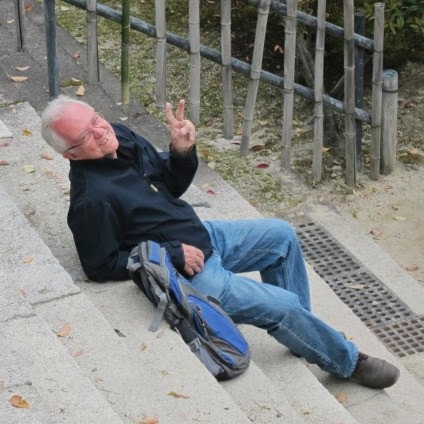
More likely, it's because I'm old as well now.  The Vietnamese I met in Hanoi seemed to have forgiven the misdeeds of my country.  So I have no more reason for grudges.  This trip made me realize my age acutely.  The four floors walkup in the hotel didn't help.  Most mornings while Nan slept, I wandered the surrounding area with my camera looking for a good cup of coffee (toast was the usual accompaniment).  By the time we set out on our day's tourist adventures, my feet, right knee and legs were already sore. I learned to search out the elevators and escalators in the underground. Rheumy eyes made it hard to see clearly. And I even got sunburned though the weather was mostly cloudy with a bit of drizzle.  Arthritic fingers ached from gripping maps. By late afternoon, I was pretty much wiped out, and we took more taxis than our budget recommended. Future trips will require better pacing.

As Christal Whelan points out in Kansai Cool, Japan's ministry of tourism now uses the slogan "Cool Japan" to advertise its wares. When we got off the plane back in Bangkok the hot air hit us like an explosion, emphasizing the temperature difference. But the cities differ in other interesting ways.  That night back home we went to an outdoor restaurant in Pinklao serving Isan food. The place was full of people happily chatting. In Kyoto at night the streets were silent, except for in the busy karaoke bar section of Pontocho.  In my youth, I lived for a time in Cuernavaca, and loved the street life there.  I found it again in Bangkok.  Thailand and Mexico are outside cultures, while Kyoto and probably all Japan are inside cultures.  I don't know if it's totally due to the long hot summer since Japan, like much of the north, has seasons.  In many respects, Kyoto reminded me of San Francisco.  And it was wonderful to see again pine and fir trees.

One other significant difference between the cities: Thailand is known as the "Land of Smiles" and if you look at someone they will almost always smile at you (even if they think you're a farang who smells like a turtle).  I smiled at lots of strangers in Kyoto and no one returned my grin.  On the other hand, we were struck by the friendliness, from the customs inspector at the airport who wanted to know if we were married, to the helpful staff at the hotel and the subway ticket taker who saw we were lost and gave us a free ticket to the proper stop.  The Japanese are punctual and incredibly efficient.  At the Daimaru Department Store, the information staff pictured directed us to an elevator that had not one but two operators, both grinning from ear to ear and eager to help us to our destination.  When our plane departed, the ground crew waved goodbye (they also did in Taiwan).

In Japan I knew nothing of the country's politics.  There could have been a revolution brewing and it wouldn't have interrupted my activities. This must be what it's like for a tourist in Bangkok ignorant of the current crisis that seems so disturbing to us expats.  After nearly a week there I will probably pay more attention to any news stories I see mentioning Japan.  Obama arrived in Tokyo the day we left the airport in Oasaka. Parts of the country remain uninhabitable after the earthquake, tsunami and nuclear meltdown.  More than the tourist crowds and the temple shopping malls, I'll probably remember quiet mornings in Higashiyama when residents came outside to water their plants and sweep up the leaves while the many streams through the area provided the rippling sound of water rushing over pebbles.


Saturday, April 12, 2014

To Be Me or Not to Be Me


Living in a Buddhist country, Thailand, I find it remarkable how little impact the Buddha's teaching about the self appears to have for the people around me.  They regularly frequent the many temples with flowers and incense to "tambun" (make merit) for the happiness and success of themselves and others, and to secure a favorable rebirth.  Their world is full of good and evil spirits that require small shrines full of icons outside buildings, religious tattoos, prayers and special amulets for protection. 

Since the Buddha's discourses were written down for his monastic followers, perhaps the teaching on anatta is primarily for monks.  The students to whom I teach English are mostly monks, and other than their robes and shaved heads appear to be little different from other young men their age in Thailand.  They joke about girlfriends and passionately follow British football teams.  All have digital devices and love the music of Michael Jackson.  When I taught the Five Precepts in English, none of them questioned the reality of a self that was able to abstain from killing, stealing, lying, intoxicants and sexual misconduct.

My monks are also aware of anicca (impermanence), the second of the three marks of existence.  When I ask them their plans for the future, they tell me no one can know what will happen.  But if I ask them "what if," then they shyly confess their dreams of becoming a teacher, a businessman or a tour guide.  Since all grew up in small villages where becoming a monk is the only way to get a university education, they know the dukkha (suffering) of poverty, the third mark of existence.  I'm sure they've also been taught the Pali terms for the Five Aggregates and can explain that the self and everything else is the result of prior conditions.  But how does this knowledge impact the effeminate monk applying makeup at the back of my classroom?

It always made sense to me that the Buddha in his teaching on anatta primarily intended to undermine a permanent or essential sense of self such as the eternal soul of Christians or the atman of the Vedas.  Buddhadasa Bhikku in Thailand described it as the "I, me, mine" that gets in the way of social relationships and makes it more difficult to feel compassion for others.  A self that is constructed by the brain through experiences of the body in the world makes perfect sense to me.  This provisional "self" dies with the brain.  And this is why the idea of reincarnation and kamma that connects successive incarnations makes no sense at all.

There is currently much theorizing about the idea of self and no-self by writers such as Julian Baggini, Jennifer Ouellette, Thomas Metzinger, Ray Kurzell, Patricia Churchland and others.  The idea of a constructed and impermanent self is no longer a surprising notion.   Only the religious faithful cling to an eternal self that can suffer rewards or punishment in an afterlife (or, as some Buddhists think, be reborn as a deva or cockroach in the next). 

Why then is the existence of a self such a sticky belief?  It must benefit the transference of our genes to the next generation, in Professor Wright's thinking.  If we were all meditating on a mountain or in a cave, there might be no next generation.  Selves are useful in an evolutionary sort of way.  They must be fed, clothed and housed, and for that a singular sense of being is necessary.  Selves incur duty and responsibility, imply an ethics, and they link us into a great chain of others.  Two selves are necessary to create the next generation.

To aid in this effort, our language locks us into a way of thinking about selves and objects.  For example, in my native English it is difficult if not impossible to speak from an abstract position; my view of the world is a perspective dictated by my body in space.  Generalities and objective claims are often only pretence. English sentences, I tell my students, must have a subject and a verb (although sometimes the subject is implied); e.g., "Speak!"  Gurus and enlightened humans have to struggle mightily to eliminate all subjectivity from their speaking and writing.  Even if all language is metaphor, a world of only objects makes little sense, and is of less interest.


I am comfortable with my self.  It has just as much solidity as the objects around me in my Bangkok apartment.  Years from now we'll all be gone.  While my brain and my body are showing increasing signs of age, they continue to provide an existence replete with security and surprise.  When it's time to relinquish this self I've labored long and hard with through the twists and turns of an amazing life, I hope to do so with gratitude and grace.

(This was written as a midterm assignment for an online course in Buddhism and Psychology given by Prof. Robert Wright of Princeton via the Coursera web site.)