Friday, December 15, 2006

And the Oscar for Best Actor Goes to...

Richard Griffiths.

Who?

I didn't know either until yesterday when I saw "The History Boys," a magnificent film which comes a very close second to "Little Miss Sunshine" as my pick for best movie of 2006.

Griffiths, however, is even better than the film. In the role of Hector, the obese, eccentric and poetic teacher at a British boys school in the 1980s, he inspires, provokes and appalls. The fact that he is a closet homosexual and likes to occasionally grope his pupils is more of a character flaw than a moral one. They, and the audience, will forgive him his failings because of his ability to teach and interpret history for them in passionate and surprising ways. Quoting A.E. Houseman, Hector declares -- between a musical hall song by one student and an imaginary scenario between several students in a house of prostitution to practice French -- that "all human knowledge is precious whether or not it serves the slightest human use." Hector is the teacher I once wanted to be, and a better version of the one Robin Williams attempted to portray in "Dead Poets Society." Griffiths fills this role of a lifetime with witticisms, mannerisms and expressions that both repulse and delight, and he shambles down the halls of the school in a body that would make Charles Laughton and Orson Welles seem puny.

Hector's foil is the younger Irwin (played by Stephen Campbell Moore). Both teachers are preparing the students for the Oxford/Cambridge entrance exam in history. Irwin tells them that history nowadays "is not a matter of conviction. It's a performance. It's entertainment." And truth "is no more at issue in an examination than thirst at a wine-tasting or fashion at a striptease." For Hector, however, history matters. He loves the subjunctive view in which the "events" of history can be seen from multiple perspectives. But his is not a superficial look at life, however, but one that engages it head on, while the more youthful Irwin cooly pontificates from his ivory tower (another closet homosexual). It is Hector's personal style of teaching, which uses popular culture as an entrance to timeless truths, that Irwin and the headmaster (a militaristic twit played by Clive Merrison) want to show as out of fashion. But it is the history boys that ultimately benefit from it.

Any film that can features quotations, several of them, from the writings of my favorite philosopher, Ludwig Wittgenstein, is unparalleled. Responsible for that, and dialogue that is intelligent, funny and stimulating (all that the same time!) is the well-known British author and playwright, Alan Bennett. "The History Boys" was a smash hit in London and on Brodway and won a record number of Tony awards this year. The original cast comes to the screen directed by Nicholas Hytner who also crafted the stage version.

While the actors playing the boys all do a superb job, the other role of note in the film is that of Dorothy Lintott, an older woman history teacher with a deep voice and a well-worn face (played wonderfully by Frances de la Tour). At one point, exasperated by her colleagues, she tells the students that history "is a commentary on the various and continuing incapabilities of men. History is women following behind with the bucket."

Griffiths might be best known as the unpleasant Uncle Vernon in the Harry Potter films. He is so dominant in "The History Boys" that I can't imagine missing him in other films. If there is any justice in Hollywood, he should be up on that stage on Academy Awards night receiving his Oscar.

Thursday, December 14, 2006

Early Stocking Stuffers

Cleaning off my desk, in preparation for two months abroad, I find a pile of magazines, clippings and printouts that contain fodder for irate thought, the juice that fuels this blog.

The Christmas buying frenzy is in full bloom several blocks away. When I was resting in the bossom of a family, I was a pushover for the whole romantic story, and could be seen wearing a Santa Claus hat the entire month of December. I loved reading "The Night Before Christmas" to all of my kids, just as my dad did for me and my brother. But over the years I became disenchanted with the routine of it, with the emphasis on commerce, and I gave up giving gifts and sending cards as a kind of ascetical practice. I meditate now on Christmas as allegory and symbol, as a sign of the birth of the divine on earth, in each of us. But occasionally I catch a glimpse of a Christmas tree or lights out of the corner of my eye, and the memories are overwhelming.

The good Bishop John Shelby Spong has punctured many of the myths about Christmas in a column on beliefnet, "A Religious Santa Claus Tale." All we know of the first Christmas comes from the books of Matthew and Luke. Did you know there are no camels in the story (sorry about that, wise men) and also no animals in a stable surrounding the crib or manger (which IS mentioned)? While Mary is supposedly a "virgin" (a mistranslation, some would say), the ancestors of Jesus are traced through Joseph who comes from the family of David. The Gospel of John refers to Jesus twice as "the son of Joseph." But the Gospel of Mark (as well as the apostle Paul) tells no birth story and what is said about Mary and the family of Jesus is not flattering. All of this only puts our memories in perspective. It does not wash away the simple beauty of the Christmas story.

My favorite Catholic theologian, Rosemary Radford Ruether, spoke on abortion and war to a Pax Christi conference and the talk, "'Consistent Life Ethic' is Inconsistent," was published in the Nov. 17 National Catholic Reporter. It's a breath of fresh air. She points out that Catholic ethics is absolutist when considering the rights of the fetus and relative when speaking about the rights of the born. Because of its stand on birth control, Catholicism "both forbids abortion under any circumstances and is a major cause of producing the situations that cause it." Ruether is concerned about the Church's less than rigorous stand on war, environmental destruction, and lack of access of clean water, education and health care by the world's poor. "Catholicism speaks softly and carries no stick when it comes to untimely and unjust death after birth...Putting the ethics of life before birth and life after birth more in sync with each other would help overcome the credibility gap from which Catholic teachings on ethics now suffer." Ruether disagrees with the Church that life begins at conception (why are there no funerals for miscarriages, I wonder) but laments abortions occuring after five months pregnancy. She argues that women often have little power to resist pregnancy and advocates that women's moral agency be recognized by Catholicism.

Now that Bush Senior's panel of experts has both condemned the war in Iraq but cautioned a go-slow approach (who wants to be the last soldier to die in this lost cause?), there are some impassioned and ironic columns on the report's import by our most excellent commentators. I can recommend Frank Rich's column in the Dec. 10th New York Times, "The Sunshine Boys Can't Save Iraq," and Patrick Cockburn's piece in the London Independent on Dec. 13, “The Americans don't see how unwelcome they are, or that Iraq is now beyond repair; The main purpose of Bush invading Iraq was to retain power at home.” Also excellent on this tragic topic is Mark Morford's column Dec. 13 in the San Francisco Chronicle, "Our Path to ‘Victory’ Ends in Defeat." El Presidente Bush, of course, is threatening to ignore the report, or at least postpone a decision on any changes until he leaves office two years from now. The howling for his blood, however, grows louder, and defections mount from even his own party. Will Karl Rove be forced to commit hari kari? Seriously, though, we must demand that George W. Bush be accountable for the crimes committed in his name, for the slaughter and the torture and the abrogation of human rights. The buck stops at his desk in the Oval Office.

I've written before about the reasonable letter that Iran's President Mahmoud Ahmadinejad sent to Bush which was ridiculed by administration spokesmen and largely ignored by the media. Ahmadinejad, who has a doctorate and was a professor before entering political life, wrote another letter on Nov. 29, this time to "Noble Americans." I found it quite enlightening and persuasive. He writes about Palestine, Iraq and the torture and mistreatment of prisoners, as well as recent elections, and even refers to Cindy Sheehan, though not by name. He criticizes the US administration, not the American people, for crimes perpetrated in their name. Ahmadinejad is obviously a thoughtful and intelligent man, and I think we should not only listen to what he has to say, but talk to him and others in Iran's government. There will be no settlement in the Middle East, in Israel/Palestine or Iraq, without the help of Iran and Syria (which was recommended by the panel of experts).

There is no better moderate spokesman on Israel's behalf than Rabbi Michael Lerner, editor of Tikkun. The journal of Jewish thought will publish an interview with former President Jimmy Carter in its January issue and Lerner wrote a letter of praise, "Thank You, Jimmy Carter!," on Dec. 6 which was reprinted by Common Dreams. Carter's new book, Palestine: Peace Not Apartheid, has been slammed by the powerful Jewish lobby which has successfully prevented any U.S. government since Carter's from a sane policy on the Israel question. Lerner takes a middle road, but supports Carter, "who is speaking the truth as he knows it, and doing a great service to the Jews." Unfortunately, according to Lerner, "this peace is impeded by the powerful voices of AIPAC and the mainstream of the organized Jewish community, who manage to terrify even the most liberal elected officials into blind support of whatever policy the current government of Israel advocates." Rosemary Radford Ruether gave a talk at UC Santa Cruz some years ago in which she argued that the struggles in the Mideast were over land, not religion. Amos Oz in a recent book, How to Cure a Fanatic, says much the same thing. Carter, in his book, says that the Jewish policies toward Muslims is not the result of racism but rather "the desire of a minority of Israelis to occupy, confiscate and colonize Palestinian land." Acceptance of this would change the face of diplomacy in the Middle East. Unfortunately, Nancy Pelosi, the new leader in the House for the Democratic Party, is an unqualified supporter of Israel.

Alexander Cockburn, Patrick's brother, is not hopeful. In his Dec. 18 column in The Nation, "Gaza and Darfur," Cockburn compares the two crisis regions and seems to liken Darfur to the poster animal of the environmental movement, the baby seals. "Darfur is primarily a 'feel good' subject for people here who want to agonize publicly about injustices in the world but who don't really want to do anything about them," Cockburn writes. Darfur is not a U.S. problem, there is no political risk in sounding righteous about genocide there, and it's "also very photogenic." Gaza is very different. "It is Israel, America's prime ally in the Middle East, that is on a day-to-day basis, with America's full support, inflicting appalling brutalities on a civilian population. " Cockburn points to the "activite complicity" of the U.S. in permitting "terrible crimes wrought by Israel, as it methodically lays waste a society of 1.4 million Palestinians." Compared to this, Darfar is a distraction.

Since I wrote on Mel Gibson the other day and his slasher flick which slanders the Mayan people, I've read an excellent perspective from Earl Shorris in the Dec. 18 issue of The Nation on this topic, "Mel and the Maya." Read the article, but avoid the film.

And finally, I want to recommend an interesting interpretation of America's history and failed promise by Andrew Bacevich in the Dec. 1 issue of Commonweal. Bacevich, a professor at Boston University, writes on "Twilight of the Republic? Seeds of Decline, Path to Renewal," arguing that "our corrupt age requires a new reformation." A decline in the march of progress, from the Empire of Production to the Empire of Consumption, from a "war on terror" that is just the latest phase in an expansionist project that is now three centuries old, however, is not a bad thing. Bacevich believes that we should "give up once and for all any pretensions about an 'indispensable nation' summoned to excercise 'benign global hegemony' in the midst of a uniquely opportune 'unipolar moment'." As a consequence of a new reformation, America might one day actually live up to its professed ideals. He's a bit dogmatic about America's "cultural assault on the world," a favorite position of the Christian and Islamic conservatives, but a prophetic read nonetheless.

Wednesday, December 13, 2006

"¡Viva la Virgen!"

The cry went up from the crowd of Latinos at the pre-dawn mass in Holy Cross Church this morning on the Feast Day of Our Lady of Guadalupe. "¡Viva la Virgen!" The hall was filled with families who braved a heavy downpour of rain, many small children dressed in Mexican costumes and young women with ribbons in their braids. The mass was preceded by Las Mañanitas, songs to the Virgen led by a mariachi trio, followed by the Rosary, all in Spanish. A large copy of the original painting of Guadalupe on the inside of Juan Diego's tilma or cloak was hanging to the right of the altar, surrounded by dozens and dozens of roses in every color. Many people knelt down before the icon during the service. Afterwards, a reception was held in the church hall and hot chocolate was served, along with Mexican sweet breads.

Octavio Paz, Mexico's Nobel laureat for literature, has written that "the Mexican people, after more than two centuries of experiments, have faith only in the Virgin of Guadalupe and the National Lottery." When I traveled in Mexico two years ago, I encountered two icons everywhere I went, that of Guadalupe and that of painter Frida Kahlo. Discovering that I had a five-hour layover at the airport in Mexico City, I thought long and hard about where I would go, either to Kahlo's Blue House in Coyoacan to the south, or to the Basilica de Guadelupe in the north of the city where the original image hangs on the wall behind the altar. I chose the latter. The streets were filled with pilgrims, and in the wide plaza many of them were on their knees. The Basilica that Sunday morning was packed to overflowing, and I walked around the side to a door where pilgrims and tourists interested in viewing the picture could enter. We were carried quickly by the icon on two moving walk-ways, but many remained standing at either side, staring up at the Virgin with tears in their eyes. I was overwhelmed by the power and respect the Virgin of Guadalupe has in the popular religious imagination.

Last week I went to see "Guadalupe," a new film by Santiago Parra, an Ecuadorian who lives in Barcelona. The story includes a Jewish businessman who is also a Guadalupaño, a devotee of the Virgen, and a Muslim researcher who reveals information about the history of Guadalupe as he writes a TV script. Contemporary events are interspersed with scenes of Juan Diego's vision of the Virgin in 1531 on the hill of Tepeyac outside of Mexico City and Miguel Sanchez who first wrote down the story in 1648. Juan Diego, who was canonized a saint by Pope John Paul II in 2002, speaks in the film the native language Nahuatl. Parra said he got this idea from Mel Gibson whose actors spoke Aramaic in "The Passion of the Christ." Asked for proof of his vision by the Spanish bishop, Fray Juan de Zumárraga, Juan Diego follows Mary's directions to a field of roses where he picks an armful, wrapping the blooms in his cloak ,and delivers them to the bishop. Inside of his cloak, as the roses (this was in December when there were no such flowers in Mexico City) tumbled out was the image which now hangs in the Basilica.

Now I am challenged by the idea of miracles, and although I am impressed by the impassioned popularity of the Virgin of Guadalupe throughout the Spanish-speaking world, I find it difficult to believe that God sent the mother of Christ to the indigenous people of New Spain at precisely the time when Spanish priests were attempting with Bible and sword to convert the Aztec people to Christianity. The many injustices of this mass conversion of the "pagans" are well known to anyone who has read the writings of Bartolome De Las Casas. But the interesting thing about Guadalupe is that she empowered the conquered people to claim Jesus, or at least his mother, as their own. She is seen as the "first mestiza" and the "first Mexican," the progenitor of a new race of people blended together from European and Indian in a way that never occured in the more racist America to the north. Guadalupe's image was held aloft by Mexican revolutionaries, from Hidalgo and Morelos to Bolivar and Zapata, to unite the country. Writer Judy King has said, "The Virgin of Guadalupe is the rubber band that binds this disparate nation into a whole." A Jesuit has written, "We say that we are more Guadalupaños than Mexicans. We say that because our Lady Guadalupe is our symbol, our identity."

But is this symbol real? Did Juan Diego (if he ever existed at all) really have a vision of the Virgin Mary and did her picture appear miraculously in his clock? The writer and filmaker of "Guadalupe" marshal all the evidence of the side of belief. They admit that her name is probably from the Arabic and that there is a Virgin of Guadalupe in Spain. But they cite a Nobel prize winner in chemistry who said in the 1930s that the fabric of the cloak was not from a known mineral, vegetable, or animal source. Claims have been made about the eyes of the Virgin in the image which are said to contain images of witnesses present when the cloak was shown to the Bishop. How could such a fragile material survive for over 500 years without any apparent deterioration?

No counter arguments are given in the film, but there are many. The hill of Tepeyac was the site of the home of an indigenous goddess named Tonantzin. Most mysterious is the 117-year gap between Juan Diego's vision and the first written report (an earlier document has been declared a blatant forgery). An art restoration expert in 2002 found there was nothing unusual about the cloth or paint used for the picture, and another researcher claimed he could identify at least three distinct layers in the painting, one of which was signed and dated. The original showed striking similarities to the Spanish version, and the fabric was composed of hemp and linen, not agave fibers as has been believed. But most telling, to me, is that Bishop Zumárraga's memoirs contain no mention of Juan Diego, although he did write: "The Redeemer of the world doesn't want any more miracles, because they are no longer necessary."

So, what if Juan Diego's vision of the Virgin of Guadalupe is a fabrication? What if it was intended to coopt the power of the indigenous goddess Tonantzin in order to win converts for Christianity, and
what if it was used for political purposes on the part of homegrown revolutionaries to unite citizens of the newly created nation of Mexico. And today, the Virgin of Guadalupe provides a center and a home for strangers in a strange land, undocumented immigrants in the United States who are trying to maintain their identity under the threat of persecution and deportation? There is historical truth, which tells us what "really" happened, and there is religious truth, which gives our lives meaning. If you were suffering and were looking for salvation, which would you choose?

Monday, December 11, 2006

Mel's Anti-War Slasher Film

No, I didn't go to see "Apocalypto," the third film in Mel Gibson's "bucket o' blood" trilogy this past weekend. For the past month I have been watching the previews for this film about the last violent days of the Mayan civilization, before the Spanish Christians arrived with sword and Bible to finish the cruel Indians off, and I was almost seduced into seeing it. You will not be surprised to hear "Apocalypto" was the box office champ, pulling in gross ticket sales of over $14 million. But this was far short of the more than $80 million Gibson earned on the first weekend of "The Passion of the Christ." Both films, along with his "Braveheart," are reputed to the most bloody and violent films ever made. This may perhaps say more about the film-going public than it does about Mel Gibson.

I have been enjoying the reviews, though. My favorite so far was written by Mick LaSalle in the San Francisco Chronicle. He's concerned about Mel.
It would be inappropriate and probably inaccurate for any critic to pronounce on the mental health of a filmmaker based on his movie. Yet no description of "Apocalypto" can even begin, much less be complete, without noting -- say in a colloquial, nonclinical, anecdotal sort of way -- that it seems like something made by a crazy person. It's unrelenting, a succession of blood-soaked disaster, an artfully designed parade of cruelty that would make the Marquis de Sade get up and say, "Enough already."
LaSalle adds an "Advisory": "This film contains nudity, decapitations, forced sex, throat cuttings, arrows in the neck, arrows through the mouth and a scene in which a jaguar bites into a man's head. Sensitive viewers may find some of this disturbing." Indeed! The reviewer for the Charlotte (N.C.) Observer, Lawrence Toppman, was no less subtle:
The film is a middle finger thrust at everyone who said the violence in "Braveheart" and "The Passion of the Christ" was too extreme. It's "Braveheart" without historical significance and "Passion" without spirituality, though it dabbles in both, and it represents as brazen an act of career suicide as I can recall from a star director. If he were a first-timer, he'd never work again.
I didn't see POTC (as the insiders call it) either. As far as I'm concerned, the message Jesus brought was about love, not blood, torture and cruelty.

So what's up with Mel? He is reputedly a talented and skilled filmmaker, and not a bad actor, if you like the characters he's played in the Mad Max and Lethel Weapon series of films. His regressive Catholic views are well known and he got in trouble recently for making anti-semetic remarks while being arrested for drunk driving. He may be an Australian, but he's also a good old boy, and apparently the conservatives in this country have seen him as one of their own. LaSalle, in his blog, wrote that his critical review of "Apocalypto" is being criticized from the right by people who seem to think that Gibson is standing up to the liberals in Hollywood by making a film they wouldn't like. "I think there are a lot of people," LaSalle wrote, "who see in Gibson someone they respect for one reason: They think Gibson is as stupid as they are. And they want to believe that being stupid is no obstacle in the pursuit of a successful life."

The film could be seen as a conservative critique of modern culture because it is about the decline and fall of a corrupt and cruel society (one that lacks American family values). It begins with a quote from pop philosopher Will Durant: "A great civilization is not conquered from without until it has destroyed itself from within." But the early publicity for "Apocalypto" hinted that it was somehow an anti-war movie, even though the actor had been a supporter of President Bush in the past. Last September, Gibson took a print of his movie to a science fiction and horror film festival in Austin. There for reporters he drew parallels between the Mayan civilization on the brink of collapse and America's present situation. "What's human sacrifice," he asked, "if not sending guys off to Iraq for no reason?"

Whoa, Mel! The next time you're in Santa Cruz, will you stop by the anti-war demonstration at the Town Clock and shake our hands, like the anti-war politician Dennis Kucinich did a few weeks ago? Now I get it, your movie is really an allegory, and the Mayan tribes slaughtering each other are stand-ins for the Sunnis and the Shias in Iraq. But wait a minute. Who are the Spaniards meant to symbolize? They come into the Americas with horses, guns, steel helmets, and disease germs, and proceed to pacify (i.e. kill off) all the warring tribes, the Mayans as well as the Aztecs and the Incas. Are they supposed to be us? If so, then Iraq is a crusade, right, for justice, Christ, and western superiority? But then...

Toppman, in the Observer, wonders:
Is he saying these Mayans are like Americans today, fighting amongst themselves while a terrorist threat masses beyond our borders? That's an interesting idea, though it makes the Spaniards -- who brought over the Christianity that Gibson fervently espouses -- into terrorists.
What worries me more than filmmakers like Gibson who are raising the slasher film to high art is the audience for this stuff. I remember when my two older boys were teenagers and they talked me into taking them to a midnight screening of "Dawn of the Dead," an early vampire slasher classic. I was horrified and appalled, while they, along with the rest of the young audience, found the blood and gore screamingly funny. Slasher films have come a long way since then (LaSalle called POTC "the Jesus chainsaw massacre"), and they seem to be more popular than ever. We're awash in blood and circuses on the screen and the barbarians are in the lobby.

It might be that horror and slasher films are the modern day equivalent of ghost stories, and that we laugh at them to asuage our fears and ease our anxieties about the terrors of everyday life (accidents, disease, mental illness like maybe Mel's). Rudolf Otto wrote about this in The Idea of the Holy. Ghost stories give us some inkling of the awesomeness of the divine. On the other hand, films like POTC, "Braveheart" and "Apocalypto" might numb us to the cruelties so prevalent in the world despite the march of technological progress. I know the link between pretend violence on the screen and real violence is not yet proven, but what are we teaching our children? On the other hand, why is it that any kind of bloody cruelty can be shown on the screen while our media routinely censors the photos and videos coming out of the Middle East? Why is fake slaughter more acceptable than the real thing?

Friday, December 08, 2006

What's So Original About Sin?

Today is the Feast Day of the Immaculate Conception. According to the catechism of the Roman Catholic Church, Mary, the mother of Christ, was redeemed from the moment of her conception. In one of the only two dogmas proclaimed as infallible by a pope, Pius IX declared in 1854 that
The most Blessed Virgin Mary was, from the first moment of her conception, by a singular grace and privilege of almighty God and by virtue of the merits of Jesus Christ, Savior of the human race, preserved immune from all stain of original sin.
The other infallible dogma is the Assumption of Mary, proclaimed in 1950 by Pius XII.

Why is Mary so highly favored? Because as the presumed Mother of God, generations of theologians as well as humble believers could not believe that she was, like the rest of us, tainted by original sin. In addition, she was not stained by sex. When the stories of Jesus began to be written down, two of the texts, the Gospels of Matthew and Luke, speak of her as a "virgin" when she became pregnant. Even death could not touch her, for she was assumed body and soul into heaven, according to the teachings of the Church.

As a humble follower of the Roman Catholic path (with frequent diversions down side roads to Buddhism and Hinduism), I find all of this very hard to take. And I write this not to denigrate the power and influence of representations of Mary. I see the focus on Mary balancing somewhat the patriarchal drift of Christianity in general and Catholicism in particular. An icon of Mary, the Virgin of Guadalupe, has empowered Latinos for generations, returning some of the independence and self-determination they lost at the hands of the Spanish conquistadores. And Mary is an exquisite symbol for openness to the divine and the incarnation of the Holy Spirit within each of us. What bothers me is that the Church commits the sin of hubris by making her special. Who can identify with the Mother of God who remains unblemished by original sin?

I also have a problem with the notion of "original sin." According to the RC Catechism:
By his sin Adam, as the first man, lost the original holiness and justice he had received from God, not only for himself but for all human beings.
Adam and Eve transmitted to their descendants human nature wounded by their own first sin and hence deprived of original holiness and justice; this deprivation is called "original sin".
As a result of original sin, human nature is weakened in its powers, subject to ignorance, suffering and the domination of death, and inclined to sin.
Much of the theology for this comes from St. Augustine who had a very Manichean (black/white, good/evil) view of human nature. Matthew Fox has countered this idea of sin as a crime which requires atonement with his theology of "original blessing," which cites God's blanket approval of his creation from the book of Genesis.

The idea of sin encoded in our DNA for something done by the primal man and woman, and for which only a blood sacrifice can set things aright, seems absurd to me. The Greek word for sin in the New Testament is hamartia which literally means "missing the mark." Salvation or redemption, in the perspective of this translation, would be a correction of aim so that the target could be hit, or the goal achieved. This I can understand. And Mary is a paragon for the straight shooter.

While we're on Mary, let's discuss her virginity, another translation error. There are two words for virgin in Hebrew, 'almah, which can also mean young woman, and bethulah, which is more properly translated as virgin. This was is turn translated by the Greeks as parthenos, which means strictly virgin, and by Jerome into its Latin equivalent, virgo. The more familiar passage about Mary's virginity in the Gospel of Luke is patterned after Isaiah 7:14 where the word used is 'almah. Only Matthew and Luke speak of virginity. Neither Mark nor the letters of the apostle Paul, written years earlier, make any mention of it. Quite likely the idea was borrowed from neighboring pagan religions in order to show the superiority of the Christian way.

Because Mary's virtue is dependent on the absence of sexual relations with a man, the history of Christianity has been marked by a hatred of sex and the body. And some of us are struggling to reconcile our spirituality and our sexuality with the help of the Gospel message of reconciliation and love, not desite it. In the reading for today from Luke, Mary responds to the news that she bears the divine son within her by saying to the messenger of God, "Behold, I am the handmaid of the Lord. May it be done to me according to your word." May we all so freely choose to follow the will of God, free of the noxious label of "original sin."

Martin Buber's "Thou"

I have struggled for many years with the word "God," trying to determine if it has a meaning for me. Most atheists, like their contemporary spokesmen Sam Harris, and Richard Dawkins, want to argue that the word "God," like "unicorn," refers only to a figment of cultural imagination. Most of the People of the Book (Jews, Christians and Muslims) believe that the word points to something real, as real as an atom, a rock or the sun; indeed, it stands for the supreme reality. I stand in the middle, between a rock and no place, wanting to know God but doubting the existence of that being described in a word.

For several years I have gathered periodically with a group of people to study the writings of Jewish philosopher Martin Buber with Ken Kramer, a retired professor who taught religious studies at San Jose State University. Kramer studied with Maurice Friedman, Buber's former student and biographer, and he wrote down some of his
insights from a lifetime of reading Buber in Martin Buber's I and Thou: Practicing Living Dialogue, in 2003.

Buber, who was a scholar of Hasidic mysticism as well as a professor (and considered a founder) of existentialism, experienced what has been called "God" as the "eternal Thou." In his book "I and Thou," published in 1923, he contrasted the dialogue of I and Thou with the monologue of I and It. Any connection between creation, humanity and the divine, was a dialogue, an encounter, a meeting, and it could not be idealized or objectified. God can not be a thing, a point of reference for a word coined by humans. "Real faith," he writes, "begins when the dictionary is put down." (Buber quotes from The Way of Response, 1966).

I find the thought that God, or ultimate meaning, cannot be captured in words to be liberating. It is what attracts me to apophatic theology which argues that God is ineffable and can only be referred to be negative statements, i.e. God is not an object, etc. Thomas Merton, in one of my favorite quotes, speaks of the encounter with God through contemplative prayer, or meditation, as an earth (and word) shattering experience:
Contemplation is no pain-killer. What a holocaust takes place in this steady burning to ashes of old worn-out words, clichés, slogans, rationalizations! The worst of it is that even apparently holy conceptions are consumed along with all the rest. It is a terrible breaking and burning of idols, a purification of the sanctuary, so that no graven thing may occupy the place that God has commanded to be left empty: the center of the existential altar which simply “is.” In the end the contemplative suffers the anguish of realizing that he no longer knows what God is. He may or may not mercifully realize that, after all, this is a great gain, because God is not a “what,” not a “thing.” That is precisely one of the essential characteristics of contemplative experience. It sees that there is no “what” that can be called God. There is “no such thing” as God because God is neither a “what” nor a “thing” but a pure “Who.” (New Seeds of Contemplation, 1962, 13).
I'm sure Buber would agree with this, and no doubt Merton was familiar with Buber's writings.

Much religion and spirituality is other-worldly, focusing on the spirit or soul and the afterlife or the cycle of rebirth. There is a depreciation of the body and the world, whether it be in aesceticism or celibacy. This ignores the counter-idea that creation is good, all of it. Refreshingly, Martin Buber argues that we encounter God only in and through the world and our neighbor.
...the God of the universe, the God who loves His world, only in the measure in which he himself learns to love the world.
God speaks to man in the things and beings that He sends him in life; man answers through his action in relation to just those things and beings.
God speaks to every man through the life which He gives him again and again. Therefore man can only answer God with the whole of life – with the way in which he lives this given life.
Buber wrote in German and the translations of his thought into English can be dense and often difficult to understand without multiple readings. In this respect, he resembles his fellow German philosopher Heideggger. Buber died in the mid-1960s, before inclusive language became more common, and so there is a persistent "he" in his work that is distracting to today's ear. But I find his grounded and embedded descriptions of God to be worth the trouble of interpreting his prose.

"God," Buber writes, "does not want to be believed in, to be debated and defended by us, but simply to be realized through us.” We meet God in the minutae of daily life, when we bring our whole self into dialogue with the other, a neighbor or even with nature. In this way we "hallow" life, make it holy, and God comes to be in the process.
Everything is waiting to be hallowed by you…Meet the world with the fullness of your being and you shall meet Him…He who loves brings God and the world together.

This nonobjectified God is a far cry from what we find in a literalist reading of religious texts. I realized this last week when I went to see "The Nativity Story," Catherine Hardwicke's new film of the birth of Jesus. I had high hopes for a new rendering of the timeless story of the incarnation of the divine on earth. Hardwicke directed the gritty "Thirteen" which portrayed the stress and anguish of teens growing up in contemporary culture, and she chose Keisha Castle-Hughes, the girl from "Whale Rider," to portray Mary. Scenes were filmed in Morocco and she used dark-skinned local actors to portray the Semitic people of Jesus's time. The Christmas story has always moved me, ever since I listened to it among the other Biblical stories on the radio show "The Greatest Story Ever Told" when I was a child in North Carolina. Mary is the perfect example of someone open to the will of God, open to the divine within. Surely this story can be told in many ways. Jean-Luc Godard made a valiant attempt with his film, "Hail Mary, " in 1985, which was highly criticized by religious conservatives.

But it was not to be. Hardwicke's film is a cartoon, a cheesy attempt to bring a King James version of the event to the screen with tacky effects more common to movies made in the 1950s or earlier. The angels, with their white robes and curled hair, backlit to emphasize holiness, are laughable. Likewise the star, a made-in-Hollywood creation. Castle-Hughes either cannot act after all (her facial expression seems frozen into a grimace) or she received poor direction from Hardwicke. Only the three wise men are vaguely interesting. Writer Mike Rich, a Native American who has written a number of family-oriented films, makes one half-hearted attempt at humor. When Mary, whose premature pregnancy has upset their village, leaves on a donkey with Joseph for Bethlehem, Joseph says, "I bet they're glad to get rid of us." Surely there were other ways to make these eternal characters believable.

This is what happens when you try to turn myth (in the highest sense of the word) into literal reality. For the same reason, many novels come out flat and one-dimensional when transfered to the screen. Martin Buber alerts us to the dangers of turning God (and her manifestations) into an object. The divine can only be described obliquely in stories and parables, in prayers and song. Not in factual history. All attempts to represent God are designed to fail (perhaps this is why Islam prohibits it). And if we cut off the spirit from the flesh, both wither.

Tomorrow is the Feast Day of the Immaculate Conception, a piece of dogma that escapes my attempts at understanding. It seems to me a mistake to make Mary special; her importance for us humans is in her ordinariness. (And maybe this could be said of Jesus as well.) Next Tuesday is the more plebian Feast Day of Our Lady of Guadalupe, a day very dear to Latinos. A film version of her story, "Guadalupe: The Miracle Revealed," is opening at the Nick. Tomorrow I will try and say something about Mary's significance for women, the poor, and especially for Latinos.

Monday, December 04, 2006

Advent: Watchful Waiting & Being Here Now

How can we be prepared for what's coming from the future while at the same time be fully present? It's a paradox, a koan if you will, at the heart of the Christian call.

As a convert to Roman Catholicism, I did not grow up with the liturgical year which begins today with the first Sunday of Advent. Every December, since I was confirmed more than twenty years ago, I scratch my head and try to remember what Advent is all about. My faith has yet to be fully formed. The word means "the arrival of something that has been awaited." For Christians, this is the birth of God on earth. So during the four weeks of advent we anticipate the coming of Emmanuel, "God with us," on December 25, Christmas.

Right away there is a problem. Christianity, like Judaism and Islam, is a linear religion, with a beginning -- the creation of the universe -- a middle -- the incarnation of the divine in a human being -- and an end -- the Second Coming and Judgment Day. But the liturgical year, the birth of Jesus and his death and resurrection, are cyclical celebrations. Linear time is a relatively new, Western concept. You can't have Progress without history. Clocks are sacred objects. In the philosophies of most of humanity, however, time is cyclical. The doctrines of karma and reincarnation are more forgiving. If at first you don't succeed, you have an eternity to make it right.

This paradox of time and eternity pervades Christian dogma. The Kingdom of God is coming, but it is already here, within us. Jesus was born in time but is reborn in the hearts of his followers, and he comes to us every day in our neighbor. In the Eucharist Christ is consumed, again and again, an eternal sacrifice for our salvation. And, we are told in the scripture readings for today, he will come again "in a cloud with power and great glory" to judge us at the end of days. We pray that God will "protect us from all anxiety as we wait in joyful hope for the coming of our savior, Jesus Christ." But we are also told by Jesus that "I am in my Father, and you in me, and I in you." We bear the divine within the cave of our hearts; for the Muslim, Allah is "closer than our jugular vein." How can we possibly reconcile linear time with cyclical time?

Despite having to live in it, I am not very fond of linear time. And even though I have a doctorate in history, I do not have much faith in reconstructions of the past. No, I am more attracted to the idea popularized in the 1960s by Ram Dass: be here now. Buddha taught that dwelling on the past and the future brings added suffering. We desperately try to avoid pain and relentlessly pursue pleasure, and in the process we ignore the present. But in cyclical time, presence is everything.

"Watchful waiting" is the sonorous description of the treatment I've chosen for my prostate cancer. It means keeping an eye on my PSA numbers from blood tests and noticing any changes in urinary function. But mostly it means living now, in the present, trusting that my cancer is slow moving and does not require invasive surgery or radiation.

Buddha means "the awakened one" and his teaching was designed to wake us up. In today's reading from Luke's Gospel, Jesus tells us to "be vigilant." Elsewhere he tells us to "stay awake," to be alert to what might come. This attitude does not dwell on the future but rather savors the present. For it is only when we are truly awake, and resting in the presence of the divine spirit within and without, that we are fully alive.

This Advent season I look forward (mindfully, in the present) to more than just the birth of Christ (stripped, hopefully, of most of its consumerist connotations). In two weeks I leave to spend the holiday in London followed by a pilgrimage to Shantivanam and several other ashrams in India. This is my third trip and I will be leading a group from my sangha in Santa Cruz. We met last Thursday for a ritual to inaugurate our pilgrimage, which included mass, seated on the ground Indian-style, and a feast. Last night several of the pilgrims gathered for a potluck dinner, and to trade travel tips.

Before my departure, there has been a flurry of activity. Yesterday was the annual Christmas parade in downtown Santa Cruz and there was a procession of antique cars interspersed with groups of kids
in costumes who showered parade watchers with candy (to the point where one child asked his mother if it was Halloween). There was a large blowup of Santa on a surf board (despite what Huntington Beach thinks, we are still "Surf City"), and, inexplicably, two bands of bagpippers. The merchants, unphased by Buy Nothing Day the day after Thanksgiving, were no doubt happy at this kickoff to the Xmas shopping frenzy.

After the parade, Shirlee and I went to see "Shut Up & Sing," the new documentary about the Dixie Chicks and the furor they caused by daring to criticize El Presidente Bush on the eve of the Iraq debacle three years ago. The film was made by Barbara Kopple, who won an Academy Award in the 1970s for her documentary "Harlan County U.S.A.," and Cecilia Peck, Gregory's daughter. Not only did "Shut Up & Sing" document the free speech issue in depth, but it is perhaps the best film I've ever seen about a musical group, managing to show the humanity of the artists while at the same time showcasing their music. After hearing that the conservative country music audience had boycotted their music, I bought the group's "Taking the Long Way" CD just on principle, even though I hadn't been a fan. This excellent film shows a group of strong women taking control of their lives.

Last night I was also in the company of a group of strong women, at a benefit for Shekhinah Mountainwater, an author and leader in the goddess and wiccan movement, who is battling uterine cancer. My daughter Molly, who read her book Ariadne's Thread when she was 12, was one of the performers, along with Shekhinah's son, Frey Faust, an internationally known dancer who is also Molly's dance teacher. The hall was filled with Shekhinah's tribe of crones along with younger women and a few supportive men. I confess to feeling a little out of place when feminists celebrate the goddess without mentioning any need for trans-gender community, but I was proud when my daughter sang two songs, one about witches, in a strong clear voice.

May this Advent season be a rich time of anticipations and presence for all.

Wednesday, November 29, 2006

Dying for Peace in Chicago


Very early on a Friday morning almost four weeks ago, Malachi Ritscher climbed onto the base of a 25-foot abstract sculpture entitled "Flame of the Millenium" in the center of an interchange along Chicago's Kennedy Expressway, and set himself on fire. He was wearing a hooded sweatshirt and a skull mask, and a U.S. flag was drapped over his head and shoulders. We know this begause he videotaped his own death. Nearby, Ritscher had planted a banner which read: "Thou Shalt Not Kill, " and "As Ye Sow So Shall Ye Reap," in black ink, and below that, "Your Taxes Buy Bombs and Bullets," in red ink. Despite his public self-immolation, the body was not identified for several days.

I learned only last Monday about the death of Malachi Ritscher on Nov. 3 from an Associated Press story in my local paper . Unlike the self-immolation of Buddhist monks during the Vietnam war, and several antiwar protestors in this country, such as Roger Allen LaPorte in front of the U.N. in 1965, his death was not front page news. The Chicago Sun-Times printed a small blurb and the Chicago Tribune ignored it. Until the independent web media and the bloggers got a hold of it. Now a Google search of Ritscher's name turns up almost 200,000 entries and stories are appearing in Paris and London and on MSNBC. There is a full Wikipedia entry. The Tribune finally printed its own version yesterday of Ritscher's fiery death with additional details from witnesses and the police.

But the most complete information comes from Ritscher himself, on his web site Chicago Rash Audio Potential. There he left a suicide note, called a "mission statement," and a self-written obituary which he called "out of time." There are also many photographs of Ritscher as a child and adult, including this one which is captioned "one last shot, october 2006." Besides Ritscher's own words, there is extensive posting from friends and family members, including his estranged son, on a Chicago Reader blog, Post No Bills, by Peter Margasak. And, finally, there is a web site, I Heard You Malachi, with information and thorough overviews by Nitsuh Abede, reprinted from PitchforkMedia.com, and graduate student Jennifer Diaz. Fliers and tee shirts are also available.

All of this is pretty amazing, considering that the world at large, i.e. the narrow one which bases its information on American media, remains relatively unaware of Ritscher's martyrdom for peace in Chicago. Or was it the result of mental illness? That's the conclusion of his son and a few others, though some argue strongly that martyrdom and mental illness are not mutually exclusive. What's unusual is that anyone who accesses Ritscher's web site can draw their own conclusions about his mental state. He is remarkably articulate, passionately persuasive and even humorous.
Reportedly, his last words were 'rosebud...ooops'. (from his obit)
I wish I had known him, and I honor his public death for what he believed in.

Mark David Ritscher was born in a small town in North Dakota 52 years ago. He dropped out of school and married at 17, fathering a son he named Malachi, after the Biblical prophet who was sharply critical of the priests and rulers of the people. When the marriage ended after 10 years, he moved to Chicago and took Malachi, which means "my messanger" in Hebrew, for his own name.

Ritscher tells us that he was a musician, a photographer, a poet and a painter, a lover of literature, a collector of everything from snare drums to fossil tully monsters and glass eyes, and "a man of strong contrasts and fierce loyalties." He was a member of Mensa and Alcoholics Annonymous and "practiced a personal and private spirituality, seeking to connect across the illustion that separates us from each other." Admitting to a fear of people, he had many acquaintances in the Chicago music scene where he could be found many nights a week recording for free local musicians, documenting over (by his count) 2000 shows. You can hear his own music on either of his two myspace pages, here and here. He had recently purchased a cemetery plot and chose for his epitath, "I Dreamt That I Was Dreaming."

"Malachi was an incredible and gentle soul," one friend told Sun-Times columnist Richard Roeper. He was reported to be kind, intelligent, funny, outgoing and polite, and others described him as warm, modest and a selfless individual. "He gave me peppers from his garden," a bartender cried when she heard what he had done. But he was also alone. In his obituary, he wrote: "He had many acquaintances, but few friends; and wrote his own obituary, because no one else really knew him." He wrote that his "metaphor for his life was winning the lottery, but losing the ticket." While he considered himself the "modern day equivalent of a 'renaissance man,' " he consistently failed in finding success," but "didn't really worry too much about it." Before he died, Ritscher was working on the night shift as a maintenance man at the University of Chicago.

Ritscher clearly intended his death to be a protest against the Iraq war and the Bush administration. In his "mission statement" he wrote:
When I hear about our young men and women who are sent off to war in the name of God and Country, and who give up their lives for no rational cause at all, my heart is crushed. What has happened to my country?
I too love God and Country, and feel called upon to serve. I can only hope my sacrifice is worth more than those brave lives thrown away when we attacked an Arab nation under the deception of "weapons of Mass Destruction." Our interference completely destroyed that country, and destablized the entire region. Everyone who pays taxes has blood on their hands.
He even answers his potential critics:
Many people will think that I should not be able to choose the time and manner of my own death. My positions is that I only get one death, I want it to be a good one. Wouldn't it be better to stand for something or make a statement, rather than a fiery collision with some drunk driver?...Here is the statement I want to make: if I am required to pay for your barbaric war, I choose not to live in your world. I refuse to finance the mass murder of innocent civilians who did notthing to threaten our country...There might be some who say "it's a coward's way out" ... From my point of view, I am opening a new door.
He ends his suicide note by writing, "Without fear I go now to God -- your future is what you will choose today."

I have written at length about the life and death of Malachi Ritscher because I find him a kindred soul, a prophet, whose passing leaves a wound in his family and community that cannot be healed easily. I do not recommend that anyone imitate his actions, however. For just as terrorism can never bring peace, I do not think that suicide affirms life in any way. Ritscher's death is a tragedy, not a mistake, not the whim of a mentally ill man. Heaven must have a special place for those who love that much.

Monday, November 27, 2006

Blogging the Blues

The rains came yesterday, threatening to overwhelm the windshield washers of my truck, turning Highway One into a river, knocking the leaves off my roof, shutting thoughts of sunshine out, turning the heart inward. In the evening I snuggled in my comfortable chair by the electric radiator while the rain poured down, listening to tunes on the iPod, and brooded. All around me the blues danced their seductive dance. What's the use, they said. It's all over in a moment.

When I was younger I wanted to play in a jazz band. I listened to the great saxophonists -- Bird, Getz, Prez, Bud Shank -- and I learned to hear the structure of chord changes in a song, within which the jazz soloist improvises. Without the structure, it's all noise (although Ornette Coleman taught the generation after me that noise can be jazz, too). I lean toward melody, away from the chaos of atonality. I cling to structure. Of course it's a cliche that you can't break the rules until you know them, and rules, in poetry as well as music, provide the structure, the womb, for creativity. So much for theory.

I find the structures around me, the familiar habit patterns that hedge in my life, crumbling. It's all improvisation now, sounds of silence signifying nothing.

One explanation is my upcoming safari, to Europe and Asia, in less than a month's time. On the road I live out of a small suitcase and backpack, the journey providing structure, the rules improvised as I go along. Habits die easily on the road.

But in anticipation I have begun to clean house, throwing away less important files and papers, books and tools, including an old rice maker and a turntable for vinyl I rarely used. Hardly worn clothes go off to Goodwill, old magazines to the (recycled) trash heap. I also erase future entries in my calendar, skip meetings, antiwar vigils and Sunday mass, dodge old friends for an afternoon at the movies by myself. I ponder the virtues of brushing teeth, doubt the efficacy of prayer, pretend that health doesn't matter, and take naps.

Structure for most people is imposed by responsibility, a job, family obligations. In a relationship, everything -- proximity, intimacy -- is determined by the Other. But I retired from work to enjoy the benefits of Social Security, money deposited in the bank every month, and my wife is gone and the children on their own. Even the wild cats in my neighborhood do not need me since I stopped feeding them at my landlady's request (too much cat shit in the garden). I am alone. I can do anything (within the bounds of my income and savings).

Such freedom is scary, and to avoid its radical call I draw on a variety of distractions, most prominent the internet and the movies, not to mention ice cream and popcorn. When my life is structured by meaningful social activities, I can justify these indulgences as harmless diversions. But when the structures break down, as they have now, then the modes of escapism are unveiled as addictions.

Writing eases the pain, soothes the unruly beast within. Like the blues singers of old, I ruminate on the joys and wrongs of life, and I mythologize the world around me.

Thanksgiving was a time of good food, music, games and videos with my extended family in Sonoma. I collect gigabytes of new digital music to audition: Joanna Newsom, Regina Spektor, Robbie Williams, Dianne Reeves, the Flaming Lips, They Might Be Giants, along with new work by the Who, Willie Nelson and Tom Waits. Just being together again, for one more year, is an act of gratitude. The next day the roads are crowded with shoppers oblivious that the Friday after Thanksgiving has been declared Buy Nothing Day by Adbusters Magazine. The incessant consumerism in the stores crushes my spirit and encourages a bah humbug attitude toward the holidays. And while it's good that the blue wave of the Democrats swept the nation, in Iraq, where the "war" has lasted longer than World War Two, people slaughter each other while the pundits continue to debate whether or not it is yet a civil war.

I learn about the horror of genetically modified food (even bagels are unsafe) from an excellent documentary, "The Future of Food," directed by Jerry Garcia's widow, and about Beethoven's passion from the fictional "Copying Beethoven" with its moving musical scene of the premiere of his Ninth Symphony which brought tears to my eyes. Beethoven, I discover, read the Bhagavad Gita, the spiritual text we've been studying in our sangha. Did he renounce the fruits of his work by being unable to hear it? The eyes of Nicole Kidder and Robert Downey Jr. have it in "Fur," a surreal film about photographer Diane Arbus and her symbolic breakthrough from housewife to creative artist. Both actors deserve an Oscar for the emotions that they can express only with their eyes. Did you know that Arbus's husband Allen became an actor and played the psychiatrist on the "Mash" TV series? He was a friend of Downey's father and acted in his cult film "Greaser's Palace." And while we're at the movies, I found Daniel Craig to be a pale imitation of Sean Connery as the new James Bond in "Casino Royale."

As I struggle with words to define whom I am and what I am to do during my brief span of years, the words of poet Mary Oliver come to me. While this may be late fall in California, and her poem marks the summer, I am still struck, again and again, by her focus on this "one wild and precious life." It's all blues to me (imagine it sung by Billie Holiday).

The Summer Day

Who made the world?
Who made the swan, and the black bear?
Who made the grasshopper?
This grasshopper, I mean--
the one who has flung herself out of the grass,
the one who is eating sugar out of my hand,
who is moving her jaws back and forth instead of up and down--
who is gazing around with her enormous and complicated eyes.
Now she lifts her pale forearms and thoroughly washes her face.
Now she snaps her wings open, and floats away.
I don't know exactly what a prayer is.
I do know how to pay attention, how to fall down
into the grass, how to kneel down in the grass,
how to be idle and blessed, how to stroll through the fields,
which is what I have been doing all day.
Tell me, what else should I have done?
Doesn't everything die at last, and too soon?
Tell me, what is it you plan to do
with your one wild and precious life?

Saturday, November 25, 2006

Remembering Bobby

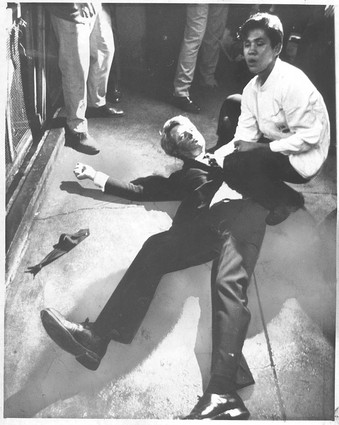
I was working on the night copy desk at the Pasadena Independent on June 4, 1968. And my job was to tear news stories off the AP and UPI teletype machines which utilized a system of bells to denote items of more than usual interest. A three-bell story would be rare, but this evening the bells started and they never seemed to stop. Bobby Kennedy had been shot in the kitchen of the Ambassador Hotel just after delivering a speech celebrating his victory as the Democratic nominee for president in the California primary election. He died from his wounds a day later.

I didn't vote for Kennedy. He had only entered the race a few months earlier, shortly before President Johnson, defeated by the quagmire in Vietnam, had announced that he would not seek reelection. My choice for president had been the radical challenger from the left, Sen. Eugene McCarthy of Minnesota, a scholar and a poet. But after Bobby Kennedy's assassination, and Nixon's defeat of Hubert Humphrey, I found myself drawn to the strong peace and social justice positions he took late in his political career. And for someone of my generation, there is no escaping the Camelot feel of the Kennedy dynasty.

These memories resurfaced last night while watching Emelio Estevez's fine film, "Bobby," which follows the stories of 22 people in the Ambassador Hotel the night Kennedy was shot. Interlaced with footage from Kennedy's life and last political campaign, "Bobby" evokes a time of innocence hope in the late 1960s, before "the music died," as Don McLean puts it in his anthem, "American Pie." There are echoes, obviously intentional, of the times we are in today, the quagmire in Iraq. But there are no leaders now of the caliber of Bobby and Jack Kennedy, who put the interests of the poor and disenfranchised before that of the businessmen. And there is little hope. Politicans sell out to corporate interests, preachers battle abortion rather than restrictions on civil rights, and half of the voters stay home.

There are some wonderful performances in Estevez's "Bobby." Aging superstars Sharon Stone and Demi Moore are so convincing in their roles as a hotel hair stylist and alcoholic lounge singer that you forget their cinematic pasts. Anthony Hopkins and Harry Belafonte, whose accomplishments should be celebrated from the rooftops, play a couple of retired hotel employees who ruminate on the history of the Ambassador and the problems of aging. William Macy, the manager of the hotel, is Stone's adulterous husband who is having an affair with telephone operator Heather Graham. Lindsay Lohan is a young woman who marries Elijah Wood to prevent his going to Vietnam. Estevez, Moore's long-suffering husband in the film, has had a checkered career in movies and TV. He is the son of Martin Sheen who plays in the film a tourist with a fashion-obsessed Helen Hunt as his wife. "Bobby" is not an unflawed film. The drug scene with Ashton Kutcher, Moore's real husband, as hippie guru is a bit absurd. And the integration of the story with TV news footage and songs from the period sometimes seems forced. But Freddy Rodriguez as the bus boy who ends up with Kennedy's head in his lap is outstanding in the role.

The Kennedys were not perfect. Their father Joe financed their political careers with ill-gotten gains from a stock market career, and the sons supported the Bay of Pigs invasion of Cuba and wars against communism in Vietnam and elsewhere. Bobby worked for the demogogic Sen. Joseph McCarthy ferreting out reds in government, and later made a name attacking racketeers like the union leader Jimmy Hoffa. But as attorney general under his brother and Johnson, Bobby developed a commitment for social justice that exceeded JFK's and one that was undoubtedly inspired by his understanding of Catholic social teaching. He was a friend to Martin Luther King and Caesar Chavez, and after becoming a senator for New York he joined them in protest marches. He was probably the last politican truly beloved by the poor. Perhaps his inherited wealth insulated him from the need to cut deals and allowed him to see America as the moral leader of the world rather than its policeman.

1968 was a watershed year in world history. It began with the Prague Spring when Dubcek in Czechoslovakia promoted "socialism with a human face," only to be overthrown by the Soviet invasion in August. The Tet Offensive in January turned public opinion against the Vietnam War, and disgust deepened with revelations in March about the My Lai massacre. At the beginning of April King was assassinated in Memphis, and at the end antiwar students at Columbia shut down the university. That same week "Hair" opened on Broadway. May was a time of protest in Paris that almost toppled the French government. The day before Kennedy was shot, Valerie Solanas shot and wounded Andy Warhol. Also in June, Pope Paul VI published an eycyclical condemning birth control. And in July, Saddam Hussein took control of Iraq in a coup d'etat. At the Democratic National Convention in August, demonstrators clashed with police in the streets of Chicago, and the whole world watched it on TV. In October, students were massacred at a protest in Mexico City right before the beginning of the summer olympic games. Kennedy's widow Jackie married the Greek shipping millionaire Aristotle Onassis, and in November the Republicans under Nixon took back the White House. Finally, on Christmas Eve, Apollo 8 went into orbit around the moon.

That year I was 28 and lived in a faux Greene & Greene cottage in Pasadena with my wife and our two sons, one four and the other less than a year old. A new liquor store with a nautical theme, Trader Joe's, had just opened around the corner from our house. I rode my Yamaha motorcycle to my work at the newspaper, and we experimented with LSD and marijuana, read a new music paper called Rolling Stone, and listened to the Beatles' Sgt. Pepper's Lonely Hearts Club Band which had been released the previous summer.

The assassinations of the Kennedys and of Martin Luther King, as well as the war in Vietnam which continued to drag on, plunged this country into a prolonged depression, a extended time of bread and circuses, from which it has yet to recover. We miss you, Bobby.

Sunday, November 19, 2006

Do You Want Shit With Your Fries?

"It's a sad fact of life, Don, but we all have to eat a little shit from time to time."
"Fast Food Nation" is not a particularly great film but it covers an incredibly important subject. Richard Linklater's fictional version of Eric Schlosser's book is more than a critique of McDonald's and other fast food companies. It is a bitter critique of the fast food culture and society that we have become in the age of industrial and corporate globalism. Fast food not only makes us sick, but it harms immgrants, the animals whose flesh we are addicted to, and the environment.

There are three interlinked stories in "Fast Food Nation" using a cinematic collage technique that is fast become the story-telling formula of choice ("Bable," "Crash," Traffic," etc.). When done well, it is a powerful way to expland the scope of a plot. Linklater's film (as well as Schlosser's book first published almost six years ago), presents Mickey's, the invented fast food franchise in the film, as the nexus for three major ethical conflicts. Mickey's company representative, Don (played by Greg Kinnear), tries to be a good provider for his family but remains silent after learning about the misdeeds of a meat packing plant which might harm other families. Amber (played by Ashley Johnson) innocently works for Mickey's but becomes an eco-terrorist when she learns about the harmfulness of factory ranching. And a group of illegal immigrants from Mexico, including Sylvia (played by Catalina Sandino Moreno who was terrific in "Maria Full of Grace"), try to start a new life in Colorado but learn that freedom and democracy is dependent on the exploitation of workers as well as drugs.

There are some wonderful cameo performances by Bruce Willis as a corporate sleaze on the take from the meat packing plant who tells Don that shit in the meat can be overcome in the cooking, Kris Kristofferson as a rancher whose land has been taken over by fast built houses, and Ethan Hawke as a college rebel turned carpenter for the wealthy. Together they expose the injustice and general tackyness of 21th century corporate consumer capitalism.

And the final bloody scene in a slaughterhouse is enough to turn any filmgoer into a vegetarian. If it weren't for the fact that fecal coloform is now being found in spinach as well as meat. I read Fast Food Nation several years ago, and the part that scared me the most was the description of laboratories where scientists known as "flavorists" can duplicate almost any taste or scent. We could be eating cardboard and not know it. In the movie, a gee-whiz flavorist develops a a barbecue taste that Don uses for Mickey's next big campaign. With the right chemicals, even shit would taste great.

Could the film of Schlosser's book have been as insightful and disturbing as a documentary? This is, after all, the Golden Age of documentary film with almost one a week coming through the cinemas in our town to much acclaim. I doubt that the nodes in the fast food chain could have been illustrated as completely if it had been simply a documentary. Last week I watched the documentary "Dying to Live: A Migrant's Journey," about the dangerous passage across the Mexican border and through the Arizona desert, and although, it was informative and moving, it did not probe as deeply into the experience of the migrants as Linklater was able to do with his fictional story.


Another documentary I saw last week, "Who Killed the Electric Car?," probably could not have been as powerful as a fictional story. The unvarnished truth, in this case, hurts. And it also illustrates the malaise of a country in the stranglehold of corporate capitalism. Only profit counts in the reign of Big Business and Global Corporations.

Directed by Chris Paine, the film tells the story of the rise and fall of the electric car, starting at the turn of the century when electric cars were more popular that those powered by gas and steam. But Henry Ford and cheap oil pushed them off the roads. Then ressurection of the electric car began in 1990 when California's Air Resources Board adopted a Zero-Emission Vehical mandate which forced auto manufacturers to develop new technology. The General Motors all-electric car, sold under the Saturn brand, was enormously popular with a small group of people who were only allowed to lease it, not buy. It had a limited range of 70 miles but battery technology existed to extend that distance. A few years later, however, the chairman of the board reversed the emissions mandate and GM recalled, and destroyed, all of its cars. It was later revealed that the chairman had an interest in hydrogen fuel cell technology and that technology was pushed by government and business, even though a successful car is still years away. In the meantime we have the hybrids which are good but nevertheless no match for the electric car.

Paine's film, which would make a good double-feature bill with "An Inconvenient Truth," concludes that the electric car was killed off by the auto makers and the petroleum industry, neither of whom wanted a replacement for the gas guzzler. This is the same group, along with tire manufacturers, who killed off the electric transit system in Los Angeles forty years ago, documented in the excellent film "Taken for a Ride."

Friday, November 17, 2006

Pope, U.S. Bishops Jump Off Cliff


The U.S. Conference of Catholic Bishops, meeting in Baltimore this week, and Pope Benedict XVI, pontificating in Rome, have issued spiritually irrelevant but nonetheless harmful pronouncements which should cause anyone identifying themselves as a Roman Catholic Christian, as I do, to think twice.

It reminds me of the story of the Gadarene (or Gerasene) swine, repeated with some variation in all three synoptic Gospels. Jesus encounters a man (or maybe two men) possessed by demons (or unclean spirits) and living, perhaps without clothes, in a cemetery. The man (or men, whose name is "Legion"), recognize him and beg for mercy. The teacher performs an exorcism and casts out the demons into a nearby herd of swine, who then proceed to jump off a cliff, like lemmings, into a lake where they drown. All three versions end the same way: The residents of the neighborhood, terrified at what they had seen Jesus do, ask him to leave.

"Let him who has ears to hear me, hear!" (Mark 4:9)

The U.S. bishops, at the end of their conference on Wednesday, released three documents which affirmed traditional, and increasingly irrelevant, church teachings: "Married Love and the Gift of Life" condemned artificial contraception; "Ministry to Persons with a Homosexual Inclination" denounced sexually-active gays and lesbians, and "'Happy Are Those Who Are Called to His Supper': On Preparing to Receive Christ Worthily in the Eucharist" suggested that those singled out above, as well as pro-choice Catholics, should consider themselves unworthy and refrain from receiving communion.

While one news source lauded the bishops for at least not invoking a communion ban for politicians who do not support the Church's teaching on abortion in their public life, which had been advocated by the American Life League and other right-wing Catholics, the Bishops' actions illustrated the persistent fixation of Church leaders on sexual issues. The Gospels are strangely silent on matters to do with sex, but they have much to say about poverty. Have the bishops not read the Beatitudes lately, or Matthew 25?

It might be the scandal of priestly sex abuse that has skewed their vision, but the Church hierarchy was misguided about sex long before the current crisis. The document on marriage, designed for engaged and young married couples, claims that artificial birth control introduces a "false note" in marriage and has led to a decline in respect for life in society. In addition, "suppressing fertility by using contraception denies part of the inherent meaning of married sexuality and does harm to the couple's unity." According to Boston's Bishop Sean P. O'Malley, heterosexual marriage is divinely ordained because of its role in procreation. Balderdash. The disordered musings of aging and celibate bachelors.

The condemnation of gay and lesbian sex uses the same reasoning. In the words of Bishop Arthur J. Serratelli of Paterson, NJ: "Because homosexual acts cannot fulfill the natural end of human sexuality, they are never morally acceptable." Making love, having sex or fucking without intending to, or being able to, make children is strictly verboten. But here it goes farther. "The homosexual inclination is objectively disordered" and therefore "homosexual acts are immoral." No gays or lesbians were consulted before drafting the document. Members of DignityUSA, an advocacy group for gay Catholics, said the new guidelines would further alienate gay people. According to Dignity president Sam Sinnet, "At some point the bishops have to realize that they speak in willful ignorance about what homosexuality is and about sexuality in general."

In my understanding, God IS love, and the Church is ignorant of the many forms that love can take, mistaking social customs for God's command. Humanity is spiritually evolving and some of us have been blessed to encounter the love in same-sex unions, and in the many non-traditional forms of family. My daughter considers herself bisexual and is in a committed relationship with a wonderful woman. Their love is not disordered, and Church leaders who declare it so will have much to answer for.

The final document on worthiness to receive the Eucharist declares that Catholics who "knowingly and obstinately...reject the defined doctrines of the church" should not seek to receive Communion. Archbishop Joseph F. Naumann of Kansas City, KS, said that this includes sexually active gays and birth-control-using heterosexuals. Apparently these pillars of the Church are ignorant of teaching that no one is "worthy" to receive the Eucharist but all are welcome. The idea that some are more worthy than others is totally foreign to the Gospels.

The bishops were encouraged to produce these documents by the same Vatican Congregation for the Doctrine of the Faith that Cardinal Ratzinger headed before he became pope. Many of the U.S. bishops were appointed during John Paul II's long reign and they were mostly chosen for their orthodoxy and subservience to Rome.

At a press conference, Bishop Serratelli said, "To be a Catholic is a challenge, and to be a Catholic requires a certain choice, and these are the choices that are consisten with the Gospel of Jesus." The bishop seems unaware that Catholics today can read the Bible, and anyone who reads the Gospels carefully will be mistified by the issues that the bishops deem most important.

Not all of the bishops’ pronouncements, however, were focused on sex. At the last minute an item on Iraq was added to their agenda, and the conference president, Bishop William S. Skylstad of Spokane, WA, issued a statement saying, "Our nation's military forces should remain...only so long as their presence contributes of a responsible transition." The bishops called on the government to "look for effective ways to end their deployment at the earliest opportunity consistent with this goal." Bravo, bishops. You have a little spine after all.

In the same week, Pope Benedict XVI met with his advisers for a "reflection" on the rule of celibacy for Roman Catholic priests. Many of the 100,000 married priests
worldwide (25,000 in the U.S. alone) held their breath in anticipation. The average age of priests in America is now over 60. The meeting was prompted by the disobedience of Archbishop Emmanuel Milingo of Zambia who was married briefly in 2001 and who recently ordained four married American men as bishops, an act that drew a swift excommunication. Eastern Rite priests, and married Anglicans converting to Catholicism, have been granted an exception to the celibacy rule. Hopes for change were dashed however, when a Vatican announcement said priestly celibacy had been affirmed. What else might one except from a pope opposed to the modern age?

The Pope has more pressing problems. This week he is receiving a visit from the Archbishop of Canterbury, Dr. Rowan Williams, who admittedly publicly that the only reason he did not become a Roman Catholic is because he does not believe the Pope is infallible. And the International Herald Tribune reported that the Vatican is upset by Italian satirists who make fun of the Pope and his staff by ridiculing his German accent and pretending that he shoots pigeons in St. Peter's Square.

And so I continue to reflect on why I became a Catholic over twenty years ago and wonder what that identity means to me now. If the Roman Catholic Church is a private club presided over by celibate gatekeepers, then count me out. I recently resigned as a communion presider after being told I must make sure that whatever I say in my reflections on the Gospel reading are in line with Church teaching. But who is worthy to decide on what is orthodox and what is not, what is approved sexually and what is not? The demons that Jesus cast into the swine, who then jumped off a cliff, remind me of the institutional leaders of the Church who ignore the teachings of love and burden the poor followers of Jesus with rules about sexuality. Does Doestoevski's Grand Inquisitor come to mind?

Vatican II declared that the Church is "the people of God," not the Vatican and not the hierarchy, not conferences of bishops or assemblies of priests. We the people, together, are the Church, and why should I leave?

Wednesday, November 15, 2006

Endless Punishment for Pervs?

It is doubtful that many of the more than two million people who voted for Proposition 83 in last week's California election gave the matter much thought. It was entitled: "Sex Offenders. Sexually Violent Predators. Punishment, Residence Restrictions And Monitoring. Initiative Statute," and most voters probably assumed the measure would "protect our kids," as the proponents argued. It was proposed by George and Sharon Runner, state senator and assemblywoman, respectively, married Republican conservatives from Southern California. Both candidates for governor backed it. The proposition passed overwhelmingly, with 71 per cent of the vote, one of only two out of eight state ballot measures to be approved by the electorate.

Maybe hanging is too good for someone who rapes a woman or molests a child. Perhaps we should cut off the hand of someone who touches another person in a sexual inappropriate manner. Or gouge out the eyes of anyone who looks at child pornography. Too tough? Do you think going back to an "eye for an eye, tooth for a tooth" criminal justice system is too radical? You might be in the minority today.

At the very least, let's put convicted sex offenders in prison and leave them there, forever. If we can't do that with sentences handed down in the courts, then let's restrict where they can live and follow their whereabouts with an electronic eye in the sky. Forever.

That's what Prop. 83, "Jessica's Law," named after the kidnap, rape and murder of a 9-year-old Florida girl by a registered sex offender last year, intended to do. Every state now has laws, which require persons convicted of sex crimes to register for life as sex offenders every year and when they move. While this might seem an additional punishment, violating the constitutional protection against double jeopardy, the Supreme Court ruled otherwise in 2003, declaring that registration was reasonable public protection. The idea that criminals can pay their debt to society does not apply to registered sex offenders (RSO). Prop. 83, in addition to increasing sentences and parole terms, would expand registration requirements to prohibit all RSOs from living within 2000 feet of a school or park, and mandates lifetime electronic surveillance by GPS devices.

There are problems, however, with Prop. 83 as written, and with the practice of registering sex offenders and making their names and residence locations available to the public. Will this law and the public branding of a class of criminals with the scarlet letter "S" make woman and children more safe, or is it part of a general trend of eroding civil liberties which leads to the abuses of Abu Ghraib and Guantanamo and to the recently passed Military Commissions Act which does away with habeas corpus and permits torture?

Less this slippery slope claim seem exaggerated, consider this. Not all RSOs are child molesters and rapists. They are also teenage boys convicted for having sex with underage girlfriends, breakers of sodomy and oral copulation laws, downloaders of internet pornography, incest violators, indecent exposurors, and those engaged in lewd and lascivious behavior (a drunken "prank" like mooning, perhaps). Currently, sexually violent predators (SVP) are categorized separately as more serious offenders, and have more severe restrictions. The Runners' law would change that, and requires all RSOs and SVPs to live outside urban areas, with multiple schools and parks, and to be tracked electronically until death. In addition, RSOs are exposed to vigilante justice. Last year a man in Maine killed two RSOs whose names he found on the web; one had raped a child and the other slept with his girlfriend before she turned 16. The murderer committed suicide before explaining his motives.

Minors in Connecticut have to register for having consensual sex in Connecticut. A criminal attorney in that state, Norman Pattis, argues that “sex crimes are the equivalent of what witchcraft was in Salem…a lot of the law is draped in Victorian convictions about sex and sensibility. There have always been young teenagers who were sexually active, but we don’t want to admit it so instead we criminalize it…the state is overreacting to the public’s hysteria.”

The morning after the election a lawsuit was filed in a federal court in San Francisco, and the judged ruled that the measure "is punitive by design and effect" and likely unconstitutional. She issued a temporary restraining order blocking enforcement and set a hearing date later this month. The plaintiff, identified as "John Doe," argued that the measure, if applied retroactively, would effectively banish him from his community and the home he owns with his wife "for a crime he committed, and paid his debt for, long ago." The proposition's sponsor, State Sen. Runner, claims it was not intended to be applied retroactively, but nothing in the language says that.

Other problems with Prop. 83 include questions about who will enforce the electronic surveillance of ex-cons no longer on parole and who will pay for the expensive equipment. RSOs currently register with local police but they would need additional staff and funding to keep track of increasing numbers of RSOs. How will the law define "park"; the measure is not clear on this. And the language of the proposition includes no new section to be added to the Penal Code. For Prop. 83 to be applied it will have to be amended in line with future court rulings by the state legislature which requires a two-thirds majority.

Still, if all this protects women and children, shouldn't we consider limits to civil liberties therefore beneficial? According to John LaFond, author of Protecting Society from Sexually Dangerous Offenders: Law, Justice and Therapy, there is "no evidence that registration or notification [to citizens of a sex offender’s presence in the neighborhood] either reduce sex crimes or help in their solution." LaFond says his concern "is the misdirection by public officials and parents toward strangers and away from the real threat: the family and friends they know.” Almost 80 percent of sexual crime victims know their perpetrators. “These new monitoring laws are symbolic gestures by politicians to show that they are doing something. But in the long run, they do a disservice to the community.” Pamela Schultz, author of Not Monsters: Analyzing the Stories of Child Molesters, said, “It’s not the creepy guy who moves in next door you need to be most concerned about, but family, friends – people who have access to your children on a regular basis.”

We should not so easily give up the idea that a person convicted of a crime can pay their debt to society and get a new start. If RSOs must be watched for the duration of their life, why not bank robbers? Some think child molesters are mentally ill. If so, they should be hospitalized. Restricting their residence but not their freedom to walk around will not make our children safer.

Marc Rotenberg, executive director of the Electronic Privacy Information Center, says that electronic monitoring of sex offenders opens a Pandora’s box. “If you start tracking convicted sex offenders, what about convicted drunk drivers or registered handgun owners? What about people law enforcement might consider suspicious but have no basis to arrest? States should proceed down this road carefully.”

And, finally, this should be a lesson to the idea that we can govern by proposition, by ballot measures designed by citizens with an ax to grind rather than legislators trained and experienced in balancing conflicting objectives. Prop. 187, designed to deny immigrants social services, health care and public education, passed in California in 1994 with 59% of the vote, but it was overturned by a federal court. We should demand that our politicians govern, rather than stand by while popularity contests determine our laws.