When the sky turned dark as night at 4 in the afternoon and moments later hail the size of plums plumeted (couldn´t resist that) from the sky, turning on car alarms and breaking windows, the students in my class all turned to each other with the same thought: "¡Es el fin del mondo!" It´s all over folks. Al Gore was right. And he even talked about the glacier that was shrinking not that far south of here in Patagonia.
As we watched from our 4th floor classroom in the Universidad de Belgrano, thunder roared, hail poured down on fleeing pedestrians and we saw the back windows on two cars cave in. Hail was followed by rain, buckets of it. The storm was over in 20 minutes but Ofelia told me this morning that 300 taxis were damaged and many people were sent to the hospital with bloody heads. According to this morning´s Buenos Aires Herald (in English), 14 people were injured, subway and train service was disrupted, streets were flooded and numerous accidents clogged highways. Eugenia, our teacher (who is probably in her early 30´s) said she had never seen a storm like that. One of our students, Marilyn, said it brought back memories for her of being in a high-rise building during the ´89 quake. The disaster syndrome.
I can´t say that my lessons are going well. I tanked an exam yesterday because the more I study the difference between verbs in the preterito and verbs in the infinitivo, the more confused I become. Spanish has a way to discriminate between completed activities in the past and ongoing actions. But there are numerous exceptions, at least so it seems to me. On the other hand, I´m enjoying the conversations enormously. One day we described movie plots and the others had to guess. My account in Spanish of "Superman Returns" was fairly easy. Yesterday we got together in groups of three and came up with stories about fiestas. Each member of the group told a story about a similar party and the others had to guess which of the three had really attended it. It was, as we say, "muy divertida."
Yesterday morning I went to meet with Juan De Wandelear, a friend of Phil McManus´s. He works in the baroque city hall in the Comision Pro Monumento a Las Victimas del Terrorism de Estado. I didn´t get to find out what he does because he was unable to keep the appointment. We´re made arrangements by email to reschedule for next week when I also hope to meet with Phil´s other friend here, Beverly Keene, an American who has lived in BsAs for 20 years.
After a slow cafe, and a stab at doing homework, in the atmospheric Le Pureto Rico near the Plaza de Mayo, I took a taxi to the Mueseum de Arte Latinoamericano de Buenos Aires, better known as the Malba, which opens daily at noon. It opened in 2001 to house the private collection of Argentine multimillionaire Eduardo Constantini, and includes Frida Kahlo and Diego Rivera. There was an exhibit of drawings by Roy Lichtenstein in the upper of the two floors of the very modern and airy museum. I recall meeting him in 1967 when the Hollywood PR firm I was working for was hired by the Pasadena Art Museum, before Norton Simon took it over, to do publicity for a show of his work. Since I lived in Pasadena, I was in charge. It was humiliating. Since our specialty was celebrities, we made a spectacle of his show. And we erected a building on La Cienega in art gallery row which we had him unveil while the docents of the museum served tea to the media, dressed, for some unknown reason, in 19th century costumes. I recall Lichtenstein as being tall, thin and shy. But he climbed up to the billboard and unveiled it for the cameras while I cringed.
I was less interested in Lichtenstein´s pop art than the permanent collection which included Antonio Berni. The day before Eugenia had shown me a postcard of one of his works. It´s a large painting called "Manifestation (demonstration)" and it shows a variety of faces with a sign in the back saying "pan y trabajo (bread and work)." It was painted in the 30´s and obviously shows people suffering from the world-wide Depression. I found it an icon in general for suffering; very moving. I also liked his later work which include college, assemblage and sculpture. In the evening I browsed at La Ateneo, supposedly in the biggest bookstore in South America, but was unable to find a small book of his work. One of the more recent works in the collection was a large model of a U.S. Air Force jet headed downward which was hanging from the ceiling. Attached to the jet was a crucified Christ. Done by Leon Ferrar in 1966, the piece was entitled: "Western Christian Civilization." How very true. It was like a kick in the stomach. On a pedestal stood a bottle of red water which was entitled "Rhine Water Polluted: H20 + 10,000 Poisons," by Nicolas Garcia Uriburu. It reminded me of Duchamp´s found art. And finally, there was a huge painting on a balcony outside of an armed battle between revolutionaries and the authorities that was extremely powerful. I´m not sure if it was modeled after an actual event or something imagined.
Great art and a hail storm in one day. Life in Buenos Aires is full of surprises.
Thursday, July 27, 2006


Wednesday, July 26, 2006
The Ugly Side of Capitalism

Last night our small group from Santa Cruz visited El Museo de Deuda Externa in Buenos Aires. Opened last year in the basement of a cultural center near the medical school, this is the first ever museum of foreign debt in the world. But there ought to be more. Foreign debt is the reason why the rich -- primarily in the west -- prosper and the poor -- primarily in the south -- suffer. Although loaning money may seem like an altruistic move on the part of First World banks, it enables them to control and enfeeble Third World economies.
We learned about this during a talk by museum docent Albierto Murrillo. Argentina is a likely place to have a Museo de Deuda Externa because it was the first country to renounce its debt and free itself from a crippling economic burden. But, as Murrillo pointed out, renouncing¨"hated debt" is a recognized principle of international law. After the American Revolution, the new United States cancelled all its debts with Britain. And, more recently, under the direction of the U.S., Iraq renounced its debt to European banks because it was incurred under the government of Sadam Hussein. So when President Nestor Kirchner renounced (which sounds more positive than "defaulted") Argentine´s debt of something like $150 billion, he felt the country was within its rights since the loans were contracted by previous corrupt governments, particularly the military regimes which ruled in the 1970s and 1980s.
Murrillo told us, in Spanish (which was translated for the less advanced like me), that Argentina was first offered money by the British in 1824 which was used to build infrastructure. By the 1980s, however, a "financial bicycle" was in place which allowed corrupt politicians and businessmen to launder money and to profit from money transfers to other countries. Factories closed because imports were so cheap. Inflation and unemployment rose to astronomic heights. By the time of Carlos Menin, the country was surviving not by producing goods but by borrowing money. Eventually the economy collapsed, the banks shut, and everyone suffered. Under "Plan Brady" the country´s loans were sold and distributed around the world and interest rates rose rapidly, making it impossible to repay the loans. Kirchner´s only solution was to renounce/default.
This economic system, however, is no accident. The west prospers at the expense of weaker countries. In order for there to be wealth in one place, it is necessary that others must pay. Argentina now is struggling to become a victor rather than a victim. As the sign says in the museum: "Deuda Externa -- Nunca Mas."
I´ve been walking extensively through different barrios in Buenos Aires, and little poverty is apparent, at least during the day. The streets are mostly clean and many of the buildings are new. I know it´s different in the country and even in the city at night when the "cartoneros" come out to scavage for useful trash that might bring them some pesos. The streets in Palermo and Belgrano are lined with tall apartment buildings. Their lobbies are gleaming with marble, glass and overly polished brass. There are modern podiums outside the door where one rings a bell for the apartment. Block after block of luxury flats. Who is living in them? Certainly not the poor. Moochie told me the other night that these neighborhoods are populated mainly by the military, and they´ve been on top of the social structure in Argentina for decades. They also perpetrated the worst abuses of the "Dirty War" in the 1970s when thousands of people, mostly young, disappeared. Now they live in these beautiful buildings which are surrounded by shops catering to the middle and upper classes. It´s a lovely picture. But watch out for the dog poop on the sidewalks!
Does capitalism have a beautiful side? Only, I think, if you´re rich and powerful.
Tuesday, July 25, 2006
Hanging Out With the Gauchos
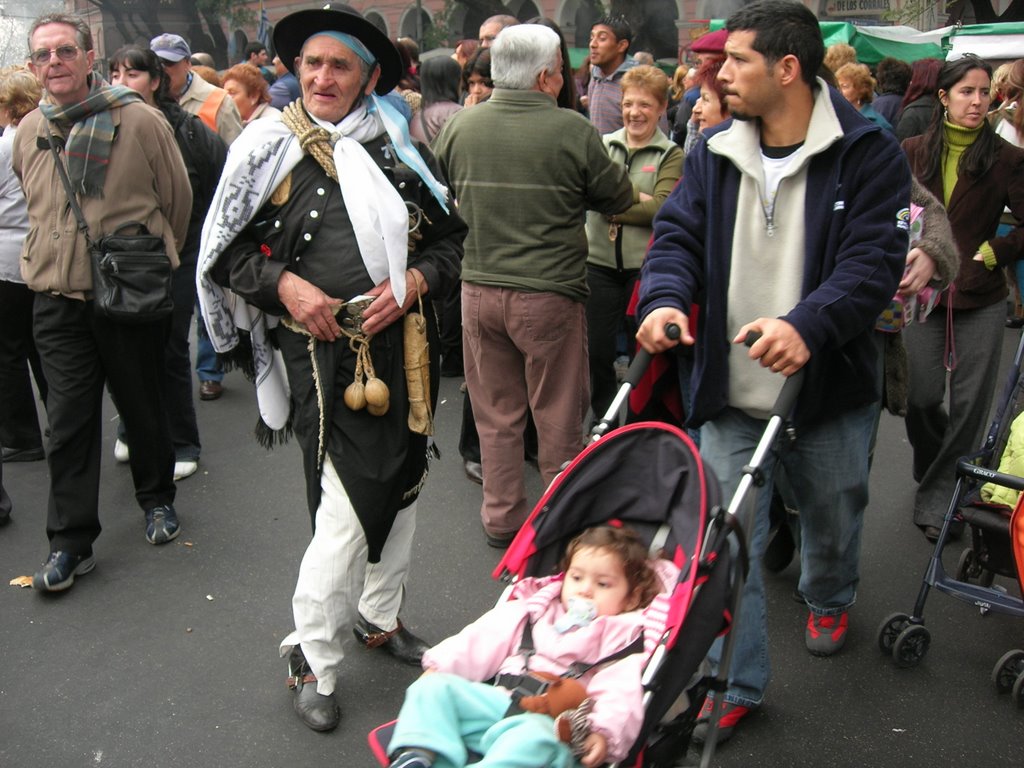 Yesterday we journeyed an hour in a collectivo (bus) to the western suburb of Matadores where a feria is held every Sunday. I met Lorraine and Toni at the apartment across the street where they are staying with a delightful former nun named Moochie who likes to host foreign students in her home. Besides the Cabrillo students, her guests currently include Pascal from Switzerland and Michael from Texas. Amelia from our Santa Cruz contingent joined us and Moochie led the six of us on a journey into the land of the gauchos.
The town is named for the slaughterhouse that once were located there. It was once nicknamed Nueva Chicago. Less a flea market than a craft fair, with entertainment, the Matadores Feria featured dozens of booths spread out in the main streets of the town. After checking out the lay of the land, we adjourned to a wonderful corner restaurant and enjoyed a two-hour lunch. The sign on the window said "Hoy Locro," so Amelia and I, being adventurous, tried locro, the speciality of the day. It turned out to be a stew of corn, meat and white beans and utterly delicious. Lorraine and Toni went for the steaks, and Michael and Moochie the pasta (the Italian influx has resulted in some terrific fresh pasta in many restaurants like I had for lunch yesterday).
There were all kinds of crafts for sale, an an usual number of little dolls made out of a variety of materials that appeared to be elves of dwarves. I finally found a mate cup that I liked, with a silver bombilla to drink it through. The others bought gifts. Both Lorraine and Moochie got rain sticks that make a noise like you might hear in a rain forest. Toni bought some gifts. The gauchos were having a riding contest called a sortija, and we went to watch. The horsemen would whip their horses into frantic speeds down a narrow street, stand up in the stirrups and attempt to stick a pencil through a tiny ring hanging from a ribbon while riding at full tilt. Only a few succeeded.
At the center of the feria was a stage which held a succesion of musicians while members of the audience danced in front. One of the traditional dances involved handkerchiefs and looked more like flamenco than the tango. The various groups dances, I learned, have the names chacarera, chamane and the samba, though not the one from Brazil. The latter did apparently involve the seducation of the woman by the man, symbolically of course. Men, young and old, strolled through the crowd in their guacho outfits. The old man picture above was particularly colorful. We went inside a pulperia, or saloon, off the main street where dozens of people were eating at long tables, and we watched a group of dancers perform while a woman sang and a man played guitar. It looked to me something like a square dance with the participants clicking their heels as if they were in Spain. Moochie told me that the music and dancing were "folklorico."
As the day wore on, clouds increased and soon it began to rain. We returned to Buenos Aires by collectivo, standing up most of the way amidst a crowd of porteños. Back at her apartment, Moochie offered off "facturas" -- little pastries she bought at the bakery around the corner -- and, for me, mate. Not in my new cup, for it needs to be properly seasoned (I´ll have to translate the directions which are in Spanish), but in one of her own. Actually the cup is the mate; a "cup of mate" would be an oxymoron. She packed the mate with yerba (pronounced "churba" in Castellano), and poured in very hot water. The social ritual is: you pour, you sip until it gurgles, and you pass the mate along to the next person. The tea is somewhat bitter and very strong. I´m sure it´s an acquired taste. Moochie continued to sip throughout the evening while we talked in English, Spanish, Italian and French. When I got home, Ofelia examined my mate and offered to season it herself. I think it involves letting liquid sit in it for some time to close any holes. But then I haven´t translated the directions yet.
When I arrived home from the Evita museum the day before, I showed Ofelia the literature that I had collected. She frowned. Evita was not her heroine, and she explained why. Rolling up her sleeves, she showed me her wrists which were covered with scars. She told me that she was badly burned when she was 16. But because her father was not a Peronista, a supported of Evita´s husband, Juan Peron, they would not treat her at the local hospital which was one of Evita´s projects. For this, Ofelia can never forgive her. She also told me that Peron was the friend of Nazis and was a fascists himself. So I could see her point and promised to give this perspective to people in the United States.
Sunday, July 23, 2006
Sampling Culture in BA

This happy group of students of Spanish as well as all things cultural in their temporary home away from home, Buenas Aires, have just been to the Teatro Colon to see three opera ballets by Igor Stravinsky. They´re celebrating with a variety of taste treats (an incredible ice cream sundae for me) and alcoholic beverages (I discovered that cognac goes quite well with a selection of helados). Don´t we look happy? (from L to R: Toni, me, Lorraine, Jani and Amelia)
The Teatro Colon is a venerable institution, a huge concert hall that debuted with Verdi´s "Aida" in 1908 and was the biggest in the southern hemisphere until Sydney built their hall. It holds 2,500 in the audience with room for 500 standing. I´ve heard that more than 1,000 workers are employed behind the scenes and I´ll learn more when I take a tour on Monday. Inside, the Teatro is U-shaped with six balconies. Lorraine, Toni and I were pleasantly surprised that seats were available on the day of the performance, for only 230 pesos (about $75). Seats on the floor were twice that. Perhaps that´s why the hall was way less than half full, a real shame. We sat at the edge of the first balcony on the third floor (lower floors contained boxes), and peered down on the orchestra (4 grand pianos for one numbers), singers and dancers. Jani and Amelia waved at us from the stratosphere where their SRO tickets cost only 5 pesos each (about $1.50). The performance featured three pieces by Stravinsky. "Les Noces" was about a wedding between an initially reluctant and later enthusiastic couple. While the singing was in French, a Spanish translation was shown on a screen over the stage, thereby helping to advance our linguistic progress. The second piece, "Les Rossignol," was based on a Hans Christian Andersen story, "The Emperor´s Nightingale" and featured a magical bird, one emperor, and lots of subjects, as well as a fisherman whose role was unclear. The final piece was "Petrushka," and it appeared to be about the director of a dance troupe and his dancers. If I understood it correctly, the director was bisexual but ultimately it was the male dancer who broke his heart. Does that sound like Stravinsky? I knew BA was gay friendly, but...
Today was a very full day. I´m typing this at an internet "locutorio" near my apartment, and a group of three Hare Krishnas just danced by on the sidewalk, chanting through a loudspeaker. An hour ago I was walking in the early evening through an extremely crowded shopping area along Avenida Santa Fe in Recoleto. I´ve been to a number of such areas in this large city and the streets are always thronged with people and the modern stores full of the latest glossy consumer items. I browsed in a large bookstore designed like a concert hall, with a cafe where the stage should be. And I looked through the CD bins at a two-storey music store next door. I´m beginning to think that American cities are drab and spiritless compared to some of the places I´ve visited in the last couple of years, Buenos Aires, Bangkok and Rome foremost among them. And when the stores close, porteños party. The bars and clubs are full from midnight until dawn (so I´m told, not being a night owl myself).
What I do is explore. Today I slept in because of my late night cultural expedition to the Teatro Colon. Then I walked past the giant new mosque to the Parque 3 de Februaro (the significance of that date escaped me), rented a bike and pedaled around a lovely lake. There were strollers, joggers, bicyclists like me, rollerblade hockey players, others playing soccer and ping pong, a couple of groups doing yoga, and a jazzercise class. The weather is unseasonably warm and everyone was taking advantage of it. After strolling through a rose garden to see Borges´ bust among other writers in a poetry corner, I stopped at an outdoor cafe for a cappuchino followed by a dulce de leche cone, and then walked to the nearby Museo de Evita. A lovely series of exhibits and video footage have been gathered to celebrate the life of Eva Peron Duarte. I learned that she favored fashions in black and white and earth colors. I wonder why she didn´t wear anything brighter? Perhaps she didn´t want to outshine her husband. There is something about her that I find admirable, despite the hype, then and today. She rose from humble beginnings and really did strive to help her people, particularly women, the poor, elderly and children. It´s too bad it had to be in a fascist context.
My second pilgrimage today was to the home of tango singer Carlos Gardel, now a museum, in the Abastos district not far from where we had our first tango lession the other night. Since I signed up for this trip, I´ve been educating myself about music and film in Argentina, and Gardel is a giant, even though he died in a plane crash over 70 years ago. He is Presley and Sinatra rolled into one. Gardel is one of the three icons of Argentina, along with Evita and soccer hero Diego Maradona. The museum contained little beside clippings and photos, and some household artifacts of the 1930s. But the neighborhood features his picture on the side of buildings, and some of the houses on his street are painted in colors unknown to Evita.
Finally, I stopped at the Clasica y Moderna Cafe on the busy Avenida Callao. Like many of the cafes I´ve visited in Buenos Aires, it is a quiet haven away from the crowds. This one also contains a wonderful bookstore. It features performers in the late evening and even Mercedes Sosa, Argentine´s best known folk singer, has appeared there. Yesterday I had lunch at the Richmond along the pedestrionized Florida, where Borges once ate. In the basement, old men played billiards and chess as they have for decades. Sitting in some of the cafes, I am reminded of what the Java House (later Union Street) might have become. But I´m afraid we in Santa Cruz are not part of a similar cafe culture, despite the crowds at Lulu´s and the Pergolesi. Someone needs to open up a branch of the Cafe Tortoni or the Richmond in our city.
It´s hard to escape the shame of being from the United States. Everyone comments about Bush and is pleased when I explain to them that not only do I hate him and his policies but that I am not alone in my country. I had an interesting discussion with a taxi driver last night about Hiliary Clinton whom he likes(she´s not my choice). And the newspaper headlines here (BA has many more papers than any American city) scream the news about Lebanon and Bush´s unqualified support for the atrocities being commited by Israel while the rest of the world watches and does nothing. We´re a long way away from the Middle East but not far enough.
Tomorrow I´m off to a giant flea market, or feria, in Matadores. Hasta luego.
Friday, July 21, 2006
"A Generation has been stolen from our country."
Yesterday our group of students from Cabrillo College studying Spanish in Buenos Aires visited with Los Madres de Desparecidos, a group of mothers who have been demonstrating weekly in the Plaza de Mayor for nearly thirty years in the hope of 
finding out what happened to thousands of children and spouses that were "disappeared" during the "Dirty War" from 1976 to 1983 when up to 30,000 were arrested, tortured and killed by the police for having even vaguely leftist ideas and opinions.
We gathered in the group´s downtown office in a room on the first floor and listened to the stories of three of the mothers: Aurora (pictured above under the photo of her missing daughter), Pepa and Aida. All three lost children who would now be in their fifties. The women should be grandmothers but the possibility of descendents was eliminated when their children were taken by a repressive military government intent on wiping out all opposition.
The first wave of arrests began in March of 1976. Numerous students were identified by an undercover agent even though many of them had no connection with the Montoneros rebel organization. Even taxi drivers worked for the police. The students´parents were mystified because neither the police nor the government would admit they were taken. Only a few rare witnesses could provide evidence that the police were involved. Even the clergy (some of whom were aware of what was happening and supported it) denied knowledge of the arrests. Gradually the mothers ran into each other during their searching and discovered a pattern of disappearances. Their first march was on April 30, 1977. Several of the early leaders were themselves disappeared, but the marches continued, the mothers wearing white scarves and carrying photos of their missing relatives. They march every week on Thursdays.
Although government files on the missing people have never been released, the mothers gradually learned that their children and spouses were in many cases tortured and sometimes thrown out of planes alive. Women were raped. Babies were born in prison and adopted by people friendly to the government. Only now are some of them discovering their biological grandparents. Those responsible have not been brought to justice, and the women have reached beyond Argentina for help from world agencies.
Because my Spanish is a tad insufficient, one of the group coordinators, Lucilla, translated the stories of the women. Some of us were in tears. All three women were in their 70s, their hands and faces wrinkled with age. They have been telling these stories of horror and loss for years. I wondered how they can cope. And how is it that a government can go so out of control that it assassinates the best and brightest of the younger generation? The Nazis marginalized Jews and then exterminated them. The Argentines in the 1970s destroyed its future. Fear of progressive ideas -- that the poor should be fed, that outrageous wealth should be moderated, etc. -- was the rule in South America during the 1970s when most countries were ruled by military dictatorships. Can this kind of repression happen in the United States? We should watch closely and learn from what happened here.
Afterwards, some of us walked to the Cafe Tortoni, a venerable BA institution since the 1850s. Jose Luis Borges used to sip coffee here, as did the singer tango Carlos Gardel. Now both are memorialized with wax life-sized effigies with another friend, the artist Solari, sitting down in at a corner table. We had a delicious lunch of beef, the national bood of Argentina. Outside in the street, thousands of poor workers marched for a decent wage while tourists gazed at them from the sidewalk.
In Argentina, it was El Dia de Amigo, the day when friends contact each other and express their love and affection. I was told that it was on July 20 because that was the day that Neal Armstrong walked on the moon. I´m not sure how that connects with friendship, but the Argentinians are nothing if not creative. We have Mother´s Day and Father´s Day and Valentine´s Day in the U.S., but no day for to celebrate our friends. Perhaps it´s a good idea.

finding out what happened to thousands of children and spouses that were "disappeared" during the "Dirty War" from 1976 to 1983 when up to 30,000 were arrested, tortured and killed by the police for having even vaguely leftist ideas and opinions.
We gathered in the group´s downtown office in a room on the first floor and listened to the stories of three of the mothers: Aurora (pictured above under the photo of her missing daughter), Pepa and Aida. All three lost children who would now be in their fifties. The women should be grandmothers but the possibility of descendents was eliminated when their children were taken by a repressive military government intent on wiping out all opposition.
The first wave of arrests began in March of 1976. Numerous students were identified by an undercover agent even though many of them had no connection with the Montoneros rebel organization. Even taxi drivers worked for the police. The students´parents were mystified because neither the police nor the government would admit they were taken. Only a few rare witnesses could provide evidence that the police were involved. Even the clergy (some of whom were aware of what was happening and supported it) denied knowledge of the arrests. Gradually the mothers ran into each other during their searching and discovered a pattern of disappearances. Their first march was on April 30, 1977. Several of the early leaders were themselves disappeared, but the marches continued, the mothers wearing white scarves and carrying photos of their missing relatives. They march every week on Thursdays.
Although government files on the missing people have never been released, the mothers gradually learned that their children and spouses were in many cases tortured and sometimes thrown out of planes alive. Women were raped. Babies were born in prison and adopted by people friendly to the government. Only now are some of them discovering their biological grandparents. Those responsible have not been brought to justice, and the women have reached beyond Argentina for help from world agencies.
Because my Spanish is a tad insufficient, one of the group coordinators, Lucilla, translated the stories of the women. Some of us were in tears. All three women were in their 70s, their hands and faces wrinkled with age. They have been telling these stories of horror and loss for years. I wondered how they can cope. And how is it that a government can go so out of control that it assassinates the best and brightest of the younger generation? The Nazis marginalized Jews and then exterminated them. The Argentines in the 1970s destroyed its future. Fear of progressive ideas -- that the poor should be fed, that outrageous wealth should be moderated, etc. -- was the rule in South America during the 1970s when most countries were ruled by military dictatorships. Can this kind of repression happen in the United States? We should watch closely and learn from what happened here.
Afterwards, some of us walked to the Cafe Tortoni, a venerable BA institution since the 1850s. Jose Luis Borges used to sip coffee here, as did the singer tango Carlos Gardel. Now both are memorialized with wax life-sized effigies with another friend, the artist Solari, sitting down in at a corner table. We had a delicious lunch of beef, the national bood of Argentina. Outside in the street, thousands of poor workers marched for a decent wage while tourists gazed at them from the sidewalk.
In Argentina, it was El Dia de Amigo, the day when friends contact each other and express their love and affection. I was told that it was on July 20 because that was the day that Neal Armstrong walked on the moon. I´m not sure how that connects with friendship, but the Argentinians are nothing if not creative. We have Mother´s Day and Father´s Day and Valentine´s Day in the U.S., but no day for to celebrate our friends. Perhaps it´s a good idea.
Thursday, July 20, 2006
Looking for Robert Duvall
Robert Duvall is a hero in Buenos Aires. He fell in love with the tango many years ago and visits frequently. Not long ago he made a film, "Assassination Tango," with BA for the setting and the tango as a subtheme to an aging contract killer plot. It wasn´t a very good movie, I thought, and I believe Duvall to be one of our best actors. On Monday we tried to find a restaurant in La Boca where, according to Lonely Planet, Duvall is a frequent diner. It seemed like a good recommendation to us. But we got lost and, even with the help of a taxi driver, could not find the place.
Last night, however, I came close. Our class adjourned to the Academia Carlos Coppello for our first tango lesson. And there on the wall was a poster from the film with Duvall´s autograph featured prominently. There were also pictures on the wall of Duvall and the owner. Surely he had passed through that very room, not more than a year ago.
It didn´t help my dancing, however. Nor did my shoes, the comfortable Chaco sandals that I´ve worn from Europe to Central America, Asia and back. Tango shoes have heels, even for the men, and they make a clicking noise on the floor. Mine made kind of a shoosh sound every time I stumbled or stepped on my partner´s toes. Still, we made a brave show of it, slipping and slidding to the seductive rhythms of the tango. On the walls the famous tango singer Carlos Gardel´s ever-present image looked down upon us. His picture was on the side of two buildings we passed in Abastos, the district where he lived before his tragic death in a plane crash in 1935. Carlos is a god here, Elvis and Frank Sinatra rolled into one. I´ve got dozens of his songs on my iPod.
Getting to the tango school was an adventure. Lucila decided all 22 of us would go by bus. When it arrived, Diana, Ben and I got on board, but no one else would fit. Before we could get off to wait for a less full bus, the doors closed and Lucila waved goodbye. It was our first bus ride and neither of the three of us were clear about where we were going. But the passengers and driver were friendly and I was able to talk with Lucila on my cell phone to receive directions. As it turned out, we arrived well before anyone else, and Lucila was very pleased at our accomplishment.
The weather has improved dramatically. Yesterday was bright and sunny, and today promises to be the same. Porteños, however, dress all bundled up as if it´s winter in New York, when actually it feels like a nice summer day in San Francisco. Yesterday, after writing my blog, I set out on the subte for the city center, the Plaza de Mayo, and walked through the busy business district north to the district of Retiro in search of Plaza San Martin which my friend Norma from Holy Cross had told me about. First I encountered the Galerias Pacifico, a huge monument to consumption that includes an art gallery in the center with works by Freda Kalho and Diego Rivera, not to mention Picasso. On the way I stopped by Norma´s church, the Basilica de Santisimo Sacramento which is relatively new, having been built at the turn of the last century. Plaza San Martin is a very large park facing the harbor and the wide lawn was filled with sleeping porteños while the pathways contained numerous dog walkers as well as people like me enjoying beautiful weather. I stopped to take a picture of a fenced area for dogs and was approached by a helpful young man whom it turned out was fund-raising for some kind of AIDs project. At least that´s what I think he said. I gave him two pesos which seemed to him insufficient.
My next stop was Recoleto, another upscale business and residential district north of Retiro where a large cemetery houses the now dead rich and famous in hundreds of little houses decorated with elaborate statuary. The most notable, of course, is Evita. I donated five pesos for a map but I still got lost in the maze of cemetery streets. Eventually I spotted a crowd and realized I´d found her. The tomb is modest in comparison with some of the others. Made of black marble, the door (can she leave?) was covered with flowers. The visitors with me did not seem especially reverent, but were frantically taking photos to remember this moment at a later date.
After a lovely lunch at an outdoor cafe bordering the park in front of the Cemeterio de la Recoleta, I took a taxi to Belgrano in order to be on time for class at 3. There were secretive murmurings halfway through the session, and Lorraine unveiled two beautiful cakes and a candle, numer 9 (signifying my 39th birthday), which was lit and I blew out. Feliz Compleaños was sung and we all celebrated my advanced age. I also received for a gift a lovely book containing paintings by La Boca´s most famous artist, Benito Quinquela Martin, whose subjects included colorful ships and their seamen.
After class we viewed a video documentary of the mothers of the disappeared by a professor from San Jose State, Bob Freimark. Today we are going to have a "charla," a chat, with some of the mothers and grandmothers who lost 10-30,000 relatives during the "Dirty War" from 1976 to 1983 against anyone with vaguely leftwing or progressive politics. This group of women continues to demonstrate every Thursday in the Plaza de Mayo for justice, since few have yet been punished for the many crimes committed back then. I also hope we will be able to march with them.
Robert Duvall, I´m still on your trail...
Last night, however, I came close. Our class adjourned to the Academia Carlos Coppello for our first tango lesson. And there on the wall was a poster from the film with Duvall´s autograph featured prominently. There were also pictures on the wall of Duvall and the owner. Surely he had passed through that very room, not more than a year ago.
It didn´t help my dancing, however. Nor did my shoes, the comfortable Chaco sandals that I´ve worn from Europe to Central America, Asia and back. Tango shoes have heels, even for the men, and they make a clicking noise on the floor. Mine made kind of a shoosh sound every time I stumbled or stepped on my partner´s toes. Still, we made a brave show of it, slipping and slidding to the seductive rhythms of the tango. On the walls the famous tango singer Carlos Gardel´s ever-present image looked down upon us. His picture was on the side of two buildings we passed in Abastos, the district where he lived before his tragic death in a plane crash in 1935. Carlos is a god here, Elvis and Frank Sinatra rolled into one. I´ve got dozens of his songs on my iPod.
Getting to the tango school was an adventure. Lucila decided all 22 of us would go by bus. When it arrived, Diana, Ben and I got on board, but no one else would fit. Before we could get off to wait for a less full bus, the doors closed and Lucila waved goodbye. It was our first bus ride and neither of the three of us were clear about where we were going. But the passengers and driver were friendly and I was able to talk with Lucila on my cell phone to receive directions. As it turned out, we arrived well before anyone else, and Lucila was very pleased at our accomplishment.
The weather has improved dramatically. Yesterday was bright and sunny, and today promises to be the same. Porteños, however, dress all bundled up as if it´s winter in New York, when actually it feels like a nice summer day in San Francisco. Yesterday, after writing my blog, I set out on the subte for the city center, the Plaza de Mayo, and walked through the busy business district north to the district of Retiro in search of Plaza San Martin which my friend Norma from Holy Cross had told me about. First I encountered the Galerias Pacifico, a huge monument to consumption that includes an art gallery in the center with works by Freda Kalho and Diego Rivera, not to mention Picasso. On the way I stopped by Norma´s church, the Basilica de Santisimo Sacramento which is relatively new, having been built at the turn of the last century. Plaza San Martin is a very large park facing the harbor and the wide lawn was filled with sleeping porteños while the pathways contained numerous dog walkers as well as people like me enjoying beautiful weather. I stopped to take a picture of a fenced area for dogs and was approached by a helpful young man whom it turned out was fund-raising for some kind of AIDs project. At least that´s what I think he said. I gave him two pesos which seemed to him insufficient.
My next stop was Recoleto, another upscale business and residential district north of Retiro where a large cemetery houses the now dead rich and famous in hundreds of little houses decorated with elaborate statuary. The most notable, of course, is Evita. I donated five pesos for a map but I still got lost in the maze of cemetery streets. Eventually I spotted a crowd and realized I´d found her. The tomb is modest in comparison with some of the others. Made of black marble, the door (can she leave?) was covered with flowers. The visitors with me did not seem especially reverent, but were frantically taking photos to remember this moment at a later date.
After a lovely lunch at an outdoor cafe bordering the park in front of the Cemeterio de la Recoleta, I took a taxi to Belgrano in order to be on time for class at 3. There were secretive murmurings halfway through the session, and Lorraine unveiled two beautiful cakes and a candle, numer 9 (signifying my 39th birthday), which was lit and I blew out. Feliz Compleaños was sung and we all celebrated my advanced age. I also received for a gift a lovely book containing paintings by La Boca´s most famous artist, Benito Quinquela Martin, whose subjects included colorful ships and their seamen.
After class we viewed a video documentary of the mothers of the disappeared by a professor from San Jose State, Bob Freimark. Today we are going to have a "charla," a chat, with some of the mothers and grandmothers who lost 10-30,000 relatives during the "Dirty War" from 1976 to 1983 against anyone with vaguely leftwing or progressive politics. This group of women continues to demonstrate every Thursday in the Plaza de Mayo for justice, since few have yet been punished for the many crimes committed back then. I also hope we will be able to march with them.
Robert Duvall, I´m still on your trail...
Wednesday, July 19, 2006
Pampas Grass on the Steeple
It never occured to me that the weedy pampas grass which dots the highways along the central coast might have been an unwelcome import from Argentina. Surely, though, the name is a dead giveaway. But yesterday, walking down Defensa toward San Telmo from the central Plaza de Mayo in Buenos Aires, I spotted a patch of pampas grass sprouting from the top of the steeple on the Iglesia Santa Domingo, the ancient Dominican church which is currently undergoing renovations. I took a photo of the odd growth but haven´t figured out how to important them yet into my blog.
After two full days in BsAs (as they write it in shorthand), I am beginning to feel at home among the porteños. Yesterday Lorraine, Toni and I headed south on the subte (subway) to sightsee. In the Plaza de Mayo, not far from Casa Rosada where Juan and Evita waved to the adoring crowds, Lorraine bought a mate bowl made out of the hoof of a cow. I´m not sure I´d like to drink mate out of it, but she said it would please one of her sons. We walked south on Defensa into the San Telmo district full of antique stores. This is where the citizens of the town successfully defended against the invading British in 1806 and 1807. Unfortunately, these successes gave them unwarranted confidence against the British during the Falklands War in the 1980s. Now, artisans sell their wares around the picturesque Plaza Dorrego. From there we walked into the large Parque Lezama which, we were told later by a taxi driver, was not safe. The only danger we saw was from frequent piles of dog poop. My sense of direction failed, however, and we ended up hopelessly lost. Finding a cab, we went in search of a restaurant in La Boca, the slum area recently gentrified, that was reportedly frequented by Robert Duvall. The driver, however, got lost himself, giving us a tour of La Boca and it´s colorful houses and appalling poverty in the process, and we settled for a small restaurant back near the Plaza Dorrego where I had mystery meat and "freedom fries" for lunch.
Our language classes begin at 3 and we headed uptown to Belgrano by yet another taxi. This one took us, via the wide thoroughfare Avenida Libertador, between the harbor and the more upscale areas of the city: Microcenter, Retiro, Recoleta and Barrio Norte, and Palermo. I saw tall glasss-skinned skyscrapers, modern office buildings and luxury hotels, the Hipodromo Argentina where horses run, as well as numerous leafy parks and ostentatious statuary. In short, a city of wealth and prosperity. The undeniable poverty must be hidden, in rural areas and in slums where the cartoneros, who harvest recyclables from city streets at night, live in their humble homes.
On Monday I failed my entrance exam and was put back into Spanish 2, the same level I took in Oaxaca a year and a half ago. As a long time student, I should have known better than to not study, and review the Spanish I thought I knew. I wasn´t unhappy however; the Spanish 3 folks were clearly fluent and their grasp of the idioma was far superior to mine. I´m not here to excel anyway. I want to improve my vocabulary and grammar and to be able to hear and speak the language of the street. So I joined eight others in a lecture room with a beautiful view of Belglrano to meet our maestra, Eugenia, a young and enthusiastic porteño. The three hour conversation was intense yet filled with jokes and humor that some of us occasionally understood. By the end my brain was fried.
Today, as if to celebrate my 67th birthday, the sun is shining brightly. Vive el sol! (Yesterday I saw my frist "Vive Evita" graffiti on a La Boca wall.) I am headed off to Plaza San Martin and the Recoleta Cemetary to commune with St. Evita. Tonight is our first tango lesson at an academy in Carlos Gardel´s old neighbor, Abastos.
After two full days in BsAs (as they write it in shorthand), I am beginning to feel at home among the porteños. Yesterday Lorraine, Toni and I headed south on the subte (subway) to sightsee. In the Plaza de Mayo, not far from Casa Rosada where Juan and Evita waved to the adoring crowds, Lorraine bought a mate bowl made out of the hoof of a cow. I´m not sure I´d like to drink mate out of it, but she said it would please one of her sons. We walked south on Defensa into the San Telmo district full of antique stores. This is where the citizens of the town successfully defended against the invading British in 1806 and 1807. Unfortunately, these successes gave them unwarranted confidence against the British during the Falklands War in the 1980s. Now, artisans sell their wares around the picturesque Plaza Dorrego. From there we walked into the large Parque Lezama which, we were told later by a taxi driver, was not safe. The only danger we saw was from frequent piles of dog poop. My sense of direction failed, however, and we ended up hopelessly lost. Finding a cab, we went in search of a restaurant in La Boca, the slum area recently gentrified, that was reportedly frequented by Robert Duvall. The driver, however, got lost himself, giving us a tour of La Boca and it´s colorful houses and appalling poverty in the process, and we settled for a small restaurant back near the Plaza Dorrego where I had mystery meat and "freedom fries" for lunch.
Our language classes begin at 3 and we headed uptown to Belgrano by yet another taxi. This one took us, via the wide thoroughfare Avenida Libertador, between the harbor and the more upscale areas of the city: Microcenter, Retiro, Recoleta and Barrio Norte, and Palermo. I saw tall glasss-skinned skyscrapers, modern office buildings and luxury hotels, the Hipodromo Argentina where horses run, as well as numerous leafy parks and ostentatious statuary. In short, a city of wealth and prosperity. The undeniable poverty must be hidden, in rural areas and in slums where the cartoneros, who harvest recyclables from city streets at night, live in their humble homes.
On Monday I failed my entrance exam and was put back into Spanish 2, the same level I took in Oaxaca a year and a half ago. As a long time student, I should have known better than to not study, and review the Spanish I thought I knew. I wasn´t unhappy however; the Spanish 3 folks were clearly fluent and their grasp of the idioma was far superior to mine. I´m not here to excel anyway. I want to improve my vocabulary and grammar and to be able to hear and speak the language of the street. So I joined eight others in a lecture room with a beautiful view of Belglrano to meet our maestra, Eugenia, a young and enthusiastic porteño. The three hour conversation was intense yet filled with jokes and humor that some of us occasionally understood. By the end my brain was fried.
Today, as if to celebrate my 67th birthday, the sun is shining brightly. Vive el sol! (Yesterday I saw my frist "Vive Evita" graffiti on a La Boca wall.) I am headed off to Plaza San Martin and the Recoleta Cemetary to commune with St. Evita. Tonight is our first tango lesson at an academy in Carlos Gardel´s old neighbor, Abastos.
Tuesday, July 18, 2006
Hanging Out with the Porteños
Residents of Buenos Aires are called porteños, a nickname I believe which refers to this port city on the huge estuary of the Rio de la Plata. I spent my first full day here yesterday, strolling in the morning all over the barrio of Palermo which is where I´m living, and then in the afternoon attending the first session of our language study at the new and very modern Universidad de Belgano.
When the Spanish arrived here in 1536 they named the south bank of the estuary Puerto Nuestra Señora Santa Maria del Buen Aire, or Holy Mary of the good air. But the air for me has been full of fog, drizzle and rain so far, though I´m told the weather is changing and sun is not far off. It´s winter here but I´ve not been cold, and I packed for a typical winter in Santa Cruz. I`ve been reading Jonathan C. Brown´s "A Brief History of Argentina" and have been struck by the resemblance to the history of California. Both were settled by Spaniards against the will of the local indigenous people, but it seems the Indians here lasted longer despite imported germs and fought fiercely before being absorbed into the European culture. Both were fringe settlements and grew slowly, dependant on the silver trade from Potosi in Argentina and, later, gold from the Sierra in California. Each colony developed a landed aristocracy which raised cattle primarily for the hides. But here the comparison ends. Argentina, a third the size of the U.S. and long full of promise, has suffered from corrupt and militaristic governments and an unstable economy. Nevertheless, with a current growth rate of 8 per cent and booming tourism, prosperity may be just around the corner.
The apartment in which I´m staying, with the Señoras Ofelia and Sylvia, is on the noisy Avenida Santa Fe in Palermo, a large and rambling neighborhood. I walked around most of it yesterday, include Palermo Viajo (subdivided into Hollywood and Soho) and Las Cañitas where I had lunch at Novecento, a corner restaurant. There were cobble-stoned streets and modern shops and stores selling clothes, jewelry and all the accoutrements of modern life which tourists love to accumlate. All of these areas are more populated in the late evening when porteños love to eat and play, I´m told until 6 ot 7 in the morning. As an early riser, I expect to miss the wilder aspects of life in Buenos Aires.
My Lonely Planet guides are full of juicy information about this part of the world. Since the economic meltdown of 2001 when Argentina defaulted on its debt, the largest such event in history, over 50 per cent of the people fall below the poverty line. Of the country´s population of 40 million, a third live in Greater Buenos Aires)about 3 million in the central city. Argentina has the highest number of psychiatrists and plastic surgeons for the population in the world.
I've noticed that people here kiss each other, upon greeting and leaving, on the right cheeks. Everyone, men and women. And everyone seems to smoke, and love dogs. Dog walking is a major career choice. I saw a man with a dozen dogs yesterday walking with them down the sidewalk. I´m sure that if they all chose to chase cats at the same time, he would be helpless.
Today I´m off to San Telmo, La Boca and points north with Lorraine and Toni from our Cabrillo group. With any luck, the sun will come out of the clouds.
When the Spanish arrived here in 1536 they named the south bank of the estuary Puerto Nuestra Señora Santa Maria del Buen Aire, or Holy Mary of the good air. But the air for me has been full of fog, drizzle and rain so far, though I´m told the weather is changing and sun is not far off. It´s winter here but I´ve not been cold, and I packed for a typical winter in Santa Cruz. I`ve been reading Jonathan C. Brown´s "A Brief History of Argentina" and have been struck by the resemblance to the history of California. Both were settled by Spaniards against the will of the local indigenous people, but it seems the Indians here lasted longer despite imported germs and fought fiercely before being absorbed into the European culture. Both were fringe settlements and grew slowly, dependant on the silver trade from Potosi in Argentina and, later, gold from the Sierra in California. Each colony developed a landed aristocracy which raised cattle primarily for the hides. But here the comparison ends. Argentina, a third the size of the U.S. and long full of promise, has suffered from corrupt and militaristic governments and an unstable economy. Nevertheless, with a current growth rate of 8 per cent and booming tourism, prosperity may be just around the corner.
The apartment in which I´m staying, with the Señoras Ofelia and Sylvia, is on the noisy Avenida Santa Fe in Palermo, a large and rambling neighborhood. I walked around most of it yesterday, include Palermo Viajo (subdivided into Hollywood and Soho) and Las Cañitas where I had lunch at Novecento, a corner restaurant. There were cobble-stoned streets and modern shops and stores selling clothes, jewelry and all the accoutrements of modern life which tourists love to accumlate. All of these areas are more populated in the late evening when porteños love to eat and play, I´m told until 6 ot 7 in the morning. As an early riser, I expect to miss the wilder aspects of life in Buenos Aires.
My Lonely Planet guides are full of juicy information about this part of the world. Since the economic meltdown of 2001 when Argentina defaulted on its debt, the largest such event in history, over 50 per cent of the people fall below the poverty line. Of the country´s population of 40 million, a third live in Greater Buenos Aires)about 3 million in the central city. Argentina has the highest number of psychiatrists and plastic surgeons for the population in the world.
I've noticed that people here kiss each other, upon greeting and leaving, on the right cheeks. Everyone, men and women. And everyone seems to smoke, and love dogs. Dog walking is a major career choice. I saw a man with a dozen dogs yesterday walking with them down the sidewalk. I´m sure that if they all chose to chase cats at the same time, he would be helpless.
Today I´m off to San Telmo, La Boca and points north with Lorraine and Toni from our Cabrillo group. With any luck, the sun will come out of the clouds.
Monday, July 17, 2006
Turned Upside Down
Now that I´m at the bottom of the world in Argentina, I feel turned upside down. If I could dig down into the earth I might turn up in Kansas somewhere. Help me Dorothy!
Buenos Aires is four or five hours ahead of California, so there is no great jet lag problem. Our group of 22 Cabrillo studies, along with Nancy our teacher, arrived here Sunday morning to be greeted by fog and rain. It wasn{t my welcoming picture. But then the best travel can promise is surprise.
After all, it´s winter. I looked for the sun this morning at 7:30 and it hadn´t gotten around to rising yet. When I suggested to Ofelia Gonzalez, my hostess, that 7 might be a good time for desayuno, she shook her head and said "temprano," too early. And she was right.
After gathering our bags yesterday, we drove in the rain to our host families. Mine resides on Santa Fe, a major avenida in the district of Palermo. Ofelia lives in a tiny 3rd floor apartment with her friend Sylvia. They warmly welcomed me with rapid fire Spanish that went right through my addled brain. So we struggled for dialogue with smiles and courtesy. It being Sunday morning, I asked about the nearest church and was directed to Nuestra Señora de Lujan several blocks away where the mid-day mass was in session when I arrived. The church was packed with people who looked European. I don´t expect to see too many indigenous or blacks here where most of the immigrants over the last century have been from Europe, and Italy in particular. Since there was a large Franciscan cross over the altar, I expect the priests are from that order. Ofelia told me that the Our Lady is the patron saint of Argentina.
After mass, Ofelia and Sylvia treated me to a late lunch of cheese, what looked to be baloney, and ravioli. They were surprised I didn´t join them in a glass of vino. But all I could think of was a nap. After a delicious sleep, I ventured out into the city, taking a subte (subway) to the Plaza de Mayo, ground zero of the Microcentro district. Although the sun had set, lights lit up the Casa Rosada across the plaza which I instantly recognized from "Evita" and all of the photos I had seen of Evita and Juan Peron waving to the crowds from that very building. I ventured into the Catedral Metropolitana across the square where evening mass was in progress, and the young priest was delivering a very earnest homily. I wandered along the side chapels and found the tomb of San Martin, the "saint" of the South American liberation from Spain in the early 19th century. It was guarded by two very tall soldiers in elaborate uniforms and the tomb itself was drapped with a very large Argentinian flag.
Before joining the other students for dinner, I strolled through the damp, dark streets where, it being Sunday, most of the stores were closed. There was a long line, however, in front of the Cafe Tortoni, the oldest and most famous cafe, and the pedestrianized Florida was filled with evening shoppers in a tourist area that rarely closes, as well as diners at the numerous McDonald's and Burger King restaurants. The only cappuchino I could find was served in an espresso bar at one of the McDonald´s. May the ecological gods forgive me.
Our inaugural dinner was held at Siga la Vaca (follow the cow), a large dining emporium in Puerto Madero, a classy new area of shops and restaurants bordering on the harbor. There the folks began to get to know each other, in a mixture of English and Spanish. The table seemed to divide into los joven at one end and the los viejos like myself on the other, although there was frequent cross over. It´s an interesting and adventurous group and I look forward to getting to know many of them better.
The news today is that classes begin at 2:30 and we are to meet Marcos and Margarita, our native guides, on the steps of the Universidad de Belgrano, in a district not far north of here. In the meantime, I intend to explore the neighborhood as far as possible.
Buenos Aires is four or five hours ahead of California, so there is no great jet lag problem. Our group of 22 Cabrillo studies, along with Nancy our teacher, arrived here Sunday morning to be greeted by fog and rain. It wasn{t my welcoming picture. But then the best travel can promise is surprise.
After all, it´s winter. I looked for the sun this morning at 7:30 and it hadn´t gotten around to rising yet. When I suggested to Ofelia Gonzalez, my hostess, that 7 might be a good time for desayuno, she shook her head and said "temprano," too early. And she was right.
After gathering our bags yesterday, we drove in the rain to our host families. Mine resides on Santa Fe, a major avenida in the district of Palermo. Ofelia lives in a tiny 3rd floor apartment with her friend Sylvia. They warmly welcomed me with rapid fire Spanish that went right through my addled brain. So we struggled for dialogue with smiles and courtesy. It being Sunday morning, I asked about the nearest church and was directed to Nuestra Señora de Lujan several blocks away where the mid-day mass was in session when I arrived. The church was packed with people who looked European. I don´t expect to see too many indigenous or blacks here where most of the immigrants over the last century have been from Europe, and Italy in particular. Since there was a large Franciscan cross over the altar, I expect the priests are from that order. Ofelia told me that the Our Lady is the patron saint of Argentina.
After mass, Ofelia and Sylvia treated me to a late lunch of cheese, what looked to be baloney, and ravioli. They were surprised I didn´t join them in a glass of vino. But all I could think of was a nap. After a delicious sleep, I ventured out into the city, taking a subte (subway) to the Plaza de Mayo, ground zero of the Microcentro district. Although the sun had set, lights lit up the Casa Rosada across the plaza which I instantly recognized from "Evita" and all of the photos I had seen of Evita and Juan Peron waving to the crowds from that very building. I ventured into the Catedral Metropolitana across the square where evening mass was in progress, and the young priest was delivering a very earnest homily. I wandered along the side chapels and found the tomb of San Martin, the "saint" of the South American liberation from Spain in the early 19th century. It was guarded by two very tall soldiers in elaborate uniforms and the tomb itself was drapped with a very large Argentinian flag.
Before joining the other students for dinner, I strolled through the damp, dark streets where, it being Sunday, most of the stores were closed. There was a long line, however, in front of the Cafe Tortoni, the oldest and most famous cafe, and the pedestrianized Florida was filled with evening shoppers in a tourist area that rarely closes, as well as diners at the numerous McDonald's and Burger King restaurants. The only cappuchino I could find was served in an espresso bar at one of the McDonald´s. May the ecological gods forgive me.
Our inaugural dinner was held at Siga la Vaca (follow the cow), a large dining emporium in Puerto Madero, a classy new area of shops and restaurants bordering on the harbor. There the folks began to get to know each other, in a mixture of English and Spanish. The table seemed to divide into los joven at one end and the los viejos like myself on the other, although there was frequent cross over. It´s an interesting and adventurous group and I look forward to getting to know many of them better.
The news today is that classes begin at 2:30 and we are to meet Marcos and Margarita, our native guides, on the steps of the Universidad de Belgrano, in a district not far north of here. In the meantime, I intend to explore the neighborhood as far as possible.
Thursday, July 13, 2006
Thoughts for the Road
As I prepare to leave for a month in Argentina, the headlines scream their daily litany of madness and chaos: Thousands are dying in India, Iraq, Israel, Sri Lanka, Cechnya, Palestine and Lebanon. Death and destruction is threatened for Syria, Iran and North Korea. The world's leaders bellow like bullies on a schoolground, threatening & shouting & whacking the other when their back is turned. What's a poor human being, who just wants to get along, to do?
In the Gospel reading from Mark today, Jesus gives his disciples their traveling orders for the road. As they go along, they should say "the kingdom of heaven is at hand." Fat lot of good that would do them now, in the 21st century. Who would believe them? Then he tells them to perform a few miracles: Cure the sick, raise the dead, cleanse the lepers, drive out demons. That might help. I'd like someone to cure Noel who is suffering the effects of a stroke. Or raise Peter from the dead. I miss him. As for the demons, Luke has them in spades and could use a little exorcism along with the psychotherapy and medication. I saw lepers in Bangkok and they could use their fingers and toes back. But when I google the news, these miracles are few and far between.
"As you enter a house, wish it peace," Jesus tells his disciplines before they head out into the countryside. I wish peace for the house of Ofelia Gonzalez who will be my hostess in Buenos Aires during the coming month. She lives on the third floor of an apartment building on Avenida Santa Fe in the district of Palermo which should be not too far from my classes at the Universid de Belgrano. I look forward to the people and places I will meet in Argentina, Chile and Uruguay, and wish them peace. This peace among strangers might be the closest we will get to the kingdom of heaven in this life.
In my men's group this week we talked about faith and hope. We're all a bunch of cantankerous old lefties and hope is often hard to find. Earlier I'd seen the manifesto for global warming, "An Inconvenient Truth," for the second time, and I was not very hopeful about the fate of the planet. There is an intimate connection between faith and hope, but which comes first? In the letter to the Hebrews, we Christians are told: "Faith is confident assurance concerning what we hope for, and conviction about things we do not see." I do not see the end of the world, but I expect it, considering what humans are doing to her. But I think of faith as a fundamental trust in reality, in the deepest sense. Existence, incarnation, is meaningful. And though we won't get out of here alive, our presence in time is not a random accident.
Take care, northern hemisphere, as I slip into the south. Watch out for those bullies, particularly Bush and Israel's Olmert who don't know the meaning of "collateral damage" or "innocent civilian." Don't start Armaggedon or World War Three (or Four or Five) until I get back.
In the Gospel reading from Mark today, Jesus gives his disciples their traveling orders for the road. As they go along, they should say "the kingdom of heaven is at hand." Fat lot of good that would do them now, in the 21st century. Who would believe them? Then he tells them to perform a few miracles: Cure the sick, raise the dead, cleanse the lepers, drive out demons. That might help. I'd like someone to cure Noel who is suffering the effects of a stroke. Or raise Peter from the dead. I miss him. As for the demons, Luke has them in spades and could use a little exorcism along with the psychotherapy and medication. I saw lepers in Bangkok and they could use their fingers and toes back. But when I google the news, these miracles are few and far between.
"As you enter a house, wish it peace," Jesus tells his disciplines before they head out into the countryside. I wish peace for the house of Ofelia Gonzalez who will be my hostess in Buenos Aires during the coming month. She lives on the third floor of an apartment building on Avenida Santa Fe in the district of Palermo which should be not too far from my classes at the Universid de Belgrano. I look forward to the people and places I will meet in Argentina, Chile and Uruguay, and wish them peace. This peace among strangers might be the closest we will get to the kingdom of heaven in this life.
In my men's group this week we talked about faith and hope. We're all a bunch of cantankerous old lefties and hope is often hard to find. Earlier I'd seen the manifesto for global warming, "An Inconvenient Truth," for the second time, and I was not very hopeful about the fate of the planet. There is an intimate connection between faith and hope, but which comes first? In the letter to the Hebrews, we Christians are told: "Faith is confident assurance concerning what we hope for, and conviction about things we do not see." I do not see the end of the world, but I expect it, considering what humans are doing to her. But I think of faith as a fundamental trust in reality, in the deepest sense. Existence, incarnation, is meaningful. And though we won't get out of here alive, our presence in time is not a random accident.
Take care, northern hemisphere, as I slip into the south. Watch out for those bullies, particularly Bush and Israel's Olmert who don't know the meaning of "collateral damage" or "innocent civilian." Don't start Armaggedon or World War Three (or Four or Five) until I get back.
Thursday, July 06, 2006
Happy 100th Birthday, Fr. Bede!
Father Bede Griffiths, the British Benedictine monk who died thirteen years ago, would have turned 100 this year, and the Camaldolese order, of which he was a member, began celebrating his birthday last week with the first two of five conferences to be held in his honor this year. 
Fr. Bede is known for his journey to India in the 1950s to find "the other half of my soul," and for the "marriage of east and west" he articulated in his many writings and the talks and conferences he gave around the world. In 1968 Fr. Bede was asked to take over Saccidananda Ashram, popularly known as Shantivanam ("Forest of Peace"), in Tamil Nadu, and there, clad in the orange colored cloth of a sannyasi, he gathered around him disciples from all over the world. Since his death, the ashram has continued to draw pilgrims from diverse religious traditions who want to experience the spirituality of India from a Christian perspective.
Fr. Bede was one of the outstanding religious leaders of the 20th century. The Dalai Lama credits him with "opening the hearts and minds of mankind to gain understanding and acceptance of all the major religions." C.S. Lewis, with whom he studied at Oxford, dedicated his autobiography to him. Cardinal Basil Hume called him "a mystic in touch with absolute love and beauty." In his writings, Bede attempted to harmonize Eastern mysticism and Western science with Christianity. In his person, Bede exemplified presence and generosity. He was a priest, guru, prophet, teacher, swami and friend to all he met on the path.
The first two conferences, organized by Fr. Joseph Wong, assistant to the Camaldolese Prior General, Dom Bernardino Cozzarini, were held in California, and the next three will take place in England (this month), at Camaldoli in Italy (November), and at finally at Shantivanam on the centennial of his 100th birthday, December 17.
The first gathering, an invitational affair for monks and academics, was held at New Camaldoli Hermitage in Big Sur a week ago. They were welcomed by Dom Bernardino from Italy and Hermitage Prior Raniero Hoffman. Father George Nelliyanil, prior of Shantivanam, was on hand, visiting the U.S. for the first time, to present a paper by Brother John Martin, the ashram's resident teacher. Invited to read papers from the academic world, where scholarship into Bede's thought is generating numerous dissertations, were Jesuit Francis Clooney from Harvard, Brad Malkovsky from Notre Dame, Joseph Prabhu from California State University at Los Angeles, and Michael von Brück, theologian and Zen teacher, from Ludwig Maximilians University
 (front l-r, Clooney, von Brück, Prabhu, Coff, Malkovsky, Corcoran, Matus, Freeman; back l-r, Hoffman, Barnhart, Hale, Consiglio, Cozzarini, Wong, Nelliyanil).
in Munich, Germany. Monastics also presenting papers included Fr. Bruno Barnhart, Fr. Thomas Matus, Fr. Robert Hale, all from Big Sur; Sr. Donald Corcoran, prioress of Transfiguration Monastery in New York state, and Fr. Joseph Wong. Presenting a paper by video was theologian Beatrice Bruteau. On hand to discussion their experiences with Fr. Bede were Sr. Pascaline Coff, founder of Osage Monastery in Oklahoma, the "Shantivanam of the West," Fr. Cyprian Consiglio and Fr. Laurence Freeman, director of the World Community for Christian Meditation.
The two California conferences, both entitled "Carrying Forward the Contemplative and Proaphetic Vision of Bede Griffiths," were sponsored by the Camaldolese Institute for East-West Dialogue. The second gathering for the public was held over last weekend at Mercy Center in Burlingame before a crowd of nearly a hundred people (300 more were on a waiting list unable to get in). Papers were presented by Wong, Matus, Hale, Corcoran and Barnhart, and a round table discussion, chaired by Fr. Cyprian (who led Sanskrit chants before each presentation), featured Dom Bernardino, Sr. Pascaline and Fr. George with stories about their personal experiences with Fr. Bede.
The scholarly papers and the discussions about Bede and his significance were a bit overwhelming. It will take awhile to sort out all the ideas. Clearly, he was a man for all seasons and paths to the mystery that many call God. I missed my one chance to meet him when he visited a bookstore in Santa Cruz in 1992. But I've been to Shantivanam twice, meditated in his hut and sat by his tomb. I find the writings of his predecessor at Shantivanam, Fr. Henri le Saux (also called Abhishiktananda), more congenial. Abhishiktananda agonized over his attempt to integrate Hinduism and Christianity, whereas Bede often seemed to paper over differences with optimistic obfuscation. Several of the academic speakers pointed out that Bede romanticized Hinduism and focused on the intellectual and mystical Vedanta tradition while largely ignoring (perhaps because it frightened him) the popular religiosity of temple worship. While he was a strong critic of the institutional church, and a supporter of equality and rights for women and gays, Bede was in many respects and orthodox Christian. The Christ event, whether historical or cosmic, was at the center of his faith. He advocated a "Christian advaita," making use of the Sanskrit term for non-duality, the mystical oneness at the heart of the revelation of the Upanishads. But, as several speakers pointed out, at the heart of the Christian revelation is love, and love is not possible without two separate identities." Only Jesus can say "I and the father are one"; we are sons of the father by adoption, not by birth.
Because Fr. Bede was first and foremost a Christian, I do not see him as an important figure for inter-religious dialogue, as Fr. Robert Hale argued in his paper. Theologian Karl Rahner used the term "anonymous Christ" to locate the Christian revelation within other religions, and Bede followed this practice. But this can border on arrogance and be a stumbling block to true dialogue (in which surprise is always a possibility) with followers of other faiths. Bede's importance, I believe, is for Christians who stumble against the antiquated and reified language of a 2,000-year-old Gospel tradition, a language articulated in a very different cultural context from today. Bede, and Thomas Merton before him, have recaptured mystical insights from both medieval Europe and the Indian subcontinent and made them live again, in Bede's case with the assistance of new scientific and philosophical thinking from Sheldrake, Capra and Wilber, among others.
Perhaps Bede's most radical ideas concerned the reform of monasticism. Although a priest, he felt that the monk should be a lay person. And although most of his adult life was spent in a monastery or ashram, he felt that the future of monasticism would be in the world. In his last book, The New Creation in Christ: Christian Meditation and Community, Bede wrote that
Father Bede Griffiths continues to exemplify the possible of a radical holiness in a radical and secular world.
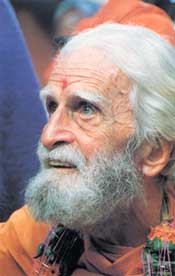
Fr. Bede is known for his journey to India in the 1950s to find "the other half of my soul," and for the "marriage of east and west" he articulated in his many writings and the talks and conferences he gave around the world. In 1968 Fr. Bede was asked to take over Saccidananda Ashram, popularly known as Shantivanam ("Forest of Peace"), in Tamil Nadu, and there, clad in the orange colored cloth of a sannyasi, he gathered around him disciples from all over the world. Since his death, the ashram has continued to draw pilgrims from diverse religious traditions who want to experience the spirituality of India from a Christian perspective.
Fr. Bede was one of the outstanding religious leaders of the 20th century. The Dalai Lama credits him with "opening the hearts and minds of mankind to gain understanding and acceptance of all the major religions." C.S. Lewis, with whom he studied at Oxford, dedicated his autobiography to him. Cardinal Basil Hume called him "a mystic in touch with absolute love and beauty." In his writings, Bede attempted to harmonize Eastern mysticism and Western science with Christianity. In his person, Bede exemplified presence and generosity. He was a priest, guru, prophet, teacher, swami and friend to all he met on the path.
The first two conferences, organized by Fr. Joseph Wong, assistant to the Camaldolese Prior General, Dom Bernardino Cozzarini, were held in California, and the next three will take place in England (this month), at Camaldoli in Italy (November), and at finally at Shantivanam on the centennial of his 100th birthday, December 17.
The first gathering, an invitational affair for monks and academics, was held at New Camaldoli Hermitage in Big Sur a week ago. They were welcomed by Dom Bernardino from Italy and Hermitage Prior Raniero Hoffman. Father George Nelliyanil, prior of Shantivanam, was on hand, visiting the U.S. for the first time, to present a paper by Brother John Martin, the ashram's resident teacher. Invited to read papers from the academic world, where scholarship into Bede's thought is generating numerous dissertations, were Jesuit Francis Clooney from Harvard, Brad Malkovsky from Notre Dame, Joseph Prabhu from California State University at Los Angeles, and Michael von Brück, theologian and Zen teacher, from Ludwig Maximilians University
 (front l-r, Clooney, von Brück, Prabhu, Coff, Malkovsky, Corcoran, Matus, Freeman; back l-r, Hoffman, Barnhart, Hale, Consiglio, Cozzarini, Wong, Nelliyanil).
in Munich, Germany. Monastics also presenting papers included Fr. Bruno Barnhart, Fr. Thomas Matus, Fr. Robert Hale, all from Big Sur; Sr. Donald Corcoran, prioress of Transfiguration Monastery in New York state, and Fr. Joseph Wong. Presenting a paper by video was theologian Beatrice Bruteau. On hand to discussion their experiences with Fr. Bede were Sr. Pascaline Coff, founder of Osage Monastery in Oklahoma, the "Shantivanam of the West," Fr. Cyprian Consiglio and Fr. Laurence Freeman, director of the World Community for Christian Meditation.
The two California conferences, both entitled "Carrying Forward the Contemplative and Proaphetic Vision of Bede Griffiths," were sponsored by the Camaldolese Institute for East-West Dialogue. The second gathering for the public was held over last weekend at Mercy Center in Burlingame before a crowd of nearly a hundred people (300 more were on a waiting list unable to get in). Papers were presented by Wong, Matus, Hale, Corcoran and Barnhart, and a round table discussion, chaired by Fr. Cyprian (who led Sanskrit chants before each
 presentation), featured Dom Bernardino, Sr. Pascaline and Fr. George with stories about their personal experiences with Fr. Bede.
The scholarly papers and the discussions about Bede and his significance were a bit overwhelming. It will take awhile to sort out all the ideas. Clearly, he was a man for all seasons and paths to the mystery that many call God. I missed my one chance to meet him when he visited a bookstore in Santa Cruz in 1992. But I've been to Shantivanam twice, meditated in his hut and sat by his tomb. I find the writings of his predecessor at Shantivanam, Fr. Henri le Saux (also called Abhishiktananda), more congenial. Abhishiktananda agonized over his attempt to integrate Hinduism and Christianity, whereas Bede often seemed to paper over differences with optimistic obfuscation. Several of the academic speakers pointed out that Bede romanticized Hinduism and focused on the intellectual and mystical Vedanta tradition while largely ignoring (perhaps because it frightened him) the popular religiosity of temple worship. While he was a strong critic of the institutional church, and a supporter of equality and rights for women and gays, Bede was in many respects and orthodox Christian. The Christ event, whether historical or cosmic, was at the center of his faith. He advocated a "Christian advaita," making use of the Sanskrit term for non-duality, the mystical oneness at the heart of the revelation of the Upanishads. But, as several speakers pointed out, at the heart of the Christian revelation is love, and love is not possible without two separate identities." Only Jesus can say "I and the father are one"; we are sons of the father by adoption, not by birth.
Because Fr. Bede was first and foremost a Christian, I do not see him as an important figure for inter-religious dialogue, as Fr. Robert Hale argued in his paper.
 Theologian Karl Rahner used the term "anonymous Christ" to locate the Christian revelation within other religions, and Bede followed this practice. But this can border on arrogance and be a stumbling block to true dialogue (in which surprise is always a possibility) with followers of other faiths. Bede's importance, I believe, is for Christians who stumble against the antiquated and reified language of a 2,000-year-old Gospel tradition, a language articulated in a very different cultural context from today. Bede, and Thomas Merton before him, have recaptured mystical insights from both medieval Europe and the Indian subcontinent and made them live again, in Bede's case with the assistance of new scientific and philosophical thinking from Sheldrake, Capra and Wilber, among others.
Perhaps Bede's most radical ideas concerned the reform of monasticism. Although a priest, he felt that the monk should be a lay person. And although most of his adult life was spent in a monastery or ashram, he felt that the future of monasticism would be in the world. In his last book, The New Creation in Christ: Christian Meditation and Community, Bede wrote that
Some monks may live in monasteries, but increasingly the majority will live in their own homes or form small communities -- a monastic order in the world.To that end, Bede traveled widely in his later years with Sr. Pascaline, Russill and Asha Paul, and Brother Wayne Teasdale (who died earlier this year) in search of somewhere to settle in such a community outside the cloister walls. While that search did not result in the establishment of a lay monastic order, there are numerous experiments going on in that direction at present, including the Sangha Shantivanam in Santa Cruz.
Father Bede Griffiths continues to exemplify the possible of a radical holiness in a radical and secular world.
Thursday, June 22, 2006
The Crucifixion of Palestine
 In 2003, a year after Israel had begun construction on a 440-mile wall to separate Palestinians in the Occupied Territories from Israel, Pope John Paul II said: "The Holy Land does not need walls, but bridges." The wall, he said, "is seen by many as a new obstacle on the road leading to peaceful cohabitation."
Without the reconciliation of spirits, there can be no peace. May the leaders have the courage to return to dialogue and negotiation, thus opening the way toward a Middle East that is reconciled in justice and peace.Nearly three years later, the pontiff's hopes have not been fulfilled. The wall, built largely on Palestinian land inside the 1967 "Green Line" separating the two sides according to international law, has effectively cut the West Bank into enclaves, making movement between communities, or between towns and farmland, almost impossible. Illegal settlements, however, are protected, in effect made a part Israel. The UN calls the wall an "unlawful act of annexation," and says it cuts off more than 200,000 Palestinians from social services, schools and places or work. The wall, and roads built for troop movements but denied to Palestinians have carved the Occupied Territory into bantustans, the geographical technique used by white South Africans to enforce apartheid.
Years ago I heard Catholic theologian Rosemarie Radford Ruether argue that the Arab-Israeli conflict, now almost sixty years old, is not about religion but about land. This to me was a startling claim, given the almost universal belief that the battle was between Jews and Muslims, with Christians often caught in the middle. But for Ruether, the struggle was over land -- the "deserts" made by Jewish settlers to bloom on land where the homes, villages and olive trees of the original residents had been bulldozed by the Israel Defense Forces.
Today there is a humanitarian crisis in the West Bank and Gaza where nearly four million Palestinians are suffering under the brutal occupation. After the victory of Hamas in democratic elections earlier this year, needed aid from the US and Europe has dwindled to a trickle. Services are crumbling. Targeted assassinations of Palestinian leaders include innocent bystanders, often children. Businesses are failing. Over 50 percent of the residents have fallen below the poverty line. A public health disaster and starvation are possible.
Is all this retaliation for a horrific campaign of suicide bombings, or is it part of a master plan to ethnically cleanse the Promised Land of an Arab presence? If outright "transfer," the euphemism coined to describe Palestinian removal, is not possible, then apartheid is the means to make life so impossible that residents of the West Bank and Gaza will have no choice but to move elsewhere. I know this sounds like conspiracy theory, but a little research will uncover a consistent thread to the motives of successive Israeli leaders.
All of this breaks my heart. The stories and photographs coming out of the Holy Land portray a crucified people, abandoned by the powers of this world. I bow my head in guilt for the injustices caused by my government in my name. The United States has been the prime supporter of Israel and currently provides almost $3 billion in aid, more than it gives to any other country. The media and Jewish lobby in this country portray criticism of Israel as anti-Semitic. But to be anti-Israel is not to be anti-Semitic.
When I studied Jewish mysticism and the history of Judaism with Mishael Caspi at UC Santa Cruz in the 1980s, he spoke of life growing up in Jerusalem as a boy before World War Two. He said that Jewish, Christian and Muslim children played together happily in a time of innocence before the establishment of the state of Israel. I also learned about a golden period in 12th century Spain when Jewish and Christian mystics and Muslim Sufis flourished together. The People of the Book are not natural enemies. They worship the same God.
Jews have long suffered at the hands of Christians, due to the misguided notion that they were responsible for Christ's death. They were expelled from Spain in 1492, were persecuted in Eastern Europe in the 19th century, and were exterminated by the millions in Nazi death camps during World War Two. The ideology of Zionism called for a homeland where Jews might be safe and, with the aid of guilty Europeans, settled on Palestine. They believe the land had been promised to them by God over two thousand years earlier. But Palestine was already occupied, by mostly Arab Palestinians, and they had lived there for many generations. Why should they leave? The Native Americans must have felt the same way when European colonists took over their land. My father long ago taught me that two wrongs don't make a right. The treatment of Palestinians is a crime that must be stopped.
Many observers of this tragedy, like historian Tony Judt, have called for a one-state solution to the problem: Jews and Arabs living together with equal rights. But this would mean the end of the religious state. And why not? There are many successful multi-ethnic states, the United States among them. Besides, there is not enough territory on the earth for every religion or every ethnicity to have a piece of the pie. Religious states, like Israel, or Iran, are inherently undemocratic, granting more rights to the dominant majority. The two-state solution, called for by the United Nations since the 1970s, and given lip service by the presidents of England and the U.S. (and occasionally Israel) is impossible without contiguous territory and a measure of administrative control on the part of both states. But the actions of Israel, in carving up the West Bank into separate enclaves, has made this impossible.
The world is slowly being sucked into a whirlpool of violence in the Middle East, war first in Afghanistan, then Iraq, and now threatened with Iran. The root of all this violence, as well as the terrorist attack of September 11th, is in Israel/Palestine. "Terrorism is a tactic, not an entity," Charley Reese wrote in a recent posting on Antiwar.com, "and it is a tactic used by people who have a political grievance. Therefore, if you want to eliminate terrorism, you have to address the political problems that gave it birth."
After the fall of the World Trade Center towers, a few sane heads asked: "Why do they hate us so much?" But this window of opportunity was closed by President Bush when he argued that the terrorists "hate freedom," and was echoed by the malicious right. If we had given the question any thought, we might have realized that until there is justice for the Palestinians, there will be no justice in the Middle East.
Monday, June 19, 2006
The Late Homer T
 Dad was named Homer after his grandfather, and he hated it (Mom called him "Humpy," but that's another story). So when I was born he named me after a soap opera popular in the late 1930s, "Just Plain Bill." His grandfather's father had no doubt read the classics. But he failed to provide his son with a middle name. Young Homer, so the family story goes, decided to pick his own, and chose the T after a certain Mr. Taylor he liked. My dad became Homer T Yaryan II. And there the name ended.
The last time I celebrated Father's Day with him was when this picture was taken in Bayonet Point, Florida, north of St. Petersburg, not long before he died thirteen years ago. Mom had made two tee shirts for us and you can almost read the one I'm wearing. Other than "Father's," I don't remember what it said. But it was a nice touch. Because he was following the Chicago Cubs baseball games on TV, I got him the hat. I had flown from California to visit him with my then wife and two youngest kids, Molly and Nicki. Various ailments, from congestive heart failure to emphysema, were beginning to take their toll.
Dad was a fraternal twin, and he and Ted lost their father to tuberculosis at the age of two. Neither got along with their step-father and he sent them off to military school in New Mexico at a young age. Uncle Ted and Dad were like two halves of a whole person. Ted was skinny and unhealthy, as well as artistic and charming. Dad was muscular and physical, the strong, silent type; one of his first jobs was as a lifeguard. Ted became an actor and appeared in small roles on Broadway. Dad was a traveling salesman for much of his working life. He sold glue to make plywood for furniture. And he married and raised two boys, while Ted was a homosexual whose long-term partner was an alcoholic.
At the age of six I developed asthma and was unable to take part in most sports. Because Dad was an enthusiastic sports fan all his life, I felt like I had failed him. I compensated by learning to read early, and taking up the clarinet. But after his death, my mother told me that Dad had worried deeply about my ill health, and when I played in a band for dances in junior high school he was often in the back of the hall, listening.
I was a rebellious teenager and we fought often. Or rather, I was the one who argued about his rules; he was a man of few words and little outward emotion. When I was 15 I peroxided my hair against his wishes. My mother's only response was a tense: "Wait till your father gets home." He came into my room with a pair of scissors and proceeded to cut off my newly blond (it was kind of reddish) hair. Neither of us spoke. The next morning he took me to the barber to have the rough edges smoothed out into a butch, his favored look anyway because it was "clean cut." I had the last laugh, though. When I let my hair grow out into a long "duck tail," it was half blond and half black. But Dad had made his point.
After high school, I didn't spend much more time at home. I was anxious to spread my wings, and I didn't think my father would appreciate my career choices. He forbid me from taking acting lessons because he thought my friend who had recommended the teacher was gay. My early career involved frequent job changes, of which he disapproved. Dad felt loyalty to an employer was important (an idea whose time has passed). He and my mother and brother returned to North Carolina from California, and I worked in New York, Pasadena, San Francisco and London. I married and we gave him a grandson, then another. Visits were few and phone calls irregular. I realize now that for many years I did not share myself openly with my Dad, fearing or imagining his disapproval.
In his later years, Dad mellowed considerably. He was a total wimp as a grandfather, letting his three grandsons and granddaughter, when they were small, do anything, from crawling all over him to eating up the refrigerator's supply of ice cream. He became pure love, and all his judgments melted away. I wished I'd known that man when I was small.
The father I remember growing up with was never sick. Even when it was obvious that he was ill, he would deny it and muscle through. Dad was the epitome of a macho man. But after two heart attacks, his attitude changed. During the last couple of years he was surrounded by pills. And he was a very good patient, doing everything the doctor prescribed. He loved the hardware store and the mall where he walked and talked with other men his age. Until he no longer had the strength.
After his death, my mother, brother and I presided over a memorial service in their home in Florida. The room was full of Dad's former golf and bridge partners and all of them had wonderful stories to tell about his friendliness, kindness and generosity. The next day we stood on a boat dock on Tampa Bay and I dropped his ashes into the waters where Dad had sailed as a boy.
On this day, when I wait for my distant children to phone, I am thinking about you Homer T and remembering what a wonderful father you were. I miss you.
Saturday, June 17, 2006
Lust & Death
When I was a young man, the thought of elderly people having sex filled me with repulsion. My grandparents! My parents, even! But that was long ago. The libido, I thought, would run out, like hair and smooth skin. But now that I have wrinkles, hemorrhoids, and even prostate cancer, my libido runs on like an Eveready Energizer bunny that just won’t give out.
The poet Dylan Thomas wrote:
So it has been easy to identify with the aging wounded heroes of Philip Roth’s fiction, and in particular the men in his recent novels, the just released Everyman and Sabbath’s Theater, published in 1995. The mad arthritic lecher, Mickey Sabbath, and the slowly dying, unnamed, Everyman both desperately fan the embers of their libidos because, for Roth and for some of us seniors, impotency equals death. Unfortunately, in his novels there is no hope for transcendence of the body. It’s all down hill.
“Passion doesn’t change with age,” Roth told a Danish journalist last year, “but you change – you become older. The thirst for women becomes more poignant. And there is a power in the pathos of sex that it didn’t have before. The pathos of the female body becomes more insistent. The sexual passion is always deep, but it becomes deeper.”
Roth’s character, Mickey Sabbath, in his 60s like the author at the time that book was published, wants to believe that there is “still a chance for the old juicy way of life to make one big last thumping stand against the inescapable rectitude, not to mention the boredom, of death.” Everyman, in his 70s like Roth today, takes walks along the Jersey shore and notices that “nothing any longer kindled his curiosity or answered his needs… except the young women who jogged by him on the boardwalk in the morning. My God, he thought, the man I once was! The life that surrounded me! The force that was mine! No 'otherness' to be felt anywhere! Once upon a time I was a full human being.” Flirting with one young jogger, Everyman feels himself
Sabbath (the name is telling), describes himself as “whoremonger, seducer, sodomist, abuser of women, destroyer of morals, ensnarer of youth,” and he pursues sexual pleasure with an athletic single-mindedness.
Novelist Nadine Gordimer, in her review of Everyman in the New York Times, wrote that for Roth, “the violent upsurge of sexual desire in the face of old age is the opposition of man to his own creation, death.” His theme is “the phenomenon presented as similar to that of adolescence – of late sexual desire. The last demanding exuberance in the slowly denuded body…[and] the doubt that comes about the unquestioned superiority of the rewards of the intellect.” The protagonist in Roth’s The Dying Animal “claims the phenomenon as the undeniable assertion of ‘erotic birthright’.”
I wonder if women also experience the phenomenon of late sexual desire? In my observation, gender differences (sex plus its social construction) make for two very different paths. Many women find their fulfillment in giving birth and nurturing life into adulthood. Men tend to make their mark in the world, finding their fulfillment through deeds. Aging is probably even harder on women then it is on men because of cultural standards of beauty. And finally, not a few older women I know live through their grandchildren. As Everyman puts it, the residents in his retirement home “were able not merely to construct whole conversations that revolved around their grandchildren but to find sufficient grounds for existence in the existence of their grandchildren.”
But old men, and I now count myself among them, are more content to sit on a bench and watch the joggers pass by, thanking the gods and goddesses for whoever invented the popular bare midriff look. Lust keeps the fires of life burning. Unlike Philip Roth, however, I do not equate health with potency. Sex also can be a spectator sport for those who find beauty a constant delight but have no desire for conquest.
Roth’s spiritless vision of anguished bodies in motion, permanently erased by death, holds no appeal for me. I suspect that even lust, in the form of passionate love for others, will not die but will transcend this limited time-space continuum to permeate the universe forever.
The poet Dylan Thomas wrote:
Do not go gentle into that good night,While I never intended to totter gently off this mortal coil, it never occurred to me that raging against death would take the form of relentless, unrequited lust. And a lust that was more intellectual than physical, a lingering mental erection inspired by the passing parade of beautiful women, young and old, large and small. As long as that spark of desire remains, I feel alive, I am not dead.
Old age should burn and rave at close of day;
Rage, rage against the dying of the light.
So it has been easy to identify with the aging wounded heroes of Philip Roth’s fiction, and in particular the men in his recent novels, the just released Everyman and Sabbath’s Theater, published in 1995. The mad arthritic lecher, Mickey Sabbath, and the slowly dying, unnamed, Everyman both desperately fan the embers of their libidos because, for Roth and for some of us seniors, impotency equals death. Unfortunately, in his novels there is no hope for transcendence of the body. It’s all down hill.
“Passion doesn’t change with age,” Roth told a Danish journalist last year, “but you change – you become older. The thirst for women becomes more poignant. And there is a power in the pathos of sex that it didn’t have before. The pathos of the female body becomes more insistent. The sexual passion is always deep, but it becomes deeper.”
Roth’s character, Mickey Sabbath, in his 60s like the author at the time that book was published, wants to believe that there is “still a chance for the old juicy way of life to make one big last thumping stand against the inescapable rectitude, not to mention the boredom, of death.” Everyman, in his 70s like Roth today, takes walks along the Jersey shore and notices that “nothing any longer kindled his curiosity or answered his needs… except the young women who jogged by him on the boardwalk in the morning. My God, he thought, the man I once was! The life that surrounded me! The force that was mine! No 'otherness' to be felt anywhere! Once upon a time I was a full human being.” Flirting with one young jogger, Everyman feels himself
growing hard in his pants, unbelievably, magically quickly, as though he were fifteen. And feeling, too, that sharp sense of individualization, of sublime singularity, that marks a fresh sexual encounter ot love affair and that is the opposite of the deadening depersonalization of serious illness.Everyman takes its title from a 15th century morality play in which the main character is visited by death. “Oh death,” he responds, “thou comest when I had thee least in mind.” And the characters in Roth’s novels also seem chagrined, to say the least, to find their faculties failing and death a distinct possibility. In the medieval play, however, the theme is Christian salvation. Be good and go to heaven; be bad and, well, you know what happens. Roth, a secular Jew, will have no otherworldly consolation. “Religion was a lie that he had recognized early in life,” his mouthpiece Everyman thinks, “and he found all religions offensive,”
considered their superstitious folderol meaningless, childish, couldn’t stand the complete unadultness – the baby talk and the righteousness and the sheep, the avid believers. No hocus-pocus about death and God or obsolete fantasies of heaven for him. There was only our bodies, both to live and die on terms decided by the bodies that had lived and died before us.Everyman is a retired advertising artist who calls his series of abstract paintings “The Life and Death of a Male Body,” an alternate title perhaps for Roth’s book.
Sabbath (the name is telling), describes himself as “whoremonger, seducer, sodomist, abuser of women, destroyer of morals, ensnarer of youth,” and he pursues sexual pleasure with an athletic single-mindedness.
The core of seduction is persistence. Persistence, the Jesuit ideal. Eighty percent of women will yield if the pressure is persistent. You must devote yourself to fucking the way a monk devotes himself to God. Most men have to fit fucking in around the edges of what they define as the more pressing concerns: the pursuit of money, power, politics, fashion. Christ knows what it might be – skiing. But Sabbath had simplified his life and fit the other concerns in around fucking.Sabbath and Everyman, raging against the dying of the light by means of sexual excess, real or imagined, are both sad figures. The point in Roth’s fiction seems to be that death, and the manifold ways we humans invent to avoid the inevitable, is the central fact of our lives. He does not appear to advocate sexual license. A friend, whose kindness Sabbath has mocked cruelly, tells the aging lothario:
Isn’t it tiresome in 1994, this role of rebel-hero? What an odd time to be thinking of sex as rebellion. Are we back to Lawrence’s gamekeeper? At this late hour? To be out with that beard of yours, upholding the virtues of fetishism and voyeurism. To be out with that belly of yours, championing pornography and flying the flag of your prick. What a a pathetic, outmoded old crank you are, Mickey Sabbath.Roth was similarly insulted, although not in such crude terms, by his ex-wife, the actress Claire Bloom, in her bitter memoir of their nearly 20 years together, Leaving a Doll’s House.
Novelist Nadine Gordimer, in her review of Everyman in the New York Times, wrote that for Roth, “the violent upsurge of sexual desire in the face of old age is the opposition of man to his own creation, death.” His theme is “the phenomenon presented as similar to that of adolescence – of late sexual desire. The last demanding exuberance in the slowly denuded body…[and] the doubt that comes about the unquestioned superiority of the rewards of the intellect.” The protagonist in Roth’s The Dying Animal “claims the phenomenon as the undeniable assertion of ‘erotic birthright’.”
I wonder if women also experience the phenomenon of late sexual desire? In my observation, gender differences (sex plus its social construction) make for two very different paths. Many women find their fulfillment in giving birth and nurturing life into adulthood. Men tend to make their mark in the world, finding their fulfillment through deeds. Aging is probably even harder on women then it is on men because of cultural standards of beauty. And finally, not a few older women I know live through their grandchildren. As Everyman puts it, the residents in his retirement home “were able not merely to construct whole conversations that revolved around their grandchildren but to find sufficient grounds for existence in the existence of their grandchildren.”
But old men, and I now count myself among them, are more content to sit on a bench and watch the joggers pass by, thanking the gods and goddesses for whoever invented the popular bare midriff look. Lust keeps the fires of life burning. Unlike Philip Roth, however, I do not equate health with potency. Sex also can be a spectator sport for those who find beauty a constant delight but have no desire for conquest.
Roth’s spiritless vision of anguished bodies in motion, permanently erased by death, holds no appeal for me. I suspect that even lust, in the form of passionate love for others, will not die but will transcend this limited time-space continuum to permeate the universe forever.
Sunday, June 11, 2006
Al Gore's Convenient Truth

If Al Gore, the former "next president of the United States," has been so concerned about climate change since the 1960s -- as we're told in the new documentary "An Inconvenient Truth" -- then why was so little progress made in slowing or stopping global warning during the eight years he was in power as vice president during the Clinton administration?
That nagging thought made it difficult for me to appreciate director Davis Guggenheim's (director of episodes of Alias and 24) dramatic film version of the Power
 Point presentation that Gore has given thousands of times around the world since his defeat at the hands of the Supreme Court. That, and the adoring portrayal of Gore that makes him out to be a prophet, or rock star. While the clips of natural disasters and the rising roller coaster representations of statistics make an imressive and persuasive case for the devastating consequences of global warming, the documentary's primary focus is Al Gore and his future more than the environmental message he's bringing.
I suspect that Gore is positioning himself to compete with Hillary Clinton for the Democratic nomination for President in 2008. If that's so, then this adulatory video is convenient way for him to return to the political stage. But will it save the world from destruction at the hands of global corporate thugs? I doubt it. Certainly Gore offers no particular political strategy, and the suggestions, along with the film's closing credits, that individual choices will make a difference is insulting to intelligent environmentalists who know that only large corporations and courageous politicians can save us this time. Curbside recycling is a drop in the bucket; closing down large-scale polluters and finding a substitute for the use of oil might help.
In the first place, there is little information that is new in "An Inconvenient Truth." The rise of carbon dioxide in the atmosphere from the burning of fossil fuels has led to an overall rise in temperature which has resulted in the melting of polar ice and glaciers, the prediction of an eventual (perhaps catastrophic) rise in sea levels, and the production of more hurricanes and tornadoes (which are stronger and more fierce). Only the ideological right (which includes our current government) remains unconvinced by the scientific evidence, and they'll never see this film. Glenn Beck, host of CNN Radio's Headline News, accused Gore of mixing untruth with truth, just like the Nazis. The documentary will undoubtedly find a comfortable audience only among the already converted.
So will Al Gore as president save us? Here the evidence is not persuasive. Gore is the scion of an illustrious family of wealthy politicians. His father was also a senator from Tennessee. Progressive curmudgeon Gore Vidal is a distant cousin of Albert, and is not very fond of his kin. "I've always thought he was absolutely pointless as a politician. He's just another conservative Southerner," according to Vidal. For much of his political career, Gore has been pro-life and anti-abortion. He was also openly anti-gay, calling homosexuality "abnormal" and "wrong," and he was a strong supporter of the gun lobby. Vidal described his relative as "another border-state, southern lover of the Pentagon...there was never anything the Pentagon asked for that Cousin Albert wasn't down there giving it to them; he voted for the first war in the gulf," one of only ten Democrats to break with the party.
In 1988, Gore made an unsuccessful run for the presidency. In 1992 he published Earth in the Balance, which summed up his environmental ideas and made a strong case for protection of the environment. We learn in the documentary that Gore, as a Harvard undergraduate, had studied with Roger Revelle, one of the first scientists to predict that rising levels of human-produced emissions would lead to climate change. That same year he was nominated for the Democratic ticket with Bill Clinton and after their election many people expected him to be able to turn his ideas into action at the federal level.
But little changed, and why that is so is absent from "An Inconvenient Truth." Politics and corporate interests got in the way. In Al Gore: A User's Manual, written in 2000 by Alexander Cockburn and Jeffrey St. Clair, the authors skewer Gore for his hypocrisy and for his ties to moneyed interests.
Like a street mountebank fluttering a handkerchief to distract attention from his sleights of hand, Gore has always used his proficiency with the language of liberalism to mask an agenda utterly in concert with the Money Power.Cockburn and St. Clair claim Gore denounces vouchers while sending his kids to private schools, argues against the nuclear arms race while supporting the MX missile, praises civil liberties while turning a blind eye to censorship, smoked dope when younger but later advocated harsh penalties for marijuana use. Others have argued that Gore is beholden to Occidental Petroleum and helped secure oil drilling rights for that firm in the Elk Hills National Petroleum Reserve near Bakersfield, the largest turnover of public lands to a private corporation in American history. Despite protests from native peoples, many archaeological sites were destroyed. In 2000, Gore defended Occidental's plan to drill for oil near the sacred grounds of the U'wa tribe in Colombia.
Nowhere is this truer than in his supposed environmentalism, which nicely symbolizes the chasm that has always separated Gore's professions from his performance. He denounces the rape of nature, yet has connived at the strip-mining of Appalachia and, indeed, of terrain abutting one of Tennessee's most popular state parks.
Johann Hari, columnist for the Independent in London, says that Gore's speeches on global warming "are terrifying, true -- and contain a hole bigger than the old Ozone hole he spent decades warning against."
When Bill Clinton and Al Gore were in the White House, their environmental record was abysmal. They pushed through NAFTA, a free trade area for the Americas, which defined environmental regulation as an illegal "market distortion" which must be struck down by the courts. They allowed dioxin dumping in the oceans. They were the main international drivers between the World Bank and IMF, which have systematically smothered tentative environmental regulations in the developing world. They oversaw the largest slashing of publicly owned timber in US history. I could go on. And on.The problem, Hari says, is that the fossil fuel industry pays the bills for politicians in America, Democrats as well as Republicans. And without that money, you can't get elected. Twenty-eight gas and oil companies gave to Gore's failed election campaign. "These companies own the American political process," according to Hari, and if Gore wants to run for president again in 2008 "he will have to plunge back into the petrol tank to grab some campaign funds." The only solution to this impasse, according to Hari, "is for the American people to reclaim their political parties from corporations and start paying for their parties themselves, out of general taxation." But this idea is about as popular as one nationalizing the banks, or the oil companies.
"Other than his alleged environmental convictions," writes author Joshua Frank, "Gore was politically timid when push came to shove in Washington." During the 1992 campaign, he promised supporters in Ohio that Clinton's EPA would never approve a hazardous waste incinerator near an elementary school. Three months after Clinton took office the incinerator was approved; its owner was one of the top campaign contributors to the Clinton/Gore campaign. Under Clinton/Gore, the Interior Department approved a destructive deal with sugar corporations in Florida which doomed vast portions of the Everglades. Gore's successful efforts to secure an Endangered Species Act waiver for the Tellico Dam on the Little Tennessee River paved the way for the gutting of the act, according to the late David Brower. A "salvage rider" bill pushed by the timber industry directed the Forest Service to cut old-growth timber in the Pacific Northwest. The administration, under Gore's watch, eliminated a regulation that had prohibited cancer-causing pesticides to be put in our foods, and cut a deal for the use of Methyl Bromide despite its reported contribution to ozone depletion.
While vice president, Gore did little stop global warming. The administration made it easy for Bush and Cheney to back out of the Kyoto Protocol by undermining the agreement in the late 1990s. Gore championed a "pollution credits" system at the Kyoto conference in 1997. But he opposed the watered down version of the Protocol, despite loopholes that would allow corporations to continue business as usual, because he feared alienating labor organizations that worried new environmental standards would shift jobs to developing nations with weaker regulations. "So while Al Gore flies a polluting jet around the country and overseas to preach to the masses about the dangerous effects of global warming and its inherent threat to life on earth," writes Frank, "you may want to ask yourself whether the hypocritical Gores of the world are more a part of the problem than a solution to the dire climate that surrounds us all."
Even if a U.S. government with a backbone solved the global warming problem by restricting corporate abuses and developing new systems of energy, the environmental crisis would be far from over. Out-of-control climate change is only one issue, albeit a crucial one. There are many others. For example, since World War Two a proliferation of chemicals in the environment (over 75,000 new compounds, at one count) parallels a drastic rise in cancer and other environmentally caused diseases. On a graph the huge jump in chemicals and cancer is remarkably similar to the jump in carbon dioxide in the atmosphere and global temperatures. Wherever you look, humans are fouling their nest. Liberal optimists like Gore believe there is no conflict between the public welfare and corporate welfare. They see science as our savior and believe that technology can solve the very problems that it created in the first place.
But just as the United States seems unable to clean up the mess it made in Iraq, American science and industry may never be able to keep up with the unfortunate unintended consequences of technological innovation. This is nothing new. Goethe wrote about it in Faust and Walt Disney portrayed it in The Sorcerer's Apprentice.
Saturday, June 10, 2006
What's in a Name?
Communion Reflection on 2 Timothy 3:10-17 and Mark 12:35-37
What difference does it make what we call Jesus, or what title we give him?
In today’s Gospel from Mark, Jesus appears to question the title “son of David,” which is given to him in the very first verse of Matthew.
David, the most famous king of ancient Israel, was a poet who is believed to have authored or edited many of the Psalms. He prepared for the construction of the first temple in Jerusalem, which was eventually built by his son, Solomon. In the Davidic Covenant, told in the book of Second Samuel, God promised that David's royal dynasty would last forever, and that David's son would be God's Son.
The Jews in the time of Jesus, therefore, expected that the Messiah would come from the house of David. He would restore the lost glory of Israel and would rescue her people from oppression. The son of David, the anointed one of God, would be a king, a political savior. Even today Jews continue to pray for the coming of the Messiah, the son of David, who would build the third temple in Jerusalem.
Genealogies in Matthew and Luke identify Jesus as a descendant of David, by adoption through Joseph and by blood through Mary. When the angel of God appears to Joseph in a dream, telling him to take Mary as his wife, he is addressed as “son of David.” King David was born in Bethlehem, and so the Gospel writers identify this city as the birthplace of Jesus.
The Gospels record that Jesus was called by many names during his earthly life: rabbi, prophet, teacher, and also: the good shepherd, the true vine, the bread of life. Followers impressed by his authority would call him “my Lord,” a title often given to rabbis. The title “son of David” is not that common in the New Testament. In Mark and Luke, the phrase seems to refer not to royal power, but rather to the magical/ healing power for which Solomon was famous. Only Matthew uses this more often and more clearly as a messianic title with royal connotations.
There is some tension in the Gospels between the messiah as the “son of David,” a political or royal figure, and the messiah as the “son of Man (or Adam),” a heavenly figure. Some expected that Jesus would become King of the Jews, and they were disappointed.
In the reading for today, Jesus suggests, by quoting Psalm 110, that the Messiah actually pre-exists David and is superior to him, and therefore cannot be his son. In this way, he renounces the claim of a kingly messiah.
What's in a name, anyway?
According to Shakespeare, “That which we call a rose, by any other word would smell as sweet."
We can call Jesus “the Messiah, the son of the living God,” as Peter did. Or we can call him brother, for he told us that “whoever does the will of my Father in heaven is my brother, and sister, and mother."
Best of all, we can call him friend, for Jesus tells us in John’s Gospel: “I no longer speak of you as slaves, for a slave does not know what his master is about. Instead, I call you friends.”
On the question of the relevance of names, I can’t resist quoting here the lyrics of a song by that famous convert from Judaism to Christianity, Bob Dylan, In “Gotta Serve Somebody,” he sings:
After allowing us to think of ourselves as his friend, Jesus tells us: “There is no greater love than this, to lay down one’s life for one’s friends.” We can easily come up with a long list of names of those who gave their life for the Gospel, from the early martyrs of the Church to Bishop Oscar Romero and Martin Luther King in our time.
It doesn’t matter what name or title we’re called. It’s what we do that counts.
After spending at least a week in preparing the above reflection, I awoke this morning to discover that I had based it on the readings for yesterday, not today's. I suddenly felt like the man in the garden of Gethsemane, who, when Jesus was arrested, ran away naked. In Paul's letter to Timothy, in the readings today, he says "proclaim the word; be persistent whether it is convenient or inconvenient." Without my well-crafted words to read, presiding at communion today would certainly be inconvenient!
Providentially, the "real" Gospel for June 10 is the Widow's Mite. The scribes "have all contributed from their surplus wealth, but she, from her poverty, has contributed all she had, her whole livelihood." As a perfectionist with words, terrified at the thought of speaking extemporaneously (despite my debate training long ago), I can certainly identify with the scribes who thrive on admiration and respect, and who "recite lengthy prayers."
So I stood at the ambo and tore up my speech. I recalled that Fr. Cyprian, who led the retreat I attended last week at Mission San Antonio, is found of saying, with St. Paul, that "the love of God has been poured into our hearts." Certainly in the week after Pentecost, that gift of the Holy Spirit is on our minds. What a revelation: We have God within us! The Indian sages are fond of speaking of the "cave of the heart." The Spirit dwells in that cave, speaking in a still small voice. What stands between us and the experience of God within is, precisely, us, the selfishness and self-preoccupations and obsessions about the world that make us deaf to that voice. In contemplative prayer we sit silently before the cave, while the constant chatter of our egos, our selves with a little "s," rattles on endlessly. If that background noise of the self were to stop, we would be face to face with God.
The widow's utter poverty enables her to hear God speak. She is an example to all us scribes who feel naked without our fine speeches and fancy prayers. May we all be naked!
What difference does it make what we call Jesus, or what title we give him?
In today’s Gospel from Mark, Jesus appears to question the title “son of David,” which is given to him in the very first verse of Matthew.
David, the most famous king of ancient Israel, was a poet who is believed to have authored or edited many of the Psalms. He prepared for the construction of the first temple in Jerusalem, which was eventually built by his son, Solomon. In the Davidic Covenant, told in the book of Second Samuel, God promised that David's royal dynasty would last forever, and that David's son would be God's Son.
The Jews in the time of Jesus, therefore, expected that the Messiah would come from the house of David. He would restore the lost glory of Israel and would rescue her people from oppression. The son of David, the anointed one of God, would be a king, a political savior. Even today Jews continue to pray for the coming of the Messiah, the son of David, who would build the third temple in Jerusalem.
Genealogies in Matthew and Luke identify Jesus as a descendant of David, by adoption through Joseph and by blood through Mary. When the angel of God appears to Joseph in a dream, telling him to take Mary as his wife, he is addressed as “son of David.” King David was born in Bethlehem, and so the Gospel writers identify this city as the birthplace of Jesus.
The Gospels record that Jesus was called by many names during his earthly life: rabbi, prophet, teacher, and also: the good shepherd, the true vine, the bread of life. Followers impressed by his authority would call him “my Lord,” a title often given to rabbis. The title “son of David” is not that common in the New Testament. In Mark and Luke, the phrase seems to refer not to royal power, but rather to the magical/ healing power for which Solomon was famous. Only Matthew uses this more often and more clearly as a messianic title with royal connotations.
There is some tension in the Gospels between the messiah as the “son of David,” a political or royal figure, and the messiah as the “son of Man (or Adam),” a heavenly figure. Some expected that Jesus would become King of the Jews, and they were disappointed.
In the reading for today, Jesus suggests, by quoting Psalm 110, that the Messiah actually pre-exists David and is superior to him, and therefore cannot be his son. In this way, he renounces the claim of a kingly messiah.
What's in a name, anyway?
According to Shakespeare, “That which we call a rose, by any other word would smell as sweet."
We can call Jesus “the Messiah, the son of the living God,” as Peter did. Or we can call him brother, for he told us that “whoever does the will of my Father in heaven is my brother, and sister, and mother."
Best of all, we can call him friend, for Jesus tells us in John’s Gospel: “I no longer speak of you as slaves, for a slave does not know what his master is about. Instead, I call you friends.”
On the question of the relevance of names, I can’t resist quoting here the lyrics of a song by that famous convert from Judaism to Christianity, Bob Dylan, In “Gotta Serve Somebody,” he sings:
You may call me Terry, you may call me Timmy,And this service, I might add, is terminal…unto death. In the first reading from Second Timothy today we heard that “all who want to live religiously in Christ Jesus will be persecuted.”
You may call me Bobby, you may call me Zimmy,
You may call me R.J., you may call me Ray,
You may call me anything but no matter what you say,
You're gonna have to serve somebody, yes indeed,
You're gonna have to serve somebody.
Well, it may be the devil or it may be the Lord
But you're gonna have to serve somebody.
After allowing us to think of ourselves as his friend, Jesus tells us: “There is no greater love than this, to lay down one’s life for one’s friends.” We can easily come up with a long list of names of those who gave their life for the Gospel, from the early martyrs of the Church to Bishop Oscar Romero and Martin Luther King in our time.
It doesn’t matter what name or title we’re called. It’s what we do that counts.
* * *
After spending at least a week in preparing the above reflection, I awoke this morning to discover that I had based it on the readings for yesterday, not today's. I suddenly felt like the man in the garden of Gethsemane, who, when Jesus was arrested, ran away naked. In Paul's letter to Timothy, in the readings today, he says "proclaim the word; be persistent whether it is convenient or inconvenient." Without my well-crafted words to read, presiding at communion today would certainly be inconvenient!
Providentially, the "real" Gospel for June 10 is the Widow's Mite. The scribes "have all contributed from their surplus wealth, but she, from her poverty, has contributed all she had, her whole livelihood." As a perfectionist with words, terrified at the thought of speaking extemporaneously (despite my debate training long ago), I can certainly identify with the scribes who thrive on admiration and respect, and who "recite lengthy prayers."
So I stood at the ambo and tore up my speech. I recalled that Fr. Cyprian, who led the retreat I attended last week at Mission San Antonio, is found of saying, with St. Paul, that "the love of God has been poured into our hearts." Certainly in the week after Pentecost, that gift of the Holy Spirit is on our minds. What a revelation: We have God within us! The Indian sages are fond of speaking of the "cave of the heart." The Spirit dwells in that cave, speaking in a still small voice. What stands between us and the experience of God within is, precisely, us, the selfishness and self-preoccupations and obsessions about the world that make us deaf to that voice. In contemplative prayer we sit silently before the cave, while the constant chatter of our egos, our selves with a little "s," rattles on endlessly. If that background noise of the self were to stop, we would be face to face with God.
The widow's utter poverty enables her to hear God speak. She is an example to all us scribes who feel naked without our fine speeches and fancy prayers. May we all be naked!
Friday, June 09, 2006
Madison, WI: Cows, Cheese Curds & Brats
June is Dairy Month in Wisconsin and during my first visit to Madison last weekend the cows were on display. It was the 27th annual Cows on the Concourse around Capitol Square and there were 101 of them in the "CowParade" in artsy disguises like the one above.
I knew little about Madison before my visit last weekend, except that it was an exceptional college town, on a par with Berkeley, Ann Arbor and Cambridge. And I knew Wisconsin weather was something to be feared. After it had hailed several times here last winter, the local paper headlined: “Wisconsin Weather Comes to Santa Cruz.” But June is different. Madison was sunny and warm and delightful.
I got a fine view of the Capitol flying into the airport. The stately white building is surrounded by the downtown business district on a narrow isthmus between two beautiful lakes, Mendota and Menona. On the ground, Madison is straight streets, green trees, two-storey brick houses and the University of Wisconsin with its 40,000 students and the unending construction of new buildings.
Kay, my hostess with the mostess, wisked me off to the University’s Memorial Union Terrace on Lake Mendota where a large crowd was listening to Ben Sidran’s group on the opening evening of the free Isthmus Jazz Festival. Dinner for me was a glass of the local beer and an infamous Wisconsin brat which looked suspiciously like a fat hot dog with a German accent. Pleasure boats lined the waterfront within listening distance.
On Friday, after hiking through Parfrey’s Glen (we took the wrong trail and missed the scenic spot), relaxing on the grass by Devil’s Lake (alongside overweight, bikini-clad teenagers, until a rain shower sent us packing) and climbing to the top of Gibralter Rock with its incredible views of the pastoral countryside, we stopped for the traditional Friday fish fry at a local country club. I’m sorry to report that the fish was not local and had seen better days. Wisconsin is farming country and I saw cows, sheep and pigs, and fields planted with young corn plants. I also saw indoor and outdoor silos filled with corn for animals, and learned that the fumes from silos can be lethal.
On Saturday we strolled through the Dane County Farmer’s Market on Capitol Square and I was introduced to cheese curds. Where have they been all my life?
 The best curds, I was told, squeak when eaten. But they must be at room temperature. I took a pack of them with me, and, now that the airlines no longer provide meals, they kept my strength up on the long flight home. Lunch at the Market was a grilled cheese sandwich from a booth where they were fried by the hundreds, for $1 each.
The streets around the fair were lined with food stalls and one of them, “Loose Juice,” which serves organic juices, is owned by Karl Armstrong. He was one of the radicals protesting the Vietnam War who were responsible for the 1970 bombing of Sterling Hall, which housed the Army Mathematics Research Center. A young scientist was killed. After two years on the run, Armstrong was caught and served seven years in prison. Now he’s an entrepreneur.
Not far from the Capitol is the burnt out shell of St. Raphael Cathedral. The fire last year was started by a homeless man with a history of mental problems who broke into the church, stole a bottle of communion wine, and then apparently lit some matches. Madison’s bishop, Robert Morlino, is on the board of the School of the Americas, a training ground for government terrorists. Bad karma, I think.
Also a stone’s throw from the Capitola is the Monona Terrace Convention Center which was originally designed in 1937 by Frank Lloyd Wright for the city and county offices, but eventually completed in 1997 by a student of Wright’s. Wright was born in Wisconsin and studied at the University in Madison. We stood on the outdoor rooftop of the Center and watched the boats and water skiers on Lake Menona.
On my first night in town we passed up ice cream in the Union because the line was too long, but the next night, driven by desire, we waited in an even longer line. I got “blue moon,” a delectable flavor. The ice cream is made at the University, and on Monday we visited the Dairy Store in Babcock Hall where I got the “sundae of the day” which featured “lumberjack” ice cream , caramel syrup and nuts. Yum.
The long weekend was filled with fun: riding bikes through the University, past the Indian mound, and along the waterfront (next time I’ll wear padded underpants), watching the bears and the sad-looking buffalo (which once roamed free in the Midwest) at the Henry Vilas Zoo, kayaking on Lake Wingra, eating a Bob’s Bad Breath Burger at the Weary Traveler Free House, attending Josh’s graduation party in his parents’ house on a hill near the Swiss village of New Glarus, and going to mass at St. Mary of Lourdes in the rural community of Belleville where the recipients of intercessory prayers included “family farmers.” The church is presided over by the affable Fr. Ken Klink who specializes in short, pithy homilies about social justice that would make Jesus proud.
My hostess was anxious to show me Wisconsin wildlife and mentioned a Great Blue Heron she had frequently encountered on the road to Belleville. It was there in a farmer’s pond when we passed by, so we stopped to talk with the landowner. He informed us that the heron was plastic and that he had put it there to keep real herons from eating his fish. Aside from various road kill, including two dead deer, the only wildlife I saw outside of the zoo were birds – red-winged blackbirds and a variety of raptors and gulls – and the chipmunk and mice (or moles) in Kay's basement.
I’ve learned that Madison was named after President James Madison who died in 1836, the year the town was founded. It’s the home of Sen. Russ Feingold, one of the few remaining liberals in Washington, and everywhere I saw bumper stickers and signs on lawns that made abundantly clear the citizens’ dim views of Bush and his misguided war in Iraq. Kay’s neighbor advertised his liberal sentiments in stickers covering his car. But I particularly liked his front lawn which included a number of golf clubs upside down among the flowers. I feel the same way about that so-called sport.
If I didn't live in the greatest town around, I might consider moving to Madison, which I will ever hereafter think of as the "Santa Cruz of the Midwest." We'll give her our strawberries and she can send us her cheese curds.
Subscribe to:
Posts (Atom)